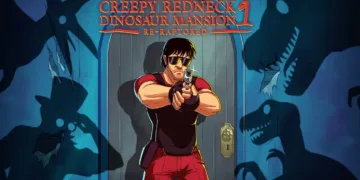




























The Creepy Redneck Dinosaur Mansion 1 Re-Raptored wears its premise on its sleeve. The title telegraphs a self-aware mash of concepts, and the game’s own label for its genre—match-3 survival horror comedy RPG Search Action—matches what plays out. The protagonist is Jack Briar, a square-jawed, action-first ATF agent assigned to the Louisiana bayou to probe illicit industrial brewing at a secluded mansion.
The expected moonshiner bust tilts into science fiction as genetically enhanced dinosaurs appear. The mansion belongs to scientist Henry Bayliss, whose experiments turn the grounds into a combat stage populated by seductive saurian foes, including a triceratops with personal motives. The script commits to absurdity, pairing outsized action with meta-humor. Jack becomes aware that he is inside an unfinished video game, and the story mines that awareness for both jokes and structural choices.
The Meta-Narrative and Himbo Hero
A dinosaur-filled Louisiana mansion sets the table, and the narrative framework gives it shape. Jack is framed as a himbo action star, a punch-first problem solver whose confidence contrasts with the cautious leads typical of horror. That trait defines his early beats as he plows through obstacles with ease.

The arc shifts once he meets Huncan, who triggers the meta-story by stating they exist inside a game. From there the plot tracks Jack and Huncan as they test the rules of the world, prod at invisible walls, and map the logic gaps of a work in progress. This scaffolding supports satire of modern development cycles and industry headaches.
The script’s strength lives in tight, funny exchanges and clean character beats. Jack’s partnership with Huncan supplies the emotional line, a slow build that the text hints may carry a boys’ love inflection. Bayliss steps in as the human antagonist, a figure defined by cowardly maneuvers that meet Jack’s muscle-forward style head-on. The last gag lands with a groan by design, a closing line that locks in the irreverent tone.
Strategic Match-3 Combat and Difficulty
Re-Raptored ties every obstacle to its board. Dialogue sequences branch in a choose-your-own-adventure style, and each gate ends in a mandatory match-3 challenge. Fights with dinosaurs, cannibals, and even locked doors resolve on the grid.

The combat model follows a Puzzle Quest template: match gems in sets of three or more, bank the results, and spend that currency on Actions. Those Actions clear sections, deal direct damage, raise shields, or restore health. The board becomes a position game rather than a pure speed exercise, with turn planning built around resource timing and lane control.
Build design narrows around Jack. His most effective path emphasizes damage spikes through extra-turn generation and damage doubling. The optimal rhythm rewards patience. You assemble the board, hold resources, and cash out in heavy sequences that swing the fight. Enemies mirror this intensity.
They conserve gems, ramp quickly into potent abilities, and punish sloppy setups. Reading the grid for future enemy gains becomes a constant requirement. The tuning moves the difficulty upward. The prior entry allowed more leeway; this sequel tightens the screws and expects familiarity with late-game match-3 problem solving. Structure shifts to match that focus. The map trims exploration, stepping away from the earlier matchroidvania detours to keep attention on dense, demanding encounters. The result feels linear, with difficulty as the core design pillar.
Examples reinforce how this plays. A locked door is not a break from combat systems, it is another board state with a health bar in disguise. A cannon-fodder enemy still poses a threat if the grid favors their color set, since they can hoard and convert faster than you expect. An optimal Jack turn may chain extra moves, double outgoing damage, and clear a quadrant to deny the opponent any productive follow-up. Mismanaging that cadence, or feeding the board into enemy hands, swings a fight in two turns. The emphasis stays on sequencing, denial, and burst planning.
Audiovisual Flair and Pacing
The soundtrack anchors presentation. Composer Aidan Myers extends the series’ polka-bluegrass identity and layers in uptempo action writing that nods to classic Japanese role-playing game energy. The music fills space that a match-3 title can leave sparse, and the lift is tangible during long board builds and late fights. The audio design turns planning turns into momentum rather than dead air.
Runtime and structure are compact. Re-Raptored plays as a short, linear piece that runs about three to four hours. The ending arrives with open questions still on the table. The project reads like a focused continuation that plugs into the franchise line rather than a standalone epic. The tight scope matches the combat-first design and highlights how the game prioritizes tuned encounters, sharp quips, and a clear mechanical thesis over wider exploration.
The Review
Creepy Redneck Dinosaur Mansion 1 Re-Raptored
Creepy Redneck Dinosaur Mansion 1 Re-Raptored is a polished, intensely focused experience. It delivers sophisticated, highly tactical match-3 combat that demands strategic patience from the player. The narrative is sharp, utilizing self-aware humor and defined characters like Jack Briar and Huncan to tell a story about being trapped in a bizarre video game. Though its playtime is brief and the high difficulty may deter new players, the excellent writing and upbeat, JRPG-inspired soundtrack make this a compelling, quality continuation of the franchise.
PROS
- Tactical match-3 combat
- Hilarious and charming writing
- Distinct, defined protagonist (Jack Briar)
- Excellent meta-story elements
- JRPG-style soundtrack
CONS
- Very short playtime (3-4 hours)
- Abruptly resolved story
- High difficulty for new players
- Reduced exploration compared to prior titles