
























![Kingdom Hearts Collection [I-III] Review](https://gazettely.com/wp-content/uploads/2026/10/Kingdom-Hearts-Collection-I-III-1-360x180.webp "Kingdom Hearts Collection [I-III] Review: KHII Holds Steady as Newer Entries Fluctuate 40")


Marisa of Liartop Mountain represents a radical shift for the Touhou series, abandoning the franchise’s signature bullet-hell gameplay for something far more experimental. Developed by UnknownX and Alliance Arts, this tabletop-inspired RPG casts players as shrine maiden Reimu Hakurei, who embarks on a quest to find her missing friend Marisa Kirisame. The twist?
Her entire journey unfolds as a board game observed by the Scarlet Devil Mansion residents: Remilia, Flandre, Sakuya, and Patchouli. These four characters treat Reimu’s adventure as their evening entertainment, offering commentary, guidance, and occasional interference as events unfold.
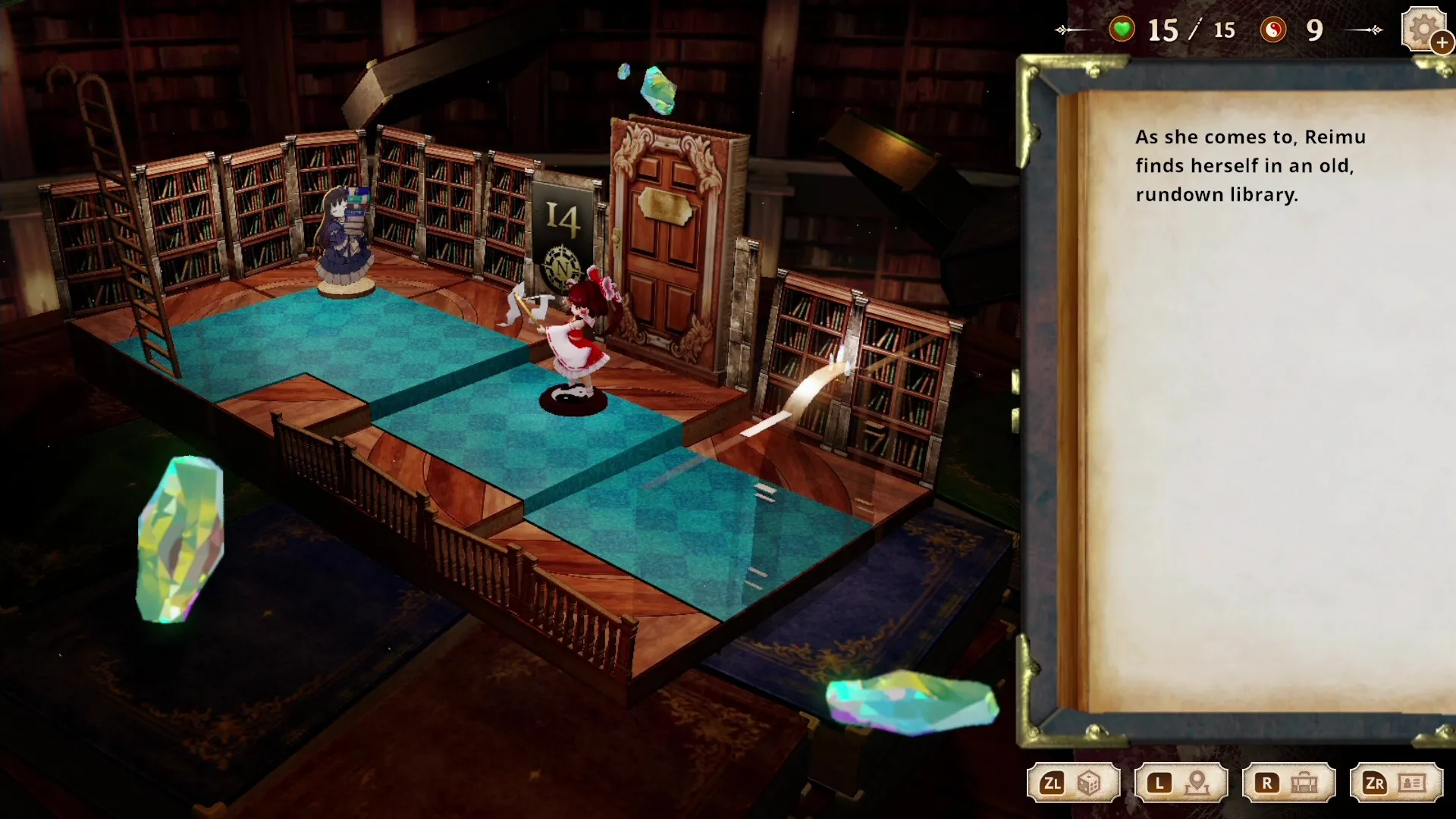
The presentation leans heavily into its board game concept. Reimu appears as a small figurine traversing diorama-style environments, while the entire experience is framed through a book-like interface complete with narrated text. Marisa herself rarely acts as the companion fans might expect. Instead, antagonistic clones of her appear throughout various chapters, each orchestrating the problems Reimu must solve.
The storybook aesthetic, combined with dice-rolling combat mechanics, creates something that feels closer to a cozy evening of tabletop gaming than a traditional Touhou experience. For a franchise built on precision dodging and overwhelming projectile patterns, this departure feels deliberately unconventional.
Dice, Decisions, and Strategic Limitations
The combat system replaces reflexes with probability management. Reimu begins with six dice slots, each fillable with various dice types that differ in meaningful ways. Some dice feature only high numbers, others display repeated values across multiple faces, and certain specialized cubes might contain single numbers useful for targeting specific ranges. Combat revolves around selecting two dice and rolling them to reach target numbers for successful attacks or defensive maneuvers. The game helpfully displays success probabilities before you commit, encouraging experimentation with different combinations.
This transparency helps players make informed choices, but the system imposes strict limitations. Once you select your two dice for a turn, you’re locked into that pairing. Even spending precious CP to reroll won’t let you swap to different dice until the next turn begins. As chapters progress, enemies introduce restrictions that complicate straightforward strategies. You might face foes that prevent you from using certain numbers (blocking 1 through 3, for instance), demand rolls within tight ranges like 7 through 12, or require strictly odd or even results. These conditions prevent combat from stagnating and force constant adaptation.
Character progression feeds directly into the dice system through a gift-selection mechanic. Every ten EXP triggers a level-up, at which point players choose rewards from one of the four mansion residents. Remilia might offer attack boosts, Flandre could provide health extensions, Sakuya presents healing options, and Patchouli grants expanded dice capacity or extra CP. Each character packages their gift with a unique die, and dissatisfied players can spend CP to reroll for different options. This choice system builds influence points that determine each chapter’s MVP, with the winning character granting Reimu a special die reward.
The CP economy forms the game’s most critical resource management challenge. These Cheat Points allow rerolling dice or boosting results when randomness turns against you, but they’re maddeningly scarce. You only gain CP through level-ups or rare story events, making every expenditure feel consequential. Early expectations of stockpiling points quickly evaporate as the game demands constant CP spending just to survive difficult encounters. By Chapter 3, conservation becomes necessary, adding tension to every decision about when to push your luck versus when to spend resources for guaranteed success.
Books, Boards, and Tedious Backtracking
The exploration structure commits fully to its tabletop inspiration. Chapters divide into connected areas resembling board game spaces, with navigation handled through directional choices rather than free movement. The entire interface mimics a storybook, with narrated descriptions delivered by voice actress Chiaki Matsuzawa (NEKI) as events unfold page by page.
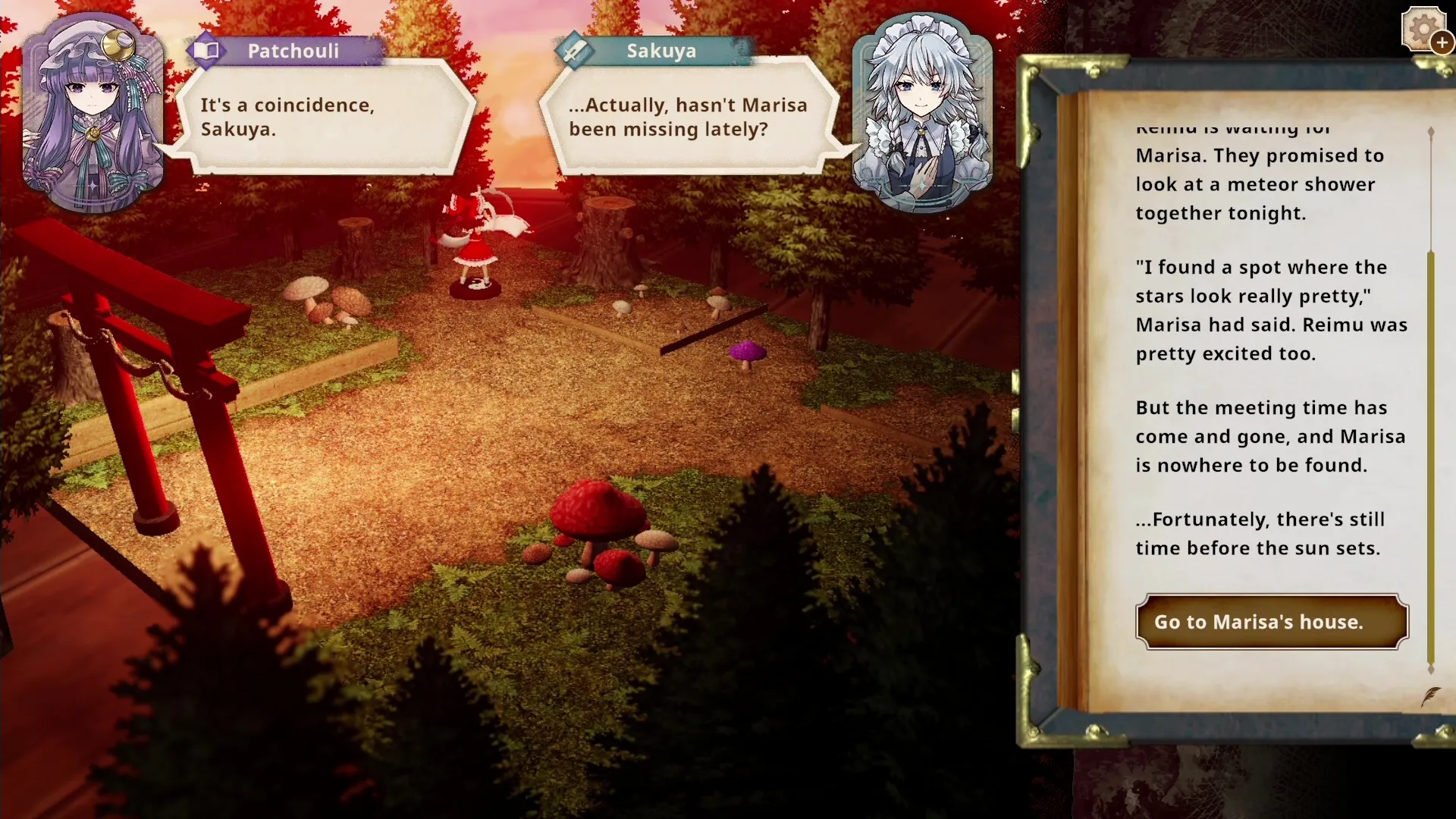
Characters manifest as figurines and paper cutouts within diorama environments, creating a tactile, crafted aesthetic that distinguishes the game from typical RPG presentations. Each chapter adopts distinct theming, from libraries to forests to deserts, with visual design reinforcing the feeling of moving game pieces through handmade scenes.
Puzzle design integrates cleverly with these environments and narratives. One recurring mechanic involves manipulating Reimu’s weight, switching between light and heavy states to access different areas. When light, she can leap onto books to reach elevated platforms. When heavy, she gains the mass needed to withstand aggressive enemies that would otherwise push her aside.
These puzzles expand to include encounters with memorable characters like camel spirits offering cryptic advice, mischievous thieves hiding crucial items, and robotic Red Riding Hoods guarding pathways. The solutions genuinely satisfy when discovered, particularly when they interweave with chapter-specific themes and geography.
The rigid structure underlying these puzzles, however, exposes significant pacing problems. Most challenges accept only one correct solution, forcing players to traverse the same areas repeatedly while searching for the specific sequence the game demands. This backtracking becomes exhausting as you retread familiar ground, listening to identical narrated descriptions for the fourth or fifth time. The linearity contradicts the tabletop fantasy the game tries to evoke. Real tabletop sessions thrive on improvisation and multiple valid approaches, but Marisa of Liartop Mountain rarely permits such flexibility.
Save point scarcity compounds the frustration. Each chapter typically contains only one or two save opportunities, represented by giant books scattered across the map. The second save point usually appears right before boss encounters, but the gaps between saves make exploratory mistakes punishing. Failed puzzle attempts can cost significant progress, and mid-tier battles recur with enough frequency that familiar encounters begin feeling like padding rather than content. After the first chapter concludes, these repetitive elements become harder to ignore.
Rolling with Randomness and Finding Your Audience
The dice-rolling foundation ensures that luck permeates every aspect of play. Boss fights particularly highlight this randomness, where poor rolls can doom otherwise sound strategies. You might carefully construct optimal dice combinations, calculate favorable probabilities, and still fail repeatedly because the numbers refuse to cooperate. This creates a different flavor of difficulty compared to bullet-hell Touhou games, which reward practiced execution and memorized patterns. Here, adaptation matters more than perfection, as you must work with whatever results the dice provide.
Checkpoints before major encounters soften the blow by preventing catastrophic progress loss, and experimenting with dice types maintains engagement even when randomness frustrates. The game captures Touhou’s reputation for brutal unpredictability through probability rather than projectile density. Players who find chance-based gameplay inherently unsatisfying will struggle with this approach, but those willing to embrace uncertainty might appreciate how it mirrors the chaos of actual tabletop sessions where dice betray you at crucial moments.
Boss encounters remain genuinely challenging despite the absence of traditional grinding. Enemies demand creative thinking and environmental exploitation rather than stat optimization. You might need to kick an opponent into a hazardous map position or recognize when staying non-violent advances the story. These situations require reading the scenario carefully and adapting your approach based on contextual clues rather than raw power.
The game serves specific audiences well. Series newcomers gain an approachable entry point into Gensokyo without the intimidating precision requirements of bullet-hell games. Tabletop RPG enthusiasts will recognize the rhythm of dice rolling, chance management, and group storytelling that defines pen-and-paper sessions.
Players who prioritize character-driven narratives and banter over mechanical depth will appreciate how the Scarlet Mansion crew’s commentary transforms potential tedium into entertainment. Veterans seeking a fresh perspective on familiar Touhou characters might enjoy seeing them placed in such unusual contexts.
Conversely, the game alienates players seeking traditional Touhou experiences or deep RPG systems. The limited enemy variety and absence of complex combat mechanics like varied abilities or debilitating status effects restrict strategic depth. Anyone frustrated by backtracking or who demands agency over outcomes will find the rigid puzzle structure and RNG dependence maddening. The game trades polish for improvisational energy, prioritizing the feeling of friends gathered around a table over refined mechanical systems.
The Scarlet Mansion residents’ running commentary ultimately determines whether the game’s flaws become dealbreakers or charming quirks. Their banter provides personality that elevates repetitive moments into opportunities for humor. The bonds between characters, particularly Reimu’s determination to find Marisa despite facing distorted clones of her friend, give the journey emotional weight that justifies pushing through frustrating sections. This is a bold experiment that successfully captures tabletop gaming’s communal spirit in single-player form, even if achieving that goal requires accepting rough edges and luck-dependent outcomes that would sink more conventional RPGs.
The Review
Marisa of Liartop Mountain
Marisa of Liartop Mountain succeeds as a tabletop simulation that prioritizes character-driven storytelling over mechanical refinement. The dice-rolling combat and storybook presentation create a cozy, communal atmosphere that distinguishes it from typical Touhou entries. However, excessive backtracking, rigid puzzle design, and heavy RNG dependence will frustrate players seeking polished RPG experiences. The Scarlet Mansion crew's commentary adds genuine charm, making repetitive moments bearable. This experimental departure works best for newcomers and tabletop enthusiasts willing to accept rough edges for creative ambition.
PROS
- Creative tabletop-inspired presentation with charming diorama aesthetics
- Engaging character commentary from Scarlet Mansion residents
- Dice mechanics encourage strategic experimentation
- Accessible entry point for Touhou newcomers
- Satisfying puzzle integration with chapter themes
CONS
- Excessive backtracking through identical areas
- Heavy reliance on RNG creates frustrating boss encounters
- Extremely scarce save points punish mistakes
- Rigid puzzle solutions limit player freedom
- Limited enemy variety and shallow combat depth