










There are men who are not men at all, but functions. They are equations of violence and will, their existence a straight line from objective to execution. Donald E. Westlake’s creation, Parker, is such a being, a ghost of pure professionalism haunting the pages of crime fiction. He is a concept more than a character, a vessel for the cold logic of survival.
Play Dirty attempts to pour into this empty vessel the warm, chaotic, and profoundly human spirit of Shane Black’s cinematic world. The result is a strange alchemy, a film that feels like a philosophical argument with itself. It places a being of absolute certainty into a universe of frantic, witty, and wounded uncertainty.
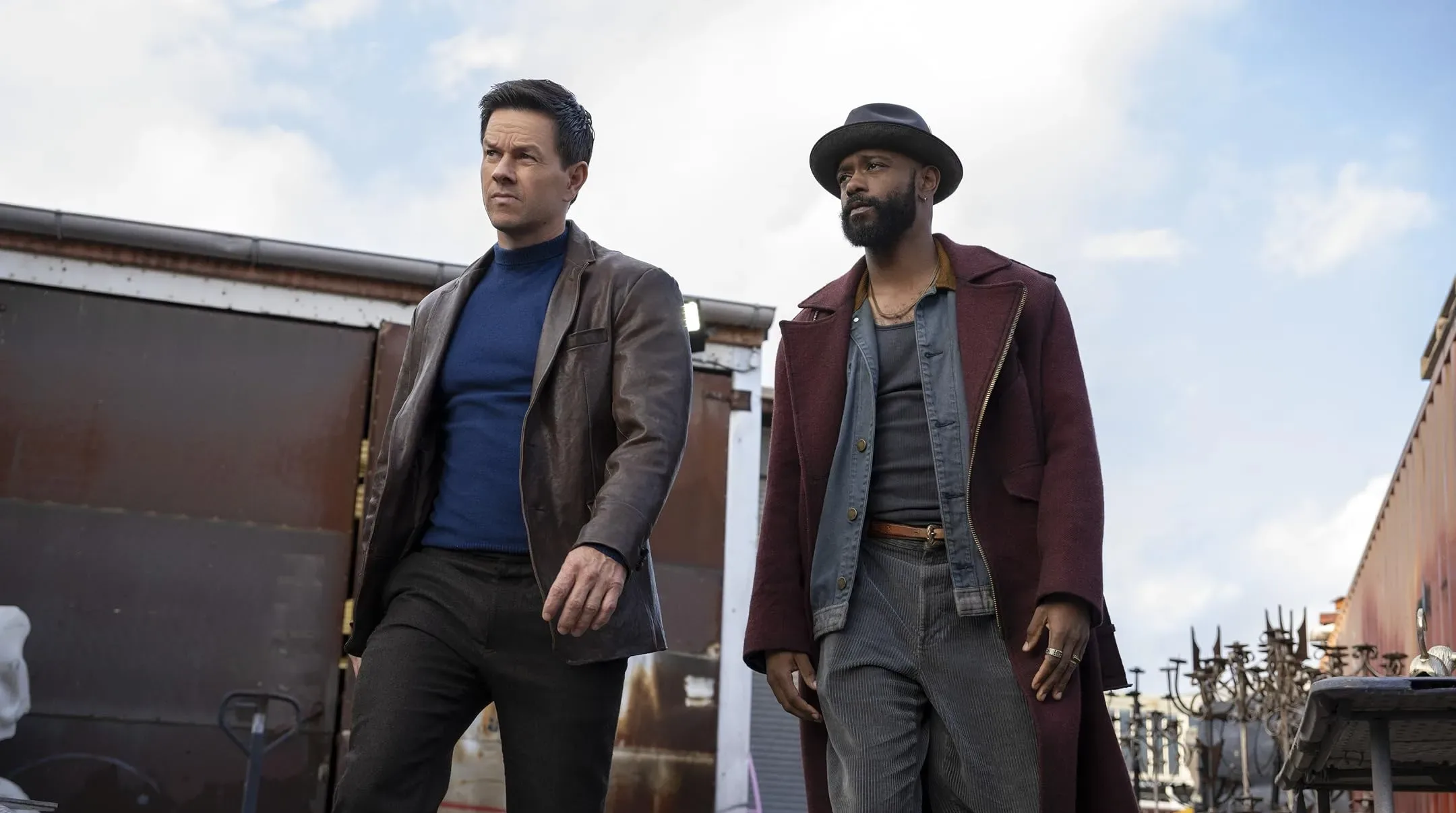
The experiment is to see which will break first: the man who is a machine, or the world that is a beautiful, bleeding mess. Mark Wahlberg assumes the shape of this hollow man, tasked with navigating a heist of sunken treasure and mob vengeance, but the film’s real heist is its attempt to steal a soul for a character who was never meant to have one.
A Symphony of Scars and Static
The language of a Shane Black film is a defense against the silence. It is a frantic, overlapping poetry of pain and deflection, where characters talk not to communicate but to build a wall of words against the encroaching darkness. Play Dirty speaks this language fluently. The dialogue is a shield, with humor serving as its desperate, glittering surface.
A dying man’s final confession is cut short by a bullet, a brutal edit that suggests the universe has no patience for sentiment. The film’s chosen season, Christmas, hangs in the background like a faded, ironic photograph of a better world, its symbols of hope and rebirth starkly out of place amidst the casual cruelty. This constant juxtaposition of the sacred and the profane, the witty and the wicked, is the director’s most reliable tell, a signature written in scars.
Yet, for all its verbal dexterity, the film’s narrative structure is a chaotic tangle. The story moves with a relentless, jarring momentum, lurching from one set piece to another with little connective tissue. This could be interpreted as a reflection of the criminal life’s moral anarchy, a world without a coherent map. The viewer is left perpetually disoriented, which may be the intended effect.
The experience is like sprinting through a labyrinth, the adrenaline masking the fact that you are going nowhere. This commitment to disorientation falters completely in the final act, where a villain stops the proceedings to deliver a lengthy, lucid explanation of the entire plot. It is a moment of narrative cowardice, a retreat from the beautiful chaos into the sterile comfort of a formula. The film, for a moment, stops dreaming and simply explains itself.
The Mannequin and the Marionettes
At the film’s core is an unmovable problem: the casting of Mark Wahlberg as Parker. The character is an abstraction of dread, a man whose reputation is his only true substance. He requires an actor who can disappear, who can become a void.

Wahlberg is incapable of disappearing. His persona, built over decades, is one of approachable celebrity. He is a known quantity in a role that demands the terror of the unknown. He does not project the effortless menace of a man who is violence itself; he projects the strenuous effort of an actor playing a part. The result is a vacuum at the story’s center, a mannequin standing where a monster ought to be.
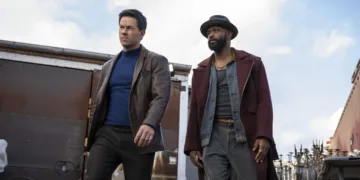
Life, thankfully, flourishes in the margins. The film is stolen outright by LaKeith Stanfield’s Grofield, a character who provides a fascinating counterpoint to Parker. Grofield is an actor, a man who finds his truth in artifice. He moonlights as a criminal to fund his failing theater, a beautifully futile gesture of creation in a world dedicated to destruction.
He is most alive when he is pretending, a moving commentary on the nature of identity in a meaningless cosmos. Rosa Salazar gives her femme fatale, Zen, a flicker of purpose beyond the heist. Her desire to fund a revolution, however thinly sketched, provides her with a moral dimension, distinguishing her from Parker’s purely functional existence. These supporting players feel like real, wounded people, their strings pulled by fate and desire, while the protagonist remains a strangely inanimate object.
The Imperfect Image
The film’s vision of violence is one of spasmodic, ugly grace. Action sequences are choreographed as brutal, clumsy affairs, full of reckless energy that feels both thrilling and deeply unsettling. A chase that plows through a horse race is a moment of sublime, profane absurdity, a collision of animal flesh and screeching steel.

The physical comedy woven into the brawls serves to underscore the pathetic fragility of the human body, its vulnerability to the blunt force of the world. In these moments, the film finds a raw, kinetic poetry, depicting violence not as a sleek, heroic act, but as a messy, desperate, and often ridiculous struggle.
This visceral reality, however, is persistently undermined by its own presentation. The film’s world is stitched together with distractingly poor digital effects. A computer-generated horse soars through the air with the weightless unreality of a cartoon, shattering the illusion of peril. This is not a mere technical flaw; it is a philosophical one.
It severs the viewer’s connection to the film’s stakes, transforming moments of life and death into sterile digital simulations. The artifice becomes too obvious, the magic trick reveals its cheap mechanics. Alan Silvestri’s musical score works against this, its primary theme a lush, romantic echo of a classic crime film. The music suggests a world of substance and style, a world the film’s flawed images cannot quite bring into focus.
An Unfinished Ghost
Play Dirty is ultimately a film of brilliant, disconnected fragments. A perfectly timed joke, a moment of unexpected pathos from a supporting player, an image of sublime chaos—these pieces flicker with the vitality of the director’s best work. Yet they never cohere.

The film is a ghost assembled from spare parts, an echo of a voice that was once clearer and more confident. Its central performance is a miscalculation that destabilizes the entire structure, and its technical shortcomings betray its ambitious spirit.
It feels less like a passion project and more like an intellectual exercise, an attempt to solve a problem that was perhaps unsolvable from the start. It leaves one with a lingering sense of melancholy, not just for the film it failed to be, but for the possibility that a singular artist’s voice can become, over time, a quieter and more uncertain thing.
Full Credits
Director: Shane Black
Writers: Shane Black, Charles Mondry, Anthony Bagarozzi
Producers and Executive Producers: Susan Downey, Marc Toberoff, Jules Daly, Robert Downey Jr., Charles Mondry, Anthony Bagarozzi
Cast: Mark Wahlberg, LaKeith Stanfield, Rosa Salazar, Keegan-Michael Key, Chukwudi Iwuji, Nat Wolff, Thomas Jane, Tony Shalhoub, Gretchen Mol, Peta Wilson, Alejandro Edda, Yvonne Zima, Hemky Madera, Chai Hansen, Claire Lovering
Director of Photography (Cinematographer): Philippe Rousselot
Editors: Chris Lebenzon, Joel Negron
Composer: Alan Silvestri
The Review
Play Dirty
Play Dirty is a fascinating, frustrating cinematic paradox. It is a film of brilliant fragments—a transcendent supporting performance from LaKeith Stanfield, flashes of Shane Black’s singular wit, and moments of beautiful, absurd violence—that never coalesce into a satisfying whole. Undermined by a fatally miscast lead and distracting technical flaws, the movie feels like an echo of a better film. It is a compelling failure, a soulless machine with a frantically beating, borrowed heart, leaving one to admire the pieces while lamenting the fractured final picture.
PROS
- A magnetic, scene-stealing performance by LaKeith Stanfield.
- Shane Black’s signature sharp, rapid-fire dialogue.
- Inventive and chaotically entertaining action set pieces.
- A charismatic and energetic supporting cast.
CONS
- Mark Wahlberg is fundamentally miscast as the cold, professional Parker.
- Poor and distracting computer-generated visual effects.
- The narrative is overstuffed, convoluted, and structurally messy.
- An uneven tone struggles to reconcile hardboiled crime with broad comedy.