


















Every war is fought twice. The first is a documented event of territory and tactics, a conflict measured in days and casualties. The second is a silent, internal siege that begins when the soldier comes home, a battle for the self against the ghosts of what was done and what was seen. Jon Shenk and Bonni Cohen’s documentary, In Waves and War, is a chronicle of this second, more insidious conflict.
It follows a small group of former Navy SEALs, men who were among the most effective instruments of American military power, now broken by the psychological fallout of their service. Having found no peace through conventional means, they pursue a radical form of psychic amnesty. Their search leads them to a clinic in Mexico, where they place their faith in a controversial therapy involving the potent psychedelic compounds ibogaine and 5-MeO-DMT.
Echoes in the Quiet
The modern “forever war” creates a peculiar kind of veteran, one whose tours of duty blend into a single, continuous decade of hyper-vigilance and violence. The film introduces us to the human cost of this sustained state of exception. We meet Marcus Capone, a man whose physical stature belies a spirit so fractured his own wife saw him as a “monster.”

We listen to DJ Shipley, who recounts how the internal chaos of his PTSD nearly destroyed the family he so desperately wanted to protect. And we follow Matty Roberts, a soldier whose visible scars are a pale reflection of the deeper, untended wounds within. The film allows their testimonies to unfold without cinematic rush, building a portrait of men hollowed out by their experiences.
They exist in a state of profound alienation, haunted by the loss of fallen comrades and the absence of the very structure and purpose that defined their lives. Society creates these warriors, lionizes their sacrifice, and then offers them a failing system upon their return.
The documentary powerfully illustrates the inadequacy of this system, portraying a cycle of ineffective therapies and numbing medications that do little to address the root of the trauma. The men are left with the grim conclusion that they must simply bear their torment, a silent penance for their service.
Animating the Abyss
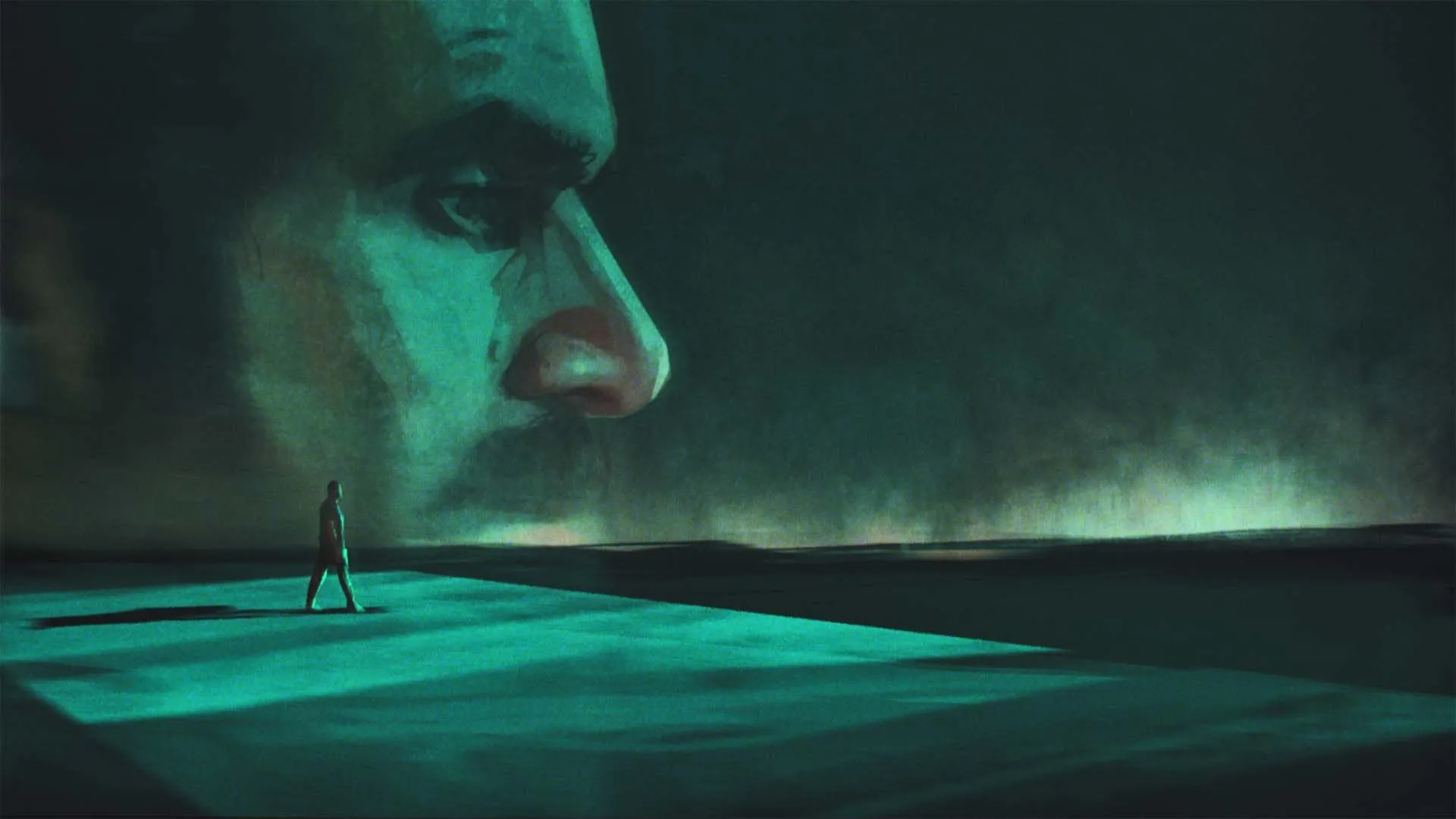
A central challenge for any film about internal states is how to make the invisible visible. Shenk and Cohen’s solution is both elegant and effective: they turn to animation. The film avoids archival combat footage, a choice that sidesteps the clichés of the war documentary and instead plunges the viewer directly into the subjective experience of trauma.

Combat is rendered as a fluid, morphing nightmare, a wash of hazy green from night-vision goggles and the stark orange of muzzle flashes. This is not the reality of war, but the texture of its memory, fragmented and menacingly alive. This aesthetic is then brilliantly repurposed to visualize the psychedelic treatments.
The experience is not depicted as a simple light show but as a deeply symbolic psychic excavation. Marcus Capone sees his life’s memories floating around him like a deck of scattered Polaroids, a life disintegrated by trauma. Matty Roberts comes face to face with a version of himself, a literal confrontation with the warrior ego he must learn to let go of.
The filmmakers use the metaphor of a two-stage process: ibogaine as a powerful “sandblaster” that strips the psyche down to its foundation, followed by “the toad” (5-MeO-DMT) as a polish that restores a sense of wholeness. The interplay between these evocative animated sequences and the stark, unadorned, direct-to-camera interviews is the film’s greatest strength. It bridges the gap between the men’s stoic exteriors and their turbulent inner worlds.
The Pharmaceutical Evangelist
There is no pretense of journalistic objectivity here; In Waves and War is a film with a clear and urgent mission. It is structured as a powerful piece of advocacy, using a classic “before-and-after” framework to demonstrate the seemingly miraculous efficacy of the psychedelic treatment.

The men we meet at the beginning, lost to despair and suicidal thoughts, are transformed by the film’s end into individuals capable of connection and peace. The narrative is anchored by Marcus Capone, who is more than a subject. As a producer of the film and the founder of an organization dedicated to helping veterans access these treatments, he becomes a compelling evangelist for this new chemical gospel.
His story follows the arc of a conversion narrative: a man lost in darkness who finds salvation and feels a profound duty to share it. This single-minded focus is what makes the film so emotionally effective, yet it is also its primary intellectual limitation. The film functions as a beautifully crafted argument for its cause, choosing to omit inconvenient complexities.
There is little discussion of the pharmacology of these powerful substances, the political and historical reasons for their illegality, or any instances where the treatment may not have been successful. The result is a work that feels less like a balanced investigation and more like a strategic, heartfelt polemic, a moving infomercial for a radical hope.
In Waves and War is a gripping and deeply personal feature-length documentary that explores the extreme mental and physical toll of war on former U.S. Navy SEALs. Directed by Bonni Cohen and Jon Shenk, the film follows a cohort of highly decorated veterans, including Marcus Capone and his wife Amber, who are struggling with treatment-resistant PTSD, traumatic brain injuries, and chronic depression after their service. The documentary chronicles their journey to Mexico to undergo experimental psychedelic-assisted ibogaine therapy, which is currently unapproved in the U.S., as a last resort for healing. The film blends intimate interviews, observational scenes, and captivating animation to depict the hallucinogenic experiences and the psychological landscape of trauma and recovery. In Waves and War premiered at the 2024 Telluride Film Festival and is scheduled to begin streaming on Netflix in November 2025.
Full Credits
Director: Jon Shenk, Bonni Cohen
Writers: Jon Shenk, Bonni Cohen, Jessica Anthony (As co-director/producer/writer)
Producers: Jessica Anthony, Bonni Cohen, Jon Shenk
Executive Producers: Jeff Skoll, Diane Weyermann, David Linde, Paula Froehle, Steven Cohen, Shizuka Asakawa, Kent McCleerey, Joseph Schull, Harriet Gugenheim, Blake Mycoskie, Eliza Dushku Palandjian, Peter Palandjian, James Neary, Rebecca Neary, Justine Nagan, Jamis MacNiven, Regina K. Scully, Geralyn Dreyfous
Cast: Marcus Capone, Amber Capone, DJ Shipley, Matty Roberts, Patsy Shipley, Dr. Nolan Williams
Director of Photography (Cinematographer): Jon Shenk
Editors: Don Bernier
Composer: Bryce Dessner
The Review
In Waves and War
In Waves and War is a profoundly moving and visually innovative documentary that gives voice to the silent suffering of veterans. While its passionate advocacy for psychedelic therapy comes at the cost of journalistic balance, its raw emotional power and intimate human stories are undeniable. It operates less as an objective inquiry and more as a necessary, heartfelt plea for a new approach to healing the invisible wounds of conflict. It is an essential, if one-sided, cinematic document.
PROS
- Features powerful, raw, and deeply personal testimonies from veterans.
- Employs a creative and effective animation style to visualize internal states like trauma and psychedelic experiences.
- Successfully highlights the failures of conventional treatments for severe PTSD.
- Functions as a compelling and emotionally resonant piece of advocacy for alternative therapies.
CONS
- Lacks journalistic balance, presenting an overwhelmingly positive and one-sided argument.
- Avoids complex discussions about the drugs' legality, pharmacology, or potential risks.
- Functions more as a persuasive film with a mission than a neutral documentary.