



























Aftershock: The Nicole P. Bell Story opens with a barrage of gunfire in 2006 Queens that arrives like a blunt shock to the senses. Director Alesia “Z” Glidewell, working from a script co-written with Cas Sigers-Beedles, starts in chaos and never entirely lets that intensity slip away. The film dramatizes the real tragedy of Sean Bell’s death at the hands of NYPD officers and follows the legal and activist fight that rises in its wake.
Told through the perspective of his fiancé, Nicole Paultre-Bell, the narrative fixes on a point of view that feels raw, recent, and painfully unresolved. The film concentrates on the systematic flaws Nicole faces while she attempts to secure justice and studies a structure that protects its own agents, turning the killing of an unarmed civilian into something that resembles an administrative inconvenience.
Performance: The Grounding Anchor of Existence
The structural stability of the film depends on Rayven Symone Ferrell’s work. Her performance as Nicole Bell serves as the emotional core and lifts material that could read as thin on the page. Ferrell plays a woman who must grow up almost overnight, shifting from someone ready to marry to a weary public figure facing aggressive media and experienced legal adversaries. She keeps a grounded, everyday quality even as the spotlight tightens. The role focuses on controlled vulnerability, on grief that appears as quiet ache, expressed without loud outburst.
Bentley Green’s Sean Bell appears at first as a limited figure, mostly defined through his bond with Nicole. The script runs the risk of leaving him too vague in the early stretches. A late scene on a baseball field corrects that absence. The moment is small and unadorned yet grants him a gentle warmth that the story needs, particularly as Nicole’s loss deepens.
The filmmakers also choose to let past infidelity and the delayed wedding commitment sit inside the frame. That decision resists an untouchable portrait of the victim and gives the story a credibility that a fully sanitized version would have lost. The harshest scenes belong to Nicole, especially when she must tell her children what happened. Those moments hold the sharpest spikes of existential pain.
Visual Language and Rhythmic Flaws
The film’s sense of style can feel unsettled. The opening stretch moves with a frantic tempo, built from rapid montages and a constant, heavy R&B soundtrack that nearly washes over the emotional detail. It plays like a compressed history that hurries past crucial elements of the relationship. Once the focus shifts to the immediate aftermath and then to the courtroom, the tone tightens and feels more grounded. The visuals drift away from a glossy music-video surface toward something closer to a hard-boiled police procedural.
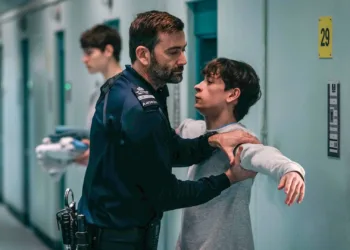
Glidewell shows a strong eye for process, capturing the slow, frustrating mechanisms of the system with clear, sharp images. Moments in which police keep a doctor from updating the family work as small procedural cruelties that heighten the tension. The officers, as written, tend to sit in familiar archetypes.
A notable exception appears in the courtroom treatment of officer Gescard Isnora, played by Byron Kenneth Brown Jr. The film offers an unexpectedly empathetic view of him there, allowing his outrage at the possible loss of his career to surface while also noting his alleged drinking on duty. The scene attempts a careful ethical balance around legal impunity, even if the effect feels faintly disorienting.
Casting choices also carry a charge. Richard Lawson’s reserved, almost generic approach to Rev. Al Sharpton underplays a figure known for fiery presence, and the unpersuasive appearance of a certain late talk show host on a television monitor interrupts the film’s reality. When Richard T. Jones appears as the defense attorney, his familiar screen presence adds a dry touch of Hollywood convention to a story rooted in real events.
Themes of Persistence and Systemic Failure
The film reads as a stark meditation on the persistence of police violence against Black civilians and on corruption inside parts of the legal apparatus. It is a difficult, necessary watch. The story stresses the exhausting demand for incremental change and makes clear that the path toward justice stretches long and remains laced with heartbreak. The film repeatedly turns to the power of organized protest and tracks how collective pressure can move the dial, however slightly.
The final sequence carries a particular force. It presents years of Nicole’s ongoing activism and outlines the legal and systematic changes that follow. At the same time, it insists that the central outrage persists, since the law still permits the killing of an unarmed person without consequence. That clash between persistence and a system that remains fundamentally unchanged creates the film’s lasting impact. The story holds the viewer inside an ongoing chapter of history, a case file that never feels closed.
Aftershock: The Nicole P. Bell Story is a true-story drama based on the tragic 2006 police shooting of Sean Bell on his wedding day. The movie chronicles the subsequent decade-long fight for justice led by his fiancé, Nicole Paultre-Bell, after the officers involved were acquitted. The film, which has a running time of approximately 105 minutes and is rated R, had its limited theatrical release via Faith Media Distribution on November 28, 2025. Following its theatrical run, the film is scheduled to become available on digital streaming platforms starting December 15, 2025.
Full Credits
Title: Aftershock: The Nicole P. Bell Story
Distributor: Faith Media Distribution
Release date: November 28, 2025
Rating: R
Running time: 1 hour 45 minutes to 1 hour 46 minutes (105 minutes)
Director: Alesia “Z” Glidewell
Writers: Cas Sigers, Alesia “Z” Glidewell
Producers and Executive Producers: Manny Halley, Rodney Turner II, Yolanda Halley, Nicole Paultre-Bell, Roc Nation
Cast: Rayven Symone Ferrell, Bentley Green, Richard Lawson, Richard T. Jones, Jazsmin Lewis, Iyana Halley, Essence Renae, Frank Adkinson, Miles Stroter, Byron Kenneth Brown Jr., Kevin Jackson
The Review
Aftershock: The Nicole P. Bell Story
The film struggles with inconsistent pacing and a generic production quality reminiscent of cable television. Despite these flaws, Rayven Symone Ferrell’s emotionally precise performance anchors the entire work. The movie succeeds as an essential, painful document of systemic failure and one woman’s long battle for accountability. It bypasses simple melodrama to present a raw, honest look at the exhausting reality of activism. The dramatic power transcends its technical limitations.
PROS
- Rayven Symone Ferrell's powerful, grounding lead performance.
- Honest, nuanced portrayal of Sean Bell that avoids simple idealization.
- Sharp focus on systemic procedural failures and bureaucratic cruelty.
- Thematic power regarding persistence in the face of institutional inertia.
- Visceral emotional truth and raw depiction of grief.
CONS
- Uneven pacing, particularly the rushed, music-heavy first act.
- Underdeveloped supporting characters outside of the protagonist.
- Technical execution often feels generic (like a "made-for-TV" movie).
- Casting and reserved portrayals of iconic real-life figures are unconvincing.
- Overly heavy soundtrack in early scenes.