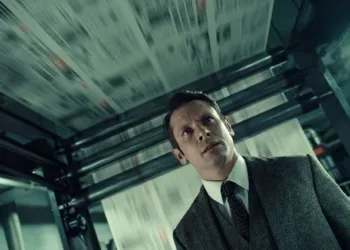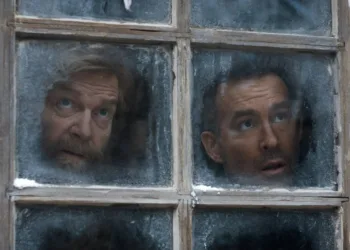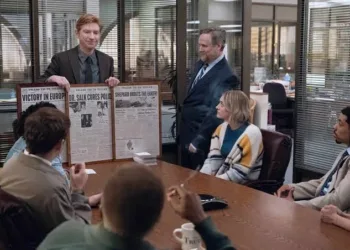































Holiday Touchdown: A Bills Love Story arrives in Hallmark’s “Countdown to Christmas” slate as a case study in how corporate ritual, regional loyalty and seasonal sentiment intersect. The film places Buffalo, New York, and the Bills Mafia’s institutional devotion in the foreground, turning the city into a kind of civic chapel.
On the surface the story functions as a straightforward holiday romance. It follows a pair of neighbors whose lives have been tangled together for decades: Morgan Quinn (Holland Roden), a diligent doctor, and Gabe DeLuca (Matthew Daddario), who oversees construction on the new Highmark Stadium.
The film works within what feels like a calibrated commercial grammar. Local sports fanaticism becomes a commodity aligned with the reassuring glow of the Christmas movie. Romance emerges from a historical investigation. Gabe, who carries intense but unspoken love for Morgan, joins her search for an anonymous benefactor who has sent gifts to her Uncle Tommy since his tour in Vietnam.
The quiet ritual stretches across decades. The script combines this multi generational mystery with present day holiday emotion and creates a mood that folds together seasonal melancholy, NFL passion and small scale relationship drama. The result resembles a study in how a geographically specific football myth can be shaped into narrative comfort food.
The Perils of “Familiarity-Blindness”
The central romantic design revisits the “friends to lovers” pattern, which I would call familiarity blindness here. Gabe’s feelings barely qualify as secret. He looks at Morgan as if she holds the coordinates of his entire universe, yet she moves through their shared history without registering the depth of his attachment. Performances from Roden and Daddario sustain this imbalance.
They project a believable, worn in past that turns the audience, and nearly every side character, into active supporters of their eventual pairing. The film invites the viewer to wish for an emotional clearing of traffic.
The anonymous gift giver plot operates as an elegantly convenient motive for that convergence. Their shared investigation creates enforced proximity and cooperative labor, which gradually increases their emotional stakes under the polite alibi of generosity and detective work.
The tension stretches across scenes, and the actors keep the connection persuasive and textured. When Gabe finally voices what he feels, triggered by the emotion of the larger secret’s exposure, the confession lands as an overdue correction to the universe. Morgan’s initial shock pauses the story for a beat of quiet uncertainty before the kiss that follows, which plays like communal catharsis.
The Architecture of Affection and the Vietnam Shadow
The story’s deepest emotional pull does not reside in the central couple. It rests in the secondary line built around Uncle Tommy (Joe Pantoliano) (ethical ballast for the narrative). Tommy serves as the moral compass, a selfless paternal presence who supported the family after Morgan’s father died while also carrying the weight of his own military service. Pantoliano’s work lifts the script beyond its familiar pattern and introduces an image of quiet virtue that feels carefully observed. His scenes supply the film’s emotional pulse.

The long standing custom of anonymous gifts – money and groceries that reached Tommy’s mother once he was drafted to Vietnam – opens the door to reflection on wartime sacrifice and unspoken social duty. The ritual suggests a private civic promise that never expired. The search for the benefactor, Mia, functions as an attempt to close a chapter of history and a personal need to finish a story that began with fear and separation.
The climactic event, which Gabe arranges to take place on the Highmark Stadium field, creates a tightly woven intersection of threads. Public celebration of Tommy and his reunion with the admirer from his past join the narrative of sacrifice with the contemporary ritual of mass fandom.
Communal life receives careful attention. The Quinn and DeLuca households evoke the idea of a commune vicinum, a neighboring community stitched together by mutual loyalty to the Bills institution. The annual stadium family photograph ritual stresses how repeated gestures help construct identity. The ensemble, which features experienced performers such as Steve Schirripa and Tracy Pollan, builds a convincing network of affection. The appearance of current and former Bills players strengthens the local texture and positions them as genial, almost talismanic civic spirits.
Tonal Synthesis and The NFL-Aesthetic
This entry in the Hallmark catalog distinguishes itself through steady, well timed dry humor. Jokes around a Bills Mafia acolyte’s extravagantly decorated man cave and the direct commentary from NFL players on Gabe’s plainly visible crush give the film bursts of levity. These moments feel like pressure valves for the otherwise meticulous sentiment.
The collaboration between the NFL and Hallmark generates an aesthetic that treats contemporary culture’s twin pillars of emotional security – the Christmas romance and professional football loyalty – as fully compatible. The Bills focused setting grants the film a concrete sense of place and shared identity.
Fantasy elements remain present yet stay anchored to recognizable social rituals and community pride. The story frames life and love in an idealized register without abandoning a basic sense of credibility. As the second chapter in the “Holiday Touchdown” franchise, the film maintains its particular charm and delivers a holiday viewing experience that pairs institutional branding with sincere emotional effect.
Holiday Touchdown: A Bills Love Story is a romantic comedy television film that premiered on the Hallmark Channel on November 22, 2025, as a central feature of the network’s annual “Countdown to Christmas” programming event. The movie centers on two lifelong friends and devoted Buffalo Bills fans, Morgan Quinn and Gabe DeLuca, who embark on a mission to find the anonymous person who has been sending Christmas gifts to Morgan’s beloved Uncle Tommy for over 60 years. The film features an extensive cast, including many current and former Bills players, and can be watched on the Hallmark Channel or streamed the following day on Hallmark+.
Full Credits
Title: Holiday Touchdown: A Bills Love Story
Distributor: Hallmark Channel
Release date: November 22, 2025
- Cast: Holland Roden, Matthew Daddario, Joe Pantoliano, Tracy Pollan, Caroline Aaron, Steve Schirripa, Patti Murin, Sean McDermott, Ray Davis, Damar Hamlin, Dion Dawkins, Dawson Knox, Reid Ferguson, DeWayne Carter, Joshua Palmer, Jim Kelly, Steve Tasker, Thurman Thomas, Scott Norwood, Andre Reed, Chris Brown, Luke Russert
The Review
Holiday Touchdown: A Bills Love Story
Holiday Touchdown: A Bills Love Story succeeds by grounding its predictable friends-to-lovers narrative in a genuinely affecting multi-generational family mystery. The emotional anchor provided by Uncle Tommy's story, elevated by Joe Pantoliano's performance, transcends the genre's usual limitations. The film effectively synthesizes the cozy holiday aesthetic with the passionate Bills Mafia community, offering superior humor and a strong sense of place. It is a highly satisfying, emotionally resonant, and well-cast entry into the seasonal canon.
PROS
- Joe Pantoliano provides the movie's emotional weight as Uncle Tommy, lifting the overall quality.
- The long-running mystery of the anonymous benefactor is deeply satisfying and rewarding.
- The film effectively utilizes the Buffalo Bills setting and the "Bills Mafia" spirit to create a rich, cohesive, and charming atmosphere.
- Features several truly funny moments and a light, enjoyable tone.
- Holland Roden and Matthew Daddario display great chemistry, making the romantic payoff worthwhile.
CONS
- The central "friends-to-lovers" plot follows a highly familiar, well-worn path.
- The resolution of the romance relies on a dramatic confession tied to the mystery's climax, which feels slightly manufactured.
- As the second entry in a themed series, the storytelling structure is inherently less fresh than its predecessor.