




























The annual rush of festive releases has begun, and Netflix has slipped an unusual title into the line-up: Jingle Bell Heist. This film shifts the usual holiday formula by treating Christmas as the backdrop for a crime caper that leans into romantic comedy rhythms. Instead of the anonymous, studio-built towns that often define this corner of seasonal programming, director Michael Fimognari shoots on location in London during the Christmas period. The real pubs, cafes, and brightly lit high streets give the film a distinct, tactile atmosphere and a clear sense of place that separates it from many of its streaming neighbours.
At the film’s centre are two people pushed toward drastic choices by financial pressure. Sophia (Olivia Holt) works retail and juggles several jobs to afford private medical treatment for her sick mother. Nick (Connor Swindells) is an ex-convict who wants to support his young daughter and secure a stable future.
They share a common enemy in arrogant millionaire Maxwell Sterling (Peter Serafinowicz), whose wealth sits in sharp contrast to their precarity. Their plan is direct: pool their abilities and rob Sterling’s luxury department store on Christmas Eve. The film reconfigures familiar holiday patterns by setting its story inside a high-stakes heist driven by clear socio-economic motivations and moves away from cosy small-town ritual.
Narrative Mechanics and Emotional Pacing
The central conflict grows from recognisable material worries, and minor festive squabbles sit on the edges of the story, which gives unexpected force to the lighter premise. Sophia’s need for costly private healthcare for her mother and Nick’s attempt to rebuild after a fraud scheme and betrayal connected to Maxwell Sterling tie the story tightly to class disparity and structural unfairness. The script grounds the heist in these modern pressures on money and family, so the protagonists’ choice to commit a crime plays as a response to a skewed system.
Co-written by Abby McDonald, the screenplay wastes little time in aligning both leads against that system and in favour of their families. This shared burden lets them connect through mutual struggle, and it avoids a dynamic where one person exists to fix or tame the other. The narrative framework leans heavily on this sense of joint purpose.
Tonally, the film attempts a tricky blend. The production sets its action inside a bright, decorated holiday space while the characters carry bleak financial realities that keep pulling the mood back to ground level. That tension produces dry humour in places. The heist mechanics themselves sit on the weaker side of the design. The robbery functions less as a tightly controlled, step-by-step operation with the precision of an Ocean’s Eleven style score and more as a symbolic hit at an unfair system.
The execution often feels messy, and the leads frequently stumble through their schemes in ways that come across as broadly comic. This clumsiness serves a clear function, since the botched or awkward attempts become the main tool that pushes Sophia and Nick into closer interaction. The film treats the heist structure in the same way a game might use a flawed level, nudging players into improvised cooperation that strengthens their connection.
The relationship between the two leads operates as the true engine of the story, while the money they chase works as the excuse that keeps them in motion. The script also introduces a few late-stage twists that adjust the stakes and keep the final stretch from sinking into an entirely predictable pattern, adding a short burst of energy before the closing moments.
The Human Element: Chemistry and Performance Dynamics
The effectiveness of the film rests on how well it merges its romance and caper modes. With the heist design on shaky ground, the emphasis shifts to the central pairing. The casting pays off. Olivia Holt gives Sophia an alert, quick-witted presence that makes her easy to root for from her first scenes. She anchors the film whenever the plotting loosens. Connor Swindells plays Nick with a blend of awkward bravado and visible weariness, and his clumsy attempts at blackmail reveal the bruised side of the character.
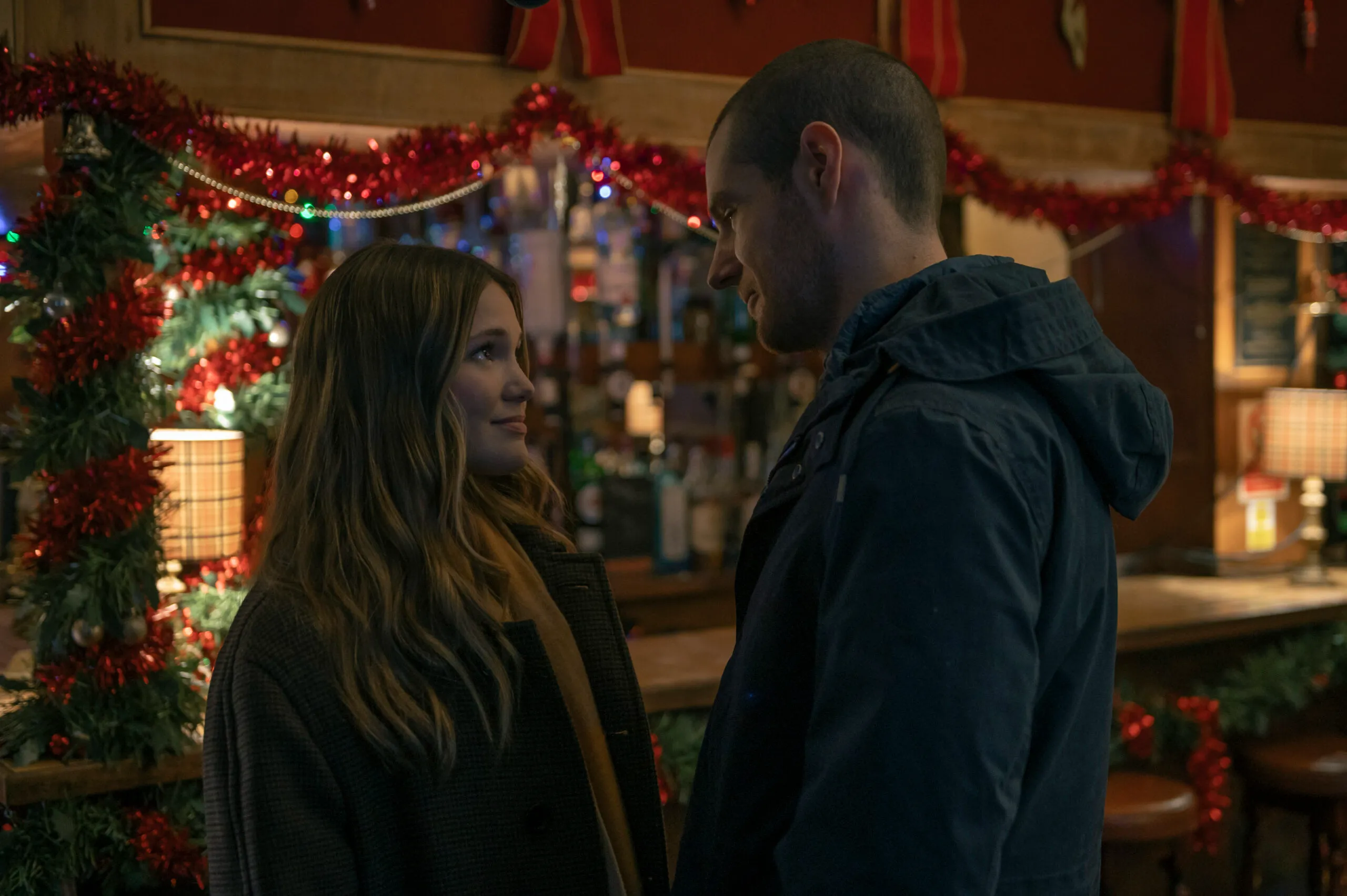
Their interaction provides the film’s strongest asset. The casual back-and-forth and the gradual trust that develops between them keep scenes alive and make their romantic thread feel earned and not imposed. The film keeps that romance on a relatively quiet, slow-burn track that grows out of their shared stress and common cause. This attention to character connection holds the viewing experience together even when the logic of the heist strains credibility.
The script does not consistently support the performers. The dialogue occasionally feels thin and undercooked, which blunts the comedy that the situations promise. This limitation shows most clearly in sequences built around earpiece chatter, where snappier writing could have made the set-pieces sharper. A more refined pass on the script could have given their exchanges extra bite and lifted the film as a whole.
Among the supporting players, Peter Serafinowicz captures Maxwell Sterling as an effective picture of smug profiteering, yet the film gives him limited space. That choice slightly reduces the impact of the antagonist. Lucy Punch, by contrast, delivers steady comic charge as Cynthia Sterling, the scheming, aggrieved wife whose theatrical plotting often gives scenes a jolt. Her timing often raises the material on the page. Another smart choice sits in the soundtrack. The film opts for an alternative holiday playlist that includes bands like Low and Run-DMC, which creates a more offbeat seasonal sound and pairs neatly with the slightly darker, less cosy angle on Christmas that the story pursues.
Cinematic Architecture and Seasonal Positioning
From a technical point of view, the film’s most striking element lies in its use of London locations. The production leans into real streets, pubs, and public spaces, which gives the images a lived-in texture that many studio-bound holiday films lack. The decorated high streets and interiors create a festive atmosphere that feels specific and avoids a generic look, and the absence of obviously artificial snow settings keeps the illusion intact. Michael Fimognari, whose background includes young adult romances, directs with steady focus on the interplay between characters, and it keeps large-scale spectacle in the background.
Within the crowded field of seasonal streaming releases, Jingle Bell Heist manages a modest lift above the most disposable titles. The film does not reach for grand invention, and it runs into flat comedic beats and stretches of story that ask the audience to accept convenient security gaps, especially around the department store break-in. Even so, its choice to tie a Christmas heist to working-class pressure gives it a distinct hook, and the charm and chemistry of Holt and Swindells supply the film with its most reliable resource.
The result is a breezy, easy-to-watch holiday option with just enough personality to stand out on a busy homepage queue. The emotional impact and lasting appeal of the film rest squarely on the central performances, which once again show that in this corner of cinema, human connection functions as the strongest mechanic in the design.
Jingle Bell Heist is an American Christmas romantic comedy film that premiered worldwide on Netflix today, November 26, 2025. Directed by Michael Fimognari, the movie centers on Sophia and Nick, two down-on-their-luck workers who join forces to rob a prestigious London department store on Christmas Eve, only to find an unexpected romance amidst the chaos. The movie has a running time of 96 minutes and is available for streaming exclusively on Netflix.
Full Credits
Title: Jingle Bell Heist
Distributor: Netflix
Release date: November 26, 2025
Rating: TV-14
Running time: 96 minutes
Director: Michael Fimognari
Writers: Abby McDonald, Amy Reed
Producers and Executive Producers: Matt Kaplan, Aubrey Bendix, Michael Fimognari, Chris Foss, Mark Lane, Matthew Janzen
Cast: Olivia Holt, Connor Swindells, Lucy Punch, Peter Serafinowicz, Poppy Drayton, Michael Salami, Ed Kear, James Dryden
Director of Photography (Cinematographer): Michael Fimognari
Editors: Jeffrey M. Werner, David S. Clark, Greg Dephoure Goldman
Composer: Steve Hackman
The Review
Jingle Bell Heist
Jingle Bell Heist manages to rise above the usual low bar of holiday fare, thanks almost entirely to the genuine chemistry and appealing performances from leads Olivia Holt and Connor Swindells. While the dialogue is occasionally flat and the mechanics of the heist itself are clumsy, the film's grounding in relatable financial hardship and its authentic London setting provide a unique texture. It is a charming, flawed film that succeeds as an easy-to-watch, character-driven seasonal feature carried entirely by its central pair.
PROS
- Genuine and believable chemistry between the two leads.
- Unique, authentic London setting elevates the atmosphere.
- Relatable socio-economic motivations for the characters.
- Stands slightly above the generic seasonal film output.
CONS
- Heist mechanics are unimpressive and often inept.
- Dialogue occasionally feels flat and underdeveloped.
- Supporting cast, especially Peter Serafinowicz, is underutilized.
- Pacing occasionally slows down to focus on drama.