



















The human condition often rests on a brittle domestic calm that conceals persistent disorder. The Family Plan 2 returns to that fragile balance, inspecting how violence lingers within suburban life. The film reunites us with Dan Morgan (Mark Wahlberg), who has traded the formal identity of covert assassin for the routine of running a high-tech security firm. His wife, Jessica (Michelle Monaghan), and their three children share the aftermath of his history, having absorbed the shock of what he once was. The prior film’s defining strain, the secret, has been transformed into a peculiar family norm.
This sequel sustains the action-comedy formula by moving the Morgans to Europe and its winter-lit streets, primarily London and Paris. The trip is framed as a holiday visit to their eldest daughter, Nina (Zoe Colletti), who studies abroad, and it soon becomes clear that the visit conceals other designs. A new client, Finn (Kit Harington), emerges from Dan’s past and drags the family back into tumult. The film poses itself as plain entertainment, and its steady predictability asks an unsettling philosophical question about the persistence of a primal identity.
The Treadmill of Recurrence
The film’s structure returns to an established formula, repeating the essential scenario: a family vacation that collapses under the weight of Dan’s criminal history. This repetition reveals a reluctance to imagine new psychic demands on the characters. The earlier, central tension—the hidden life—has dissolved, and that dissolution weakens the narrative’s coherence. The Morgans appear to have acclimated to extreme violence to a point where danger loses its tragic contour. This raises an unsettling philosophical question: if peril becomes domesticated, can the tragic dimension of human life survive?
To fill the gap left by diminished stakes, the script adds two thin plot drivers. Jessica receives a secret job offer in another state, a domestic knot that tries to mirror Dan’s past but fails to carry comparable weight. Aidan/Finn emerges as the vengeful figure who advances the conflict. The move to Europe is arranged through convenient plot mechanics: Dan’s security meeting in London happens to line up with a need to visit Nina. That convenience exposes the mechanics of the plot; motivation feels engineered rather than grown from character logic. The characters function largely as parts within a machine that exists to set up action sequences.
Character choices often strain credibility, a problem when the lead is presented as a consummate operative. Dan repeatedly falls into traps that his skills should have allowed him to avoid, and his professional acumen recedes whenever the script requires escalation. This erosion of competence is a blunt instrument used to push the plot forward. Moreover, despite the presence of assassins and international law enforcement, the film rarely produces true urgency. The cast moves through life-or-death moments with a curated detachment, which thins the emotional stakes.
A sense of consequence is further undermined by repetitive dialogue. Characters continuously assert the need to “stick together” and insist on the primacy of “family.” These statements arrive unearned by the on-screen conflicts and serve as rhetorical scaffolding in place of authentic feeling. The persistent recurrence of such platitudes registers as a manufactured attempt to anchor the film in sentiment, rather than an expression born from dramatic pressure.
The runtime, at roughly two hours, exacerbates the film’s problems. Slow pacing and narrative filler cause the middle act to sag, exposing the thinness of the script’s ideas. What could be a compact action-comedy becomes an extended accumulation of scenes that only faintly advance the plot. The result is a viewing experience that feels prolonged, a sequence of events that arrives at its conclusion with obvious inevitability.
The Faces of the Mask
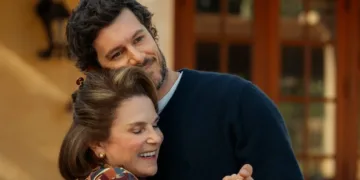
One stabilizing element is the interplay between the leads. The rapport between Mark Wahlberg’s Dan and Michelle Monaghan’s Jessica has settled into a plausible representation of a long partnership. Their timing and small gestures create a domestic rhythm that undermines the artifice of the set pieces.

Wahlberg’s work here leans on a narrow emotional register. His Dan remains chiefly an anxious, watchful father, a repeated figure whose temperament changes little across scenes. The constant expression of disapproval toward Nina’s boyfriend becomes a recurring beat that adds humor at the expense of dramatic complexity. The overprotective father sketch serves the comedy, yet it feels dated and thin.
Monaghan receives broader demands from the material. Jessica moves from a peripheral spouse into an active participant in the action. She displays physical skill and engages in combat sequences, which reveals an enlarged range for the character and a clearer will to participate in the family’s defense. This expansion hints at inner possibilities that the screenplay had previously limited, and it provides a welcome contrast within the family dynamic.
Finn, credited as Aidan/Finn and played by Kit Harington, carries an emotional motive tied to jealousy and revenge that traces back to abandonment by their father. That psychological framing offers a firmer motive than a cartoonish villainy. Harington’s performance, however, rarely achieves the necessary dark intensity; his threat reads predictable rather than truly menacing.
The children fulfill their assigned roles. Nina articulates frustration with her father’s chaotic life. Kyle (Van Crosby) remains the tech-skilled gamer and hacker. The toddler Max functions largely as a set piece. Nina’s boyfriend, Omar (Reda Elazouar), is introduced for his parkour ability, which the plot soaks up as a convenient talent, and his presence fuels Dan’s repeated on-screen disapproval that supplies a strain of forced family comedy.
The film’s comic impulses often feel exhausted. Jokes about parents singing 90s pop hits or embarrassing moments with children recur without development. Low-effort gags such as the “certified pre-owned” exchange fall flat, trading subtlety for volume. The comedy depends on repetition and predictable punchlines rather than inventive observation.
Attempts at humor that lean on stereotype — remarks about Omar’s physique or a Russian character’s eccentric singing — reveal a weaker writing strategy. Such moments expose the screenplay’s dependence on easy targets instead of cultivating situational or character-based wit. Overall, the comic elements frequently satisfy a genre requirement without delivering genuine amusement.
The Mechanics of Mediocrity
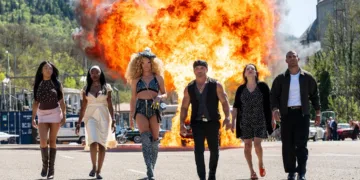
The action sequences rarely rise beyond obligatory beats. They function as checkpoints that the story must clear rather than as kinetic revelations of character or theme. Staging is often remote: the pivotal double-decker bus brawl between Wahlberg and Harington is undermined by camera choices that favor distance. Recurrent wide shots desynchronize the spectator from the immediate force of the violence and dissipate the intended intensity. Choreography reads as arranged for camera coverage rather than captured in visceral proximity.

The car chase, played partly for laughs, contains a moment of contrivance when a vehicle descends the steps of Sacré-Cœur. That visual gadgetry privileges spectacle over plausible peril. Only the Parisian parkour segment, involving Omar and Jessica, supplies a burst of physical energy. Even that sequence depends on the convenient introduction of Omar’s talent. A positive modification within the action is the decision to involve Jessica and the children actively, which adjusts the family’s role in the mayhem, though the choreography itself remains generally undistinguished.
The film returns Director Simon Cellan Jones and Screenwriter David Coggeshall to familiar terrain. The screenplay often feels blunt and repetitive, with obvious plot mechanics and redundant lines of dialogue. Several elements appear underdeveloped, as if fragments from an early draft were left in place. For example, a band of hired assassins surfaces and later disappears without resolution, leaving a gap in narrative logic. Attempts at suspense, including foreshadowing and a late betrayal, are signaled with heavy-handed cues that blunt surprise. The plotting assumes the audience needs constant reminders of the stakes rather than trusting the material to reveal them gradually. This posture diminishes the film’s intellectual confidence and wastes potential implicit dread.
Technically, the film does not elevate its material. The score, credited to Kevin Matley, functions as a generic backdrop that rarely aligns emotionally with the action. It exists as ambient support rather than as a partner in shaping tension or release. The soundtrack also relies heavily on pop needle drops during action and comic beats. The reuse of 90s songs feels formulaic and often serves as an audible shortcut to manufactured nostalgia or energy, a substitution for sharper tonal work within the script.
The Cold Glitter of Artifice
Where the film does find consistent success is in its visual register. London and Paris supply a wealth of cinematic texture: winter lights, festive decor, and familiar urban panoramas that the script cannot match in depth. The production’s scale and spectacle speak to an increased budget that shows on screen. London’s abundant Christmas decorations, in particular, create a seasonal sheen that the film leans on. The locations act as the film’s most persuasive element, a visual infrastructure that outperforms the narrative it is meant to serve.
The attempt to fold Christmas atmosphere into the plot remains largely cosmetic. The winter-lit settings are beautiful and often striking, but the festive sheen rarely reaches into the story’s emotional center. Landmark-driven action sequences emphasize spectacle and occasion more than character consequence, which casts the film toward a travel-brochure sensibility at moments. The result is a handsome visual experience that struggles to conceal the script’s emptiness. The production’s gloss becomes the dominant sensation, a cold glitter that highlights the thinness beneath.
The Family Plan 2 is a high-energy action-comedy sequel premiering globally on November 21, 2025. It is an Apple Original Film, available exclusively to stream on Apple TV+. The movie reunites the Morgan family, led by former assassin Dan Morgan (Mark Wahlberg), as they embark on a Christmas trip to Europe to visit their eldest daughter. However, the holiday plans are quickly derailed when a mysterious figure from Dan’s past (Kit Harington) resurfaces with a vengeful agenda, launching the family into an international chase filled with bank heists, car chases, and festive mayhem across London and Paris. The film is produced by Apple Original Films and Skydance Media.
Full Credits
Title: The Family Plan 2
Distributor: Apple TV+ (Apple Original Films, Skydance Media)
Release date: November 21, 2025
Rating: PG-13 (for action/violence, language, some sexual material and brief drug material)
Running time: 107 minutes (or 1 hour 47 minutes)
Director: Simon Cellan Jones
Writers: David Coggeshall
Producers and Executive Producers: Mark Wahlberg, David Ellison, Dana Goldberg, Don Granger, Stephen Levinson, John G. Scotti, Simon Cellan Jones (Executive Producer), David Coggeshall (Executive Producer)
Cast: Mark Wahlberg, Michelle Monaghan, Kit Harington, Zoe Colletti, Van Crosby, Reda Elazouar, Sidse Babett Knudsen, Sanjeev Bhaskar, Peter Lindsey, Theodore Lindsey
Director of Photography (Cinematographer): Michael Burgess
Editors: Pani Scott, Yan Miles
Composer: Kevin Matley
The Review
The Family Plan 2
The Family Plan 2 functions as a beautiful, expensive husk, its formulaic plot and repetitive humor masking a profound lack of narrative purpose. While the visual spectacle of the European setting is undeniable, and the chemistry between the leads is comfortable, the film never justifies its own existence. It is a work of empty convenience that confuses kinetic noise for genuine excitement. The result is a laborious, ultimately forgettable action-comedy that mistakes repetition for reliability.
PROS
- Visually stunning European locations (London/Paris Christmas setting).
- Improved and natural chemistry between Mark Wahlberg and Michelle Monaghan.
- Michelle Monaghan's expanded, more action-oriented role.
- High production value and scale of action set pieces (despite poor execution).
CONS
- Formulaic and predictable plot, a flat retread of the original.
- Exhausted, repetitive, and uninventive comedic elements.
- Lack of genuine stakes or urgency in the narrative.
- Weak direction and a flimsy, underdeveloped screenplay.
- Excessive runtime and slow, laborious pacing in the middle sections.