







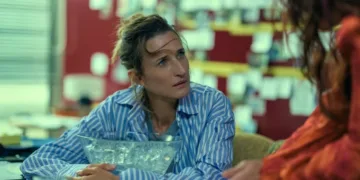


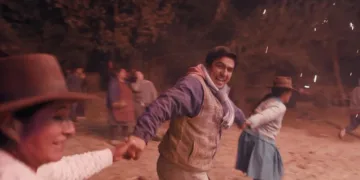











The crop circles in Bodzki are fake, but the film’s faith in rural innocence is entirely sincere. Łukasz Kośmicki’s It Takes a Village, the 2026 Polish Netflix sequel to No Pressure, returns to the same countryside fantasy with a premise that should carry sharper comic force: an elderly woman loses her savings in a crypto investment, calls off her wedding from shame, and becomes the beneficiary of a village-wide alien hoax designed to rescue her farm.
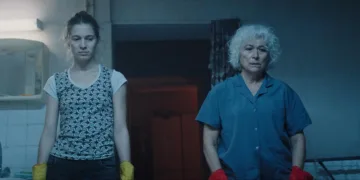
Halina, played by Anna Seniuk, abandons Jan at the altar before the priest, the band, and the assembled townspeople in traditional dress. The humiliation is public; the reason is private. Wojtek has helped vaporize her money through a doomed investment, and Halina reacts by turning financial disaster into romantic rejection.
Jan, played by Artur Barciś, broods under the belief that love has failed him, then gathers the villagers to carve mystery into a field. That is a lively setup. It places old-world village solidarity against new-world digital fraud, turning Bitcoin loss into folk performance. The film keeps refusing the sharper version of its own idea.
Halina and the Limits of Stubbornness
Halina is meant to be difficult in a comic, affectionate way, the kind of village tyrant whose harshness hides terror of dependence. Seniuk gives her the right physical authority: the stiff posture, the clipped speech, the glare that makes help sound like an insult. Yet the script traps the character in one repeated gesture. Halina conceals, scolds, rejects, then waits for everyone else to absorb the damage.
The abandoned wedding gives this pattern its cleanest form. She does not explain the lost savings to Jan; she lets him stand there wounded. Later, when others try to solve the crisis, her pride keeps creating fresh obstacles rather than deeper conflict. Her stubbornness becomes a plot machine. Each refusal exists less because Halina is being newly revealed and more because the movie needs another scene of chaos before reconciliation can be delayed.
The weakness is especially visible because the premise contains a stronger social comedy. An older rural woman falling for a modern financial scheme could expose shame, generational trust, technological mystification, and the brutal speed with which debt can erase a family home.
Also Read





It Takes a Village glances at these pressures, then reaches for shouting, broken crockery, and slapstick panic. The scam should sting. Here, it mostly functions as a setup for tourists buying cheese under the spell of imaginary aliens.
A Romance Smothered by Farce
Jan and Halina’s late-life romance has an appealingly unfashionable shape. He is a woodcarver with patience in his hands; she is all impatience and command. Their wedding could have opened a story about love after a lifetime of habits has hardened into armor. Barciś brings a tender foolishness to Jan, especially once he begins treating the crop-circle scheme as both financial rescue and romantic proof.
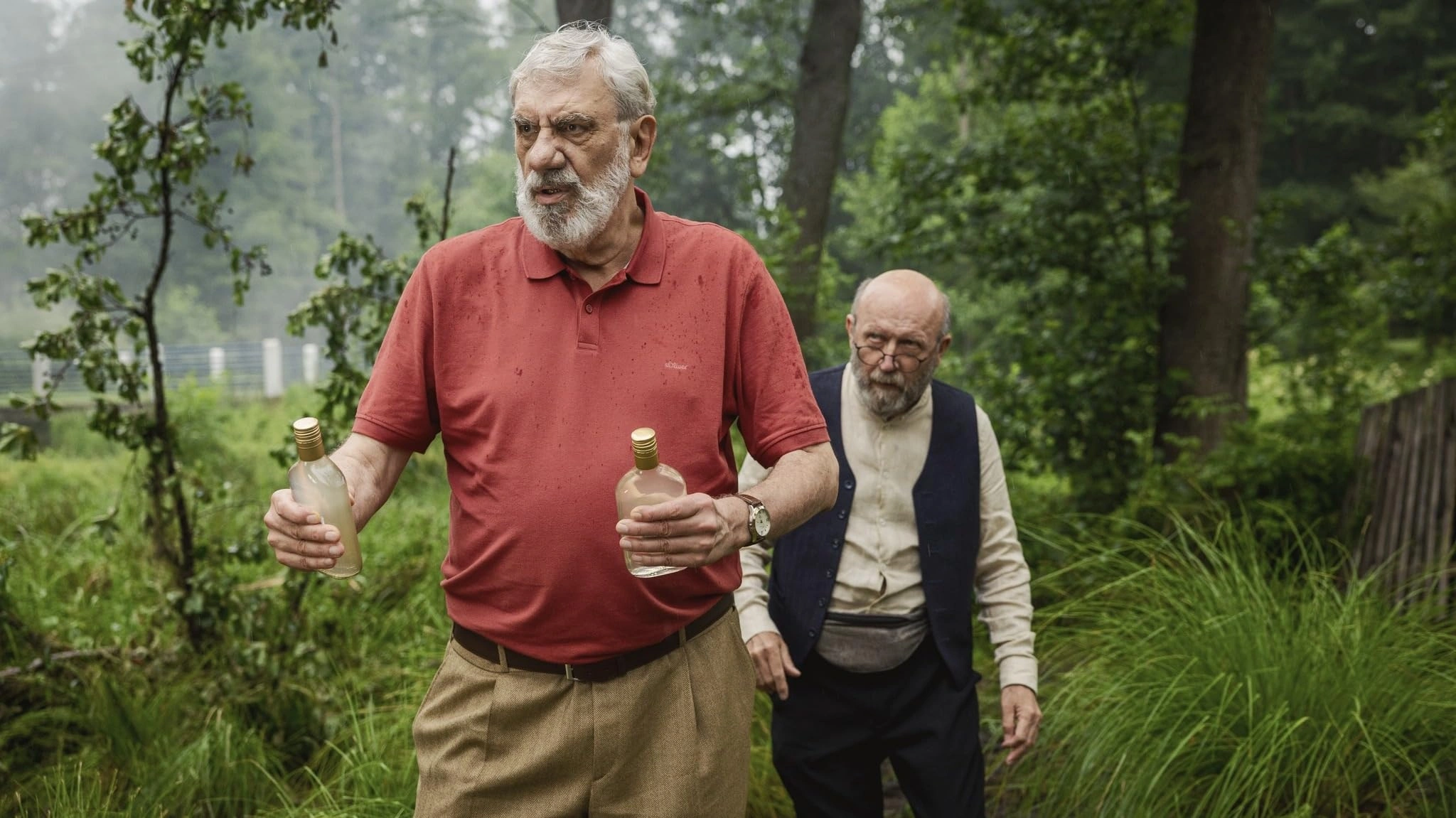
The film keeps translating that tenderness into misunderstanding. Jan believes Halina no longer loves him. A romantic rival appears and turns his insecurity into jealousy. Halina overhears or misreads enough to keep trouble alive. They are written like young rom-com leads who have wandered into older bodies, with silence doing the labor that character should be doing.
Around them, the villagers build Bodzki into a small tourist spectacle. The alien rumor spreads, visitors arrive, and local goods become part of the performance. The idea has bite: a rural community packages superstition for urban consumption, then uses the money to save one of its own.
The execution softens the satire. The tourists rarely become characters; they are a crowd of buyers and believers. The villagers rarely confront the ethical shape of the fraud. Selling crop-circle magic to gullible visitors becomes a harmless festival trick because the film cannot bear to let communal warmth look morally messy.
There is a strange condescension in this arrangement. City people arrive as easy marks, rural people as crafty innocents, and the film treats the exchange as cute commerce. Polish countryside charm becomes a brand, complete with folk music, mud, food stalls, and convenient wonder.
The Better Film Hiding in the Subplots
The supporting stories often have more texture than the main conflict. Oliwia, settled in Bodzki with Kuba after the first film, has built a restaurant but suddenly finds her recipes tasting bland to her. It is a small thread, yet it says more about permanence than the louder wedding plot. Staying in the village is not a fairy-tale ending; it brings routine, doubt, and the anxiety of building a life from a romantic decision.
Ewa’s arrival opens an even richer path. Joanna Trzepiecińska brings warmth without turning the character soft. Her mural of the townspeople on the restaurant wall gives the film one of its clearer images of community: faces turned into public memory, village identity rendered as paint rather than slogan. Her interest in Jan’s woodcarvings also creates a quieter cultural exchange than the crop-circle tourism. Here is rural craft being seen by urban art networks, with beauty caught between affection and market value.
The film touches this idea, then hurries away to broader business. Wojtek nurses a crush on Ewa after helping cause Halina’s disaster. A police chief fixates on giant pastries. A priest keeps chasing donations after damaging the church while distilling moonshine. Multiple bodies hit the mud. Some of this has comic rhythm, especially the priest’s mixture of piety and entrepreneurial guilt, but the gags rarely build. They arrive, announce themselves, and leave.
Bodzki looks inviting, green, and soft-edged, the kind of place Netflix can sell across borders without requiring viewers to understand its local textures. That accessibility is part of the film’s appeal and part of its weakness. It Takes a Village has picturesque fields, an energetic cast, and a premise full of usable cultural friction. It turns them into pleasant noise, leaving Ewa’s mural and Jan’s carvings to suggest the film that might have taken shape if anyone had trusted quiet observation over another fall in the mud.
The Polish romantic comedy feature It Takes a Village premiered globally for digital streaming on Netflix on April 1, 2026. Directed by Łukasz Kośmicki and produced by ZPR Media, this lighthearted farce serves as a direct follow-up to the network’s previous regional hit No Pressure. The wacky, small-town plot centers on an eccentric elderly woman who gets scammed out of her life savings right before her wedding, prompting her tight-knit community to hatch an outrageous fake alien crop-circle hoax to attract tourist money and save her farm.
Where to Watch It Takes a Village (2026) Online


Full Credits
Title: It Takes a Village
Distributor: Netflix
Release date: April 1, 2026
Rating: TV-14
Running time: 94 minutes
Director: Łukasz Kośmicki
Writers: Katarzyna Frankowska, Katarzyna Golenia
Producers and Executive Producers: Marta Klin, Ewa Latkowska, Ewa Latkowska, Marta Klin
Cast: Anna Seniuk, Artur Barciś, Filip Gurłacz, Joanna Trzepiecińska, Anna Szymańczyk, Cezary Żak, Mateusz Janicki, Wiktor Zborowski, Piotr Pręgowski, Paulina Holtz, Piotr Rogucki, Magdalena Smalara
Director of Photography (Cinematographer): Jeremi Prokopowicz
Editors: Wojciech Mrowczynski
Composer: Jan Sanejko
The Review
It Takes a Village
It Takes a Village has the bones of a sharper rural comedy: a crypto scam, a wounded wedding, a village selling alien folklore back to tourists. The film keeps choosing louder, thinner pleasures. Halina’s pride becomes repetition rather than character, and Bodzki’s communal warmth rarely develops past scenic comfort. Joanna Trzepiecińska gives Ewa the grace and curiosity the film badly needs, but the stronger story keeps slipping away from her. Pretty fields, busy subplots, little sting.
PROS
- Picturesque Polish countryside
- Warm Ewa subplot
- Gentle late-life romance idea
- Some comic bite around the priest
CONS
- Halina grows tiresome
- Repetitive shouting and slapstick
- Weak emotional focus
- Underused culture clash
- Subplots crowd the center