































Affluence in Sugar Beach behaves like a glass tank: everyone can see Rosalyn drowning, and nearly everyone calls it discipline. Noely Mendoza’s indie coming-of-age drama places grief inside a polished California community where good grades, athletic success, and family reputation are treated as proof that teenagers are fine.
Rosalyn Roman, played by Zoe Manzotti, is the kind of student adults like to praise because praising her saves them from looking closer. She is wealthy, gifted, and on track for valedictorian. She is also drinking her way through the guilt left by the surfing accident that killed her twin brother, Gabriel.
That contradiction gives the film its strongest American texture. Teen dramas from the United States often stage adolescence as rebellion against parents, schools, or social labels. Sugar Beach is sharper when it treats rebellion as a symptom of a system that rewards performance and then acts offended when the performer breaks. Rosalyn’s alcohol use is not filmed as party-girl chaos. It is quieter and sadder: a private anesthetic, a way of creating distance from a death she cannot revise.
A Safe Place Misread as Scandal
The relationship between Rosalyn, Emma Tanner, and Isaac Fitzpatrick is the film’s emotional risk, and Mendoza handles it with real care. Emma carries confidence like armor, while Isaac’s athletic popularity hides the pressure coming from his father.
When the three draw closer, the film does not frame their throuple as a provocation tossed at a conservative audience. It frames it as shelter. Their physical intimacy is shot with softness and respect, with bodies used to express trust rather than to decorate the frame.
This matters because the leaked private video that turns them into school gossip could have pushed the film into lurid melodrama. Instead, the leak becomes an indictment of the adult world around them. The cruelest part is not that classmates gossip. Teenagers can be vicious, and the film knows that.
The sharper wound comes when Principal Fixen removes Rosalyn and Isaac from valedictorian consideration, treating institutional image as a moral principle. In one administrative decision, academic excellence becomes conditional on public purity.
The class setting gives that punishment extra force. In this affluent coastal world, compassion arrives politely, if it arrives at all. Emma’s mother tries to support her, but she stands almost alone. Isaac’s father answers pain with expectation. Rosalyn’s mother, Madelyn, is trapped in her own grief, physically present yet emotionally unreachable. The community claims to protect its children while converting their worst day into evidence against them. There is a very American cruelty in that exchange.
Rosalyn’s Grief Has a Body
Manzotti, who also wrote the screenplay, gives Rosalyn a performance built from containment. Her strongest scenes are not the ones where the script announces pain. They are the moments where Rosalyn tries to pass as functional: moving through school with valedictorian polish, drinking to mute herself, letting Emma and Isaac see the version of her that achievement has been hiding. Manzotti does not play grief as one sustained note. She lets it flare, recede, and return in different shapes.
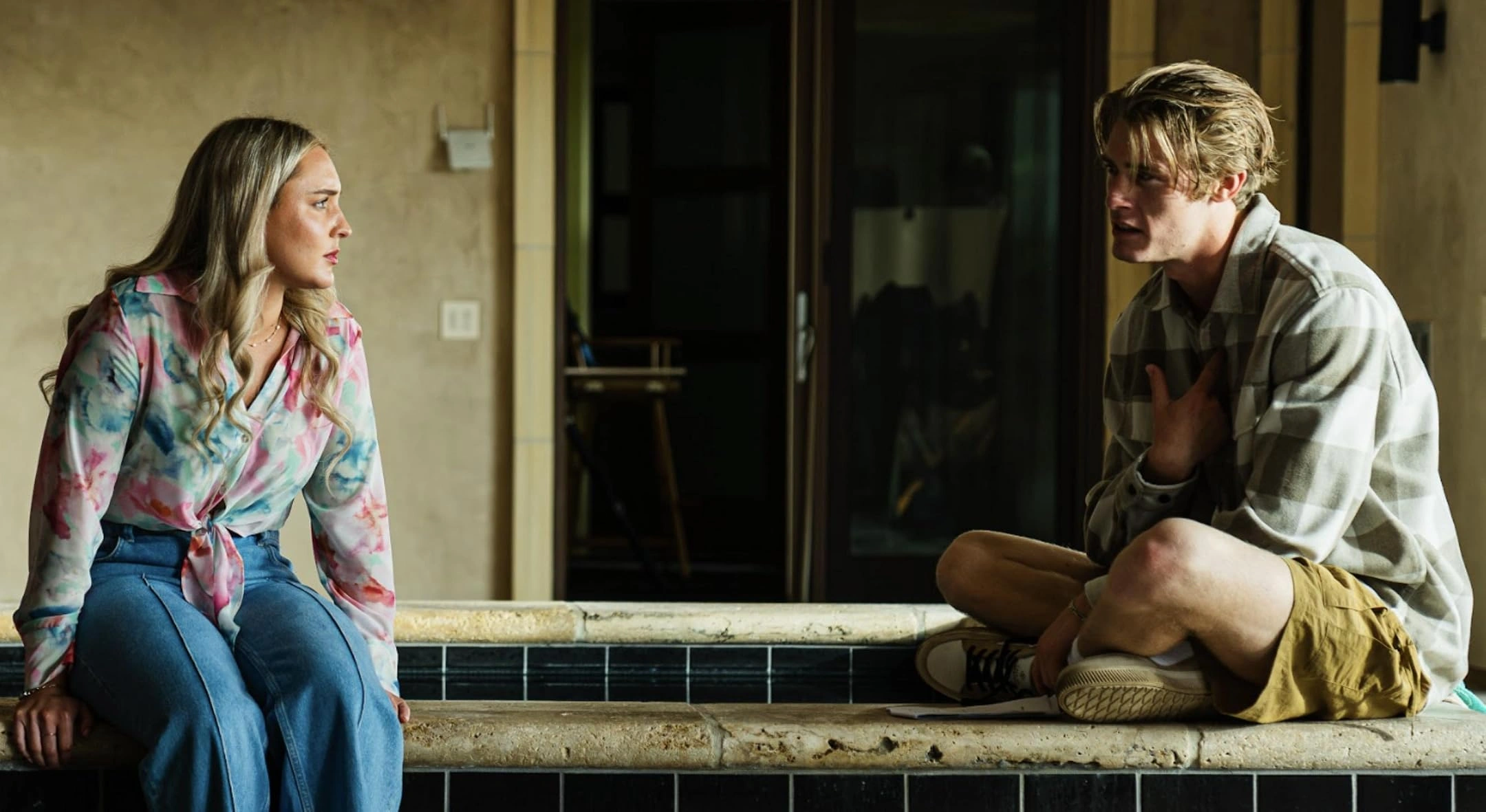
Emma Blomquist and Ryley Schroeder help make the throuple credible because they do not overplay desire. Their best scenes have the rhythm of recognition. Emma and Isaac look at Rosalyn as someone damaged, yes, but not broken beyond touch. That distinction is vital. The relationship works because the actors make comfort feel as present as attraction.
Troy Leigh-Anne Johnson gives Kiara Henry a grounded place in the story. Kiara’s friendship with Rosalyn becomes strained when Rosalyn spends less time with her, but the film uses that distance to show how grief rearranges a person’s loyalties without asking permission.
Megan Lawless finds a similarly useful restraint as Madelyn. The late conversation between mother and daughter, where Rosalyn speaks about forgiving herself for Gabriel’s death, works because Madelyn is not reduced to a monster parent. She has failed her daughter, but the failure comes from paralysis rather than malice.
The film’s weakness is structural crowding. Grief, addiction, a leaked video, school punishment, academic pressure, friendship strain, parental neglect, athletic expectation, and sexual identity all compete for space inside an 87-minute frame. Some threads need a harder cut or a longer breath. Isaac’s conflict with his father, for instance, is clear in outline but less piercing than Rosalyn’s scenes with Madelyn. The film has enough feeling for all its characters, but not always enough time.
The Ocean Remembers
Visually, Sugar Beach understands that California sunlight can be oppressive. The beach is beautiful, but Mendoza and her cinematographer resist turning it into escape. The ocean is where Gabriel died, so every coastal image carries a double meaning: freedom for everyone else, accusation for Rosalyn. Warm light and open space become part of the trap.
The late sequence in which Rosalyn returns to the water is the film’s most expressive passage. It can be read as hallucination, near-death experience, or symbolic confrontation, but its purpose is clear. Rosalyn has been drowning on land for most of the film. Underwater, memory stops being background noise and becomes a physical environment. The scene does not pretend that acceptance erases loss. It gives her a first act of refusal against self-punishment.
Mendoza’s restraint keeps the moment from becoming sentimental. The camera allows the water to carry fear, guilt, and release in the same image. When Rosalyn resurfaces, the film earns its hope because it does not confuse survival with cure. Gabriel remains gone. The leaked video remains a violation. The adults who failed these teenagers do not receive sudden wisdom. What changes is smaller and sturdier: Rosalyn begins to imagine a life that does not require her to keep drowning in loyalty to the dead.
Sugar Beach is crowded, sometimes too gentle where it might have cut deeper, yet its best scenes understand how private grief becomes public punishment in a community obsessed with appearances. The film’s tenderness is not soft. It is a form of resistance.
The queer indie coming-of-age drama Sugar Beach premiered in select theaters on June 26, 2026, anchoring its release during Pride weekend. It follows a high school valedictorian and soccer star who navigates immense grief after her twin brother drowns, eventually finding emotional solace and an intense connection within an unconventional teenage throuple. Audiences can catch this award-winning festival favorite during its limited theatrical run across select cities.
Where to Watch Sugar Beach (2026) Online


Full Credits
Title: Sugar Beach
Distributor: Seismic Releasing, Porter+Craig Film & Media Distribution
Release date: June 26, 2026
Running time: 87 minutes
Director: Noely Mendoza
Writers: Zoe Manzotti
Producers and Executive Producers: Bobbie Blyle, Tony Bracy, Re’Shaun Frear, Korey Washington, Jeff Porter, Craig Ahrens
Cast: Zoe Manzotti, Emma Blomquist, Ryley Schroeder, Kelli Garner, Michael Landes, Troy Leigh-Anne Johnson, Colin McCalla, Megan Lawless, Oliver Blank, Kio Cyr
Director of Photography (Cinematographer): Noely Mendoza
Editors: Noely Mendoza, Zoe Manzotti
Composer: Noely Mendoza
The Review
Sugar Beach
Sugar Beach reads the American teen drama through grief, class pressure, and public shame, turning a leaked private video into a social trial staged by adults who mistake punishment for care. Noely Mendoza’s film is tender with Rosalyn, Emma, and Isaac, strongest when the ocean becomes memory rather than scenery. Its reach sometimes exceeds its 87-minute frame, but Zoe Manzotti gives Rosalyn’s pain a lived-in gravity that carries the film through its crowded passages.
PROS
- Tender central throuple
- Zoe Manzotti’s vulnerable lead work
- Poetic coastal cinematography
- Strong mother-daughter scene
- Grief handled with restraint
CONS
- Too many subplots
- Some conflicts need deeper treatment
- Supporting adults can feel schematic
- Emotional climax slightly softened