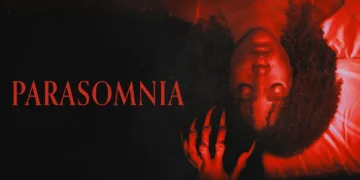
















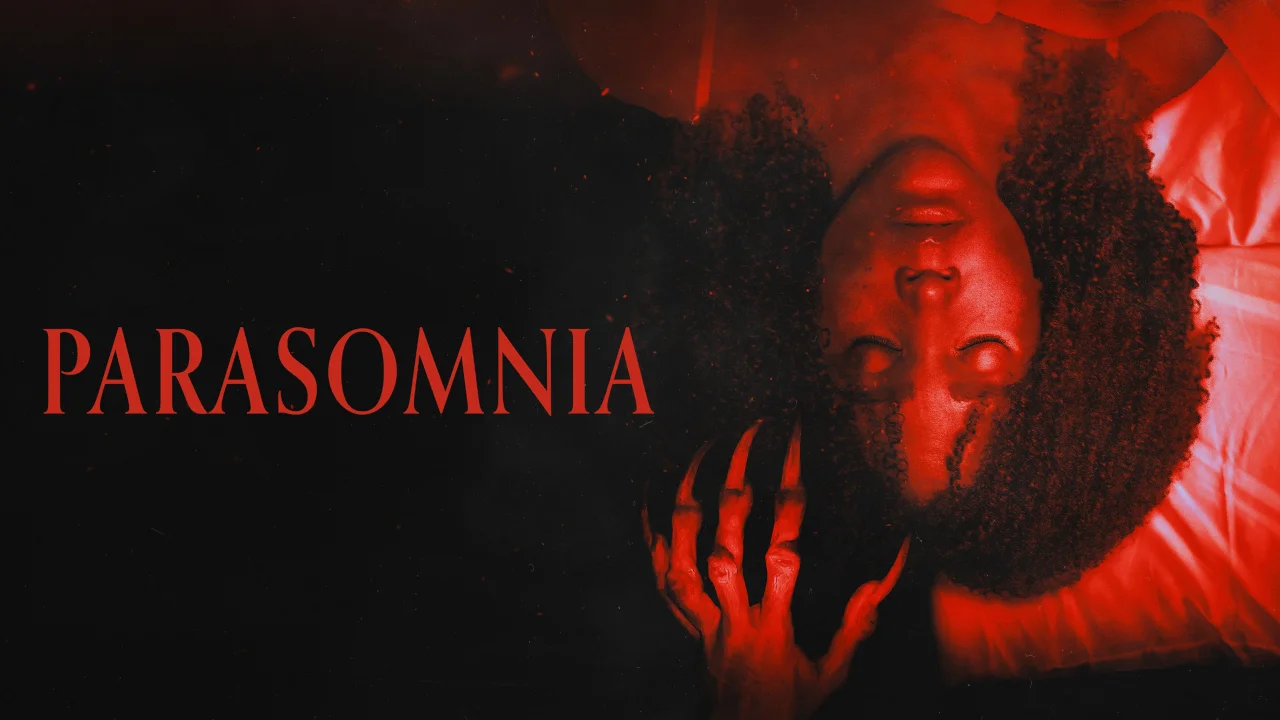

Riley has turned sleep into a household protocol. Everyone under her roof must drift off before she does, alcohol is avoided, routines are maintained, and any disturbance carries the weight of catastrophe. Jasmine Mathews plays those rules without theatrical fuss. Riley treats them like brushing her teeth because terror, repeated often enough, becomes administration.
James Ross II builds Parasomnia around that unsettling idea. At five, Riley sleeps through the murder-suicide of her parents. At fifteen, another massacre erupts at the Amherst Sanctuary Foster Home while she lies trapped between waking and dreaming. Ten years later, now living with boyfriend Cam (RJ Brown), she fears the cycle has returned.
Sleep horror inevitably carries the shadow of A Nightmare on Elm Street, yet Ross gives his nightmare a different social texture. Riley’s danger spreads outward. Anyone awake near her sleeping body can become vulnerable to the Seer, a pale supernatural presence whose victims turn murderous before mutilating their own eyes.
The all-Black cast is allowed to inhabit supernatural horror without forcing race itself to become the plot. That distinction matters in a genre where Black characters have so often existed as casualties, guides, or symbols rather than people permitted the full absurdity of being haunted.
The Birthday Curse
The surprise birthday party works because it temporarily makes Riley’s rules look ridiculous. David (Stephen Barrington), who knew Riley at the foster home, arrives with his girlfriend and immediately brings old fear back into the house. His discomfort is rooted in memory rather than superstition.
He already knows what happened the last time Riley slept near people he cared about. Cam, meanwhile, has treated her bedtime system with less precision than she requires, leaving tiny cracks in an arrangement built to keep everyone alive.
Ross lets the unease accumulate through ordinary interactions. Riley declines drinks because they could disturb her sleep cycle. Guests discuss methods for passing out quickly. Everyone eventually heads to bed under instructions that would sound comic in another film. Then the ritual fails.
The Seer’s violence has an ugly ceremonial quality. Victims are driven toward murder and suicide, with eyes gouged out, consumed, and offered back to the entity. The imagery is grotesque, yet its repetition gives Riley’s history a recognisable pattern. She has spent years constructing rules because pattern is the only evidence she possesses that chaos might be controlled.
Mathews is especially good when Riley’s certainty begins to fracture. The performance does not treat trauma as decorative backstory. Her rigid behaviour grows directly from the deaths surrounding her, and every compromised bedtime rule carries the emotional weight of another possible body.
Who Is Really Haunting Riley?
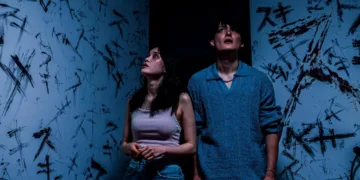
Ross refuses to let the first version of Riley’s story remain stable. Dream sequences slide between her perspective, the Seer’s presence, fragments of memory, and spaces that seem to contain former victims. Riley moves through degraded corridors and hellish rooms while the film withholds clean boundaries between sleeping and waking. One particularly effective scare has a character staring toward a distant figure and wondering if marijuana has distorted his perception before the shape abruptly becomes immediate.
Around the midpoint, the chronology folds backward. Events we thought we understood are presented from another angle, and Cam’s family history moves closer to the foreground. His mother, played by Sally Stewart, is revealed as a voodoo priestess whose revenge has helped shape the curse haunting Riley.
This is where Parasomnia becomes culturally sharper and structurally shakier. Ross treats voodoo as an active system of intention, inheritance, and consequence rather than a random box of spooky props. The Seer exists because someone wanted something, and that choice travels across years through people who barely understand the debt they inherited.
The 85-minute runtime gives those ideas little room to breathe. Cam’s mother arrives late carrying information that alters the meaning of the preceding story, while Riley’s earlier family life receives only fragments. A long explanatory passage lays out rules that had been frightening partly because they were uncertain. The mythology becomes easier to follow at exactly the point where the nightmare becomes easier to contain.
Keep the Seer in the Dark
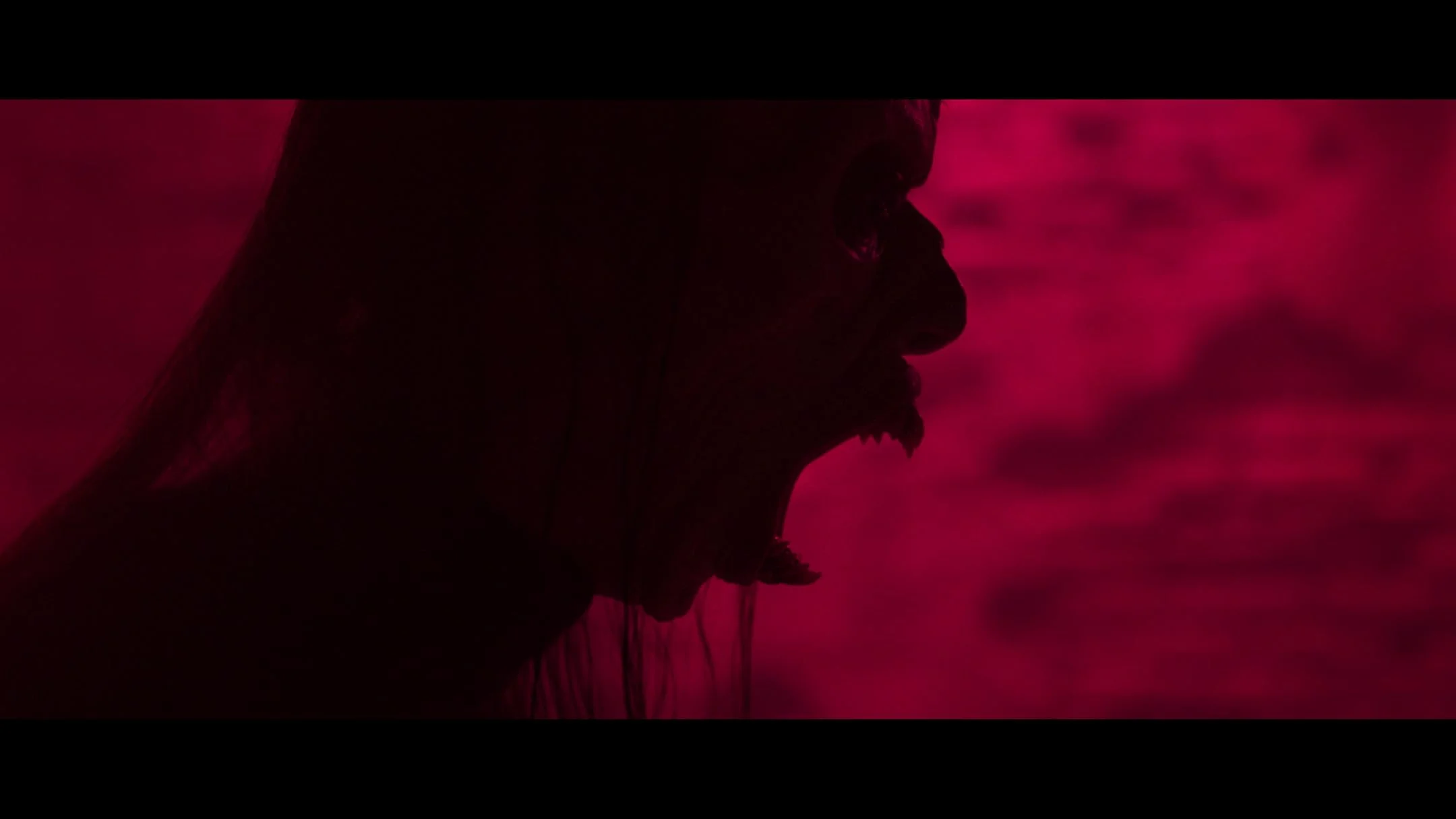
Ross is much better at showing the Seer than explaining him. Early appearances reduce the creature to partial movement: a silhouette beyond a room, a shape withdrawing from sight, something visible long enough to make a character question what was seen. Those images exploit the vulnerable geography of nighttime interiors, where an ordinary hallway can suddenly feel several feet longer.
The dream passages adopt grainy textures, restricted viewpoints, and abrupt cuts that resemble first-person horror games such as Amnesia or P.T. Riley is frequently denied a stable view of the space around her, so each corner carries the possibility of discovering that the threat has already moved closer.
Once the Seer appears clearly, some of that menace evaporates. The chalk-white face and taloned form are familiar horror iconography, less disturbing than the suggestion of him disappearing behind furniture or standing somewhere the camera cannot quite resolve.
Ross compensates with physical violence. The eye mutilations are staged with enough force to puncture the quieter stretches, creating a rhythm that shifts between waiting and eruption. Some visual effects expose the film’s limited resources, yet the framing around them often remains disciplined.
The actors keep the supernatural machinery attached to human behaviour. Barrington gives David’s return a guarded quality rooted in what he witnessed ten years earlier. Brown makes Cam convincing as the accommodating boyfriend before his family history changes his position inside the story. Stewart enters late but gives the curse a human source of anger rather than leaving the Seer as an arbitrary monster. Ross’s most revealing choice may be his simplest one: whenever the creature retreats into shadow, the film grows more frightening. Whenever someone turns on the explanatory light, the room gets smaller.
Parasomnia premiered at FrightFest on August 22, 2025, with theatrical and streaming distribution through Shudder. The horror film follows a young woman tormented by debilitating night terrors who suspects that a malevolent demonic entity from her dreams has slipped into the waking world.
Where to Watch Parasomnia (2025) Online










Full Credits
Title: Parasomnia
Distributor: Shudder
Release date: August 22, 2025 (FrightFest)
Running time: 1 hour 25 minutes
Director: James Ross II
Writers: James Ross II
Cast: Jasmine Mathews, R.J. Brown, Sally Stewart, Simon Longnight, Stephen Barrington
The Review
Parasomnia
Parasomnia is strongest when sleep feels like a breach in the walls between private terror and inherited violence. James Ross II turns Riley’s rigid bedtime rules, the Seer’s partial appearances, and the film’s eye-gouging rituals into a sharp language of fear. The later mythology is less persuasive, especially once Cam’s mother arrives carrying a heavy load of exposition. Still, Jasmine Mathews gives Riley enough emotional gravity to keep the film from dissolving into lore. Ross’s debut shows real control over darkness, perspective, and dread, even when the script explains too much.
PROS
- Strong shadow-driven horror
- Mathews’ grounded performance
- Effective nonlinear structure
- Memorable eye-gouging imagery
- Confident feature direction
CONS
- Late exposition dump
- Familiar creature design
- Some rushed mythology
- Uneven visual effects