



























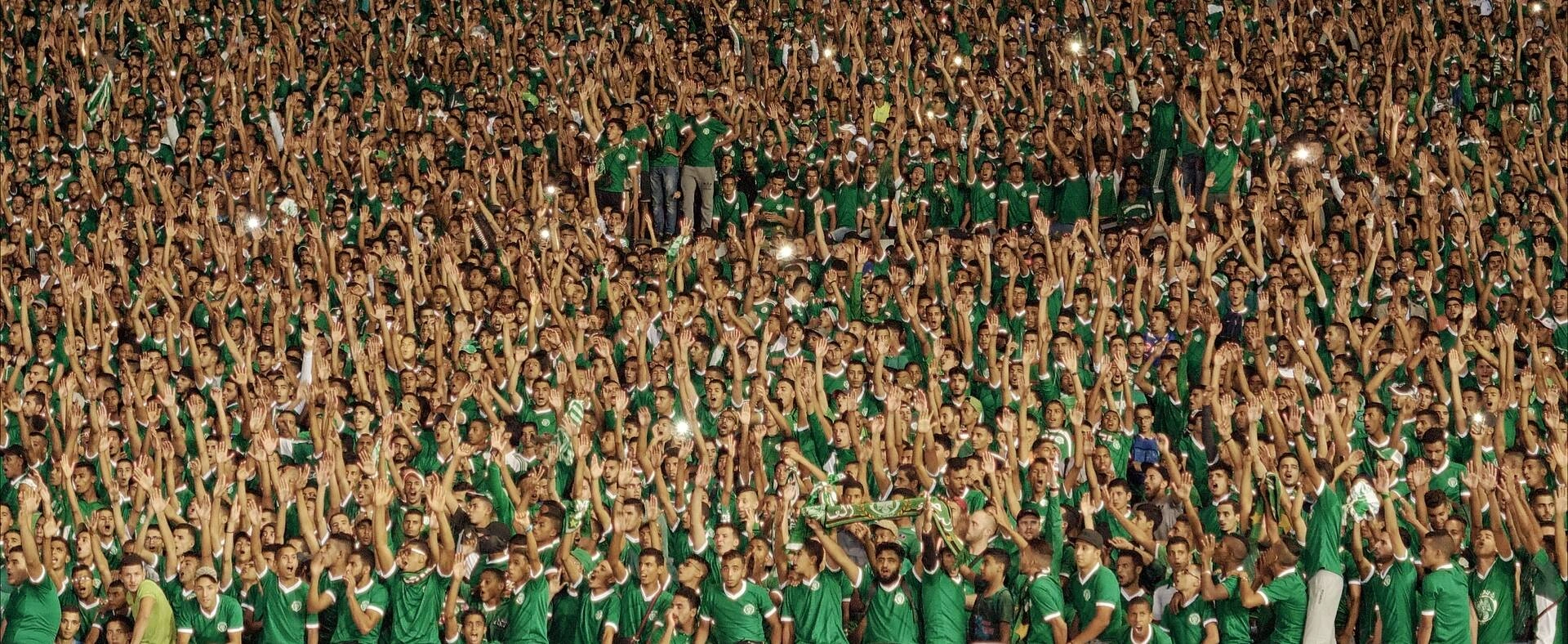

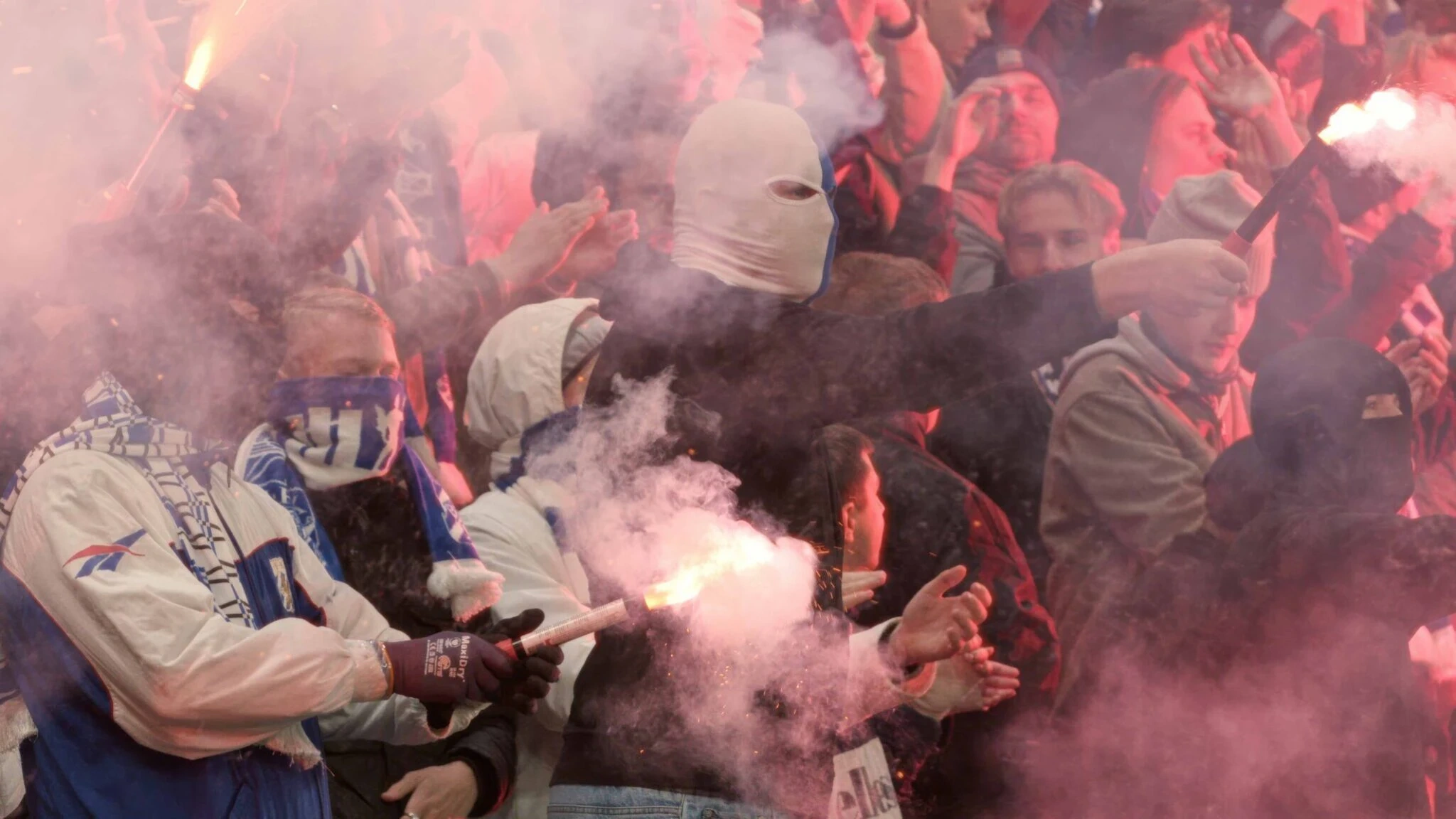
Ragnhild Ekner keeps the football match at the edge of the frame, then lets the terrace take over the movie. In Ultras, players, tactics, managers, scores, and league tables barely matter. The real action happens behind the goal, where bodies press together, drums set the tempo, flares turn the air red, and a chant can make a stadium feel like a living machine.
Ekner, a Swedish filmmaker and IFK Göteborg supporter, has made a documentary about football’s most devoted fan subculture, filmed across eight countries and four continents. The film travels through Sweden, Italy, Poland, the UK, Morocco, Egypt, Argentina, and Indonesia, tracing the ways ultra culture mutates from place to place while keeping the same pulse. The term comes from Italy, but Ekner treats the movement less like a national export than a shared human language: paint, smoke, song, sweat, loyalty.
Her smartest formal choice is simple and effective. There are no standard talking-head interviews. Voices speak over crowds, streets, banners, and stadium rituals, which means individuals are present through memory and feeling, while the image remains loyal to the collective. For a film about people losing themselves inside a crowd, that choice does a lot of work.
Art That Disappears
The documentary is at its best when it slows down enough to show the labor behind the noise. The recurring sequence devoted to a Gothenburg tifo gives the film one of its clearest arguments. Supporters spend an estimated 2,200 hours and around €30,000 worth of donated labor and materials on a giant handmade display. They paint, plan, measure, fold, and coordinate something that will exist in its full form for only a few minutes on matchday.
I love that Ekner does not treat this as quirky fan trivia. She understands it as temporary art. The camera watches hands working on fabric, then later sees the finished banner unfurled across a mass of supporters. The payoff is visual, but the meaning comes from the effort. Nobody is being paid. Nobody is building a brand asset. The work is done because the club and the crowd have become part of the same private mythology.
The Indonesian sequences push that idea into pure choreography. PSS Sleman fans raise sheets of paper in perfect formation, turning the stand into a huge pixelated display. This is the kind of crowd image that can sound chaotic when described and feels precise when seen. Ekner’s camera catches the scale, while the sound mix keeps the chanting thick and physical. You do not simply watch the supporters perform. You feel how hard it would be to stand outside that rhythm once it has started.
Belonging With Volume
Ekner’s narration frames ultra culture as resistance against loneliness, and the film finds its strongest emotional proof in the stories that cut through the spectacle. An Argentinian Nueva Chicago supporter describes how the fan community helped her survive the grief of losing her son. A Polish supporter speaks about the terraces as a place where anger could be released without curdling into private damage. In Indonesia, young Muslim women claim space inside a fan culture often assumed to belong to men.
Those stories keep the film from becoming a highlights reel of flares and flags. They also help explain why the football itself can feel secondary. The team gives the group a name, a crest, and a weekly ritual, but the deeper attachment is to the people gathered around it.
The film keeps returning to the idea that strangers can become kin through repeated acts of devotion: painting banners, learning chants, traveling together, standing in bad weather, showing up again after a loss.
The UK passages sharpen the anti-commercial thread. At smaller clubs like Eastbourne and Clapton, supporters describe non-league football as a refuge from the Premier League’s managed silence and rising costs. One man talks about top-flight matches becoming sanitized and quiet, a complaint the film visualizes through contrast rather than lecture. The non-league stands look rougher, looser, warmer. Pints are held. Songs are bawled. Nobody appears worried about matching a broadcast package.
Politics in the Crowd
The film also knows that crowds do political work, sometimes by accident and sometimes with clear intent. In Morocco, chants become a way to speak about poverty and state pressure. In Egypt, the section on Al-Ahly supporters connects ultra organization to protest culture around Tahrir Square. Ekner’s treatment of the 2012 Port Said Stadium massacre is the documentary’s darkest passage, with one interviewee’s voice modified for anonymity and the deaths framed through police hostility and state power.
This is where the film becomes both stronger and less satisfying. Stronger, because it understands that ultra culture cannot be reduced to hooliganism when fan groups have also carried grief, dissent, and mutual aid. Less satisfying, because Ekner’s love for the culture sometimes keeps her from pressing harder on its ugliest forms.
The documentary acknowledges danger, yet its attention often moves away before the difficult questions fully land. Far-right affiliations in parts of European fan culture receive far less scrutiny than they need. Racism, anti-Semitism, homophobia, and sectarian hatred have shaped some football terraces in ways that cannot be treated as side noise.
The film’s images of coordinated masses, billowing flags, smoke, drums, and raised arms can feel liberating in one context and authoritarian in another. Ekner captures the beauty of collective force, but she rarely asks enough about the fantasies that force can serve.
The gender question has a similar gap. The Indonesian women’s sections are warm and thrilling because they show young fans entering public space with confidence. Then the film brushes against macho codes elsewhere, including female supporters who must adapt themselves to male norms, and it does not stay there long enough. A documentary this interested in belonging should spend sharper time on the price of entry.
Still, Ultras has real power because its craft makes the argument before the narration does. The chants roll like weather. The tifos rise and vanish. The crowd becomes shelter, artwork, weapon, choir, and risk, sometimes in the same breath. Ekner may look too gently at the culture she loves, but she makes clear why people give themselves to it with such ferocious care.
The sports culture documentary Ultras debuted at the Visions du Réel film festival in April 2025 before securing its commercial theatrical release in the United Kingdom via Bulldog Film Distribution on April 24, 2026. Audiences can watch the film in select cinemas or stream it on major digital platforms, including Amazon Video and Apple TV. The non-fiction feature provides an inside look at extreme football fanatics across four continents, exploring how these highly dedicated supporter groups influence and reflect the societies around them.
Where to Watch Ultras (2025) Online
Full Credits
Title: Ultras
Distributor: Bulldog Film Distribution, Autlook Filmsales
Release date: April 2025 (Visions du Réel Premiere), April 24, 2026 (United Kingdom Theatrical Release)
Rating: PG
Running time: 89 minutes
Director: Ragnhild Ekner
Writers: Ragnhild Ekner
Producers and Executive Producers: Tobias Janson
Cast: Ragnhild Ekner
Director of Photography (Cinematographer): Ania Winiarska
Editors: Sofie Steenberger
Composer: Story AB Production Sound Team
The Review
Ultras
Ultras is a sweeping, sensory documentary that understands fan culture first through sound, motion, and shared labor. Ekner’s best passages, from the handmade Gothenburg tifo to the paper-card choreography in Indonesia, show how football support becomes art, refuge, and protest at once. Its weakness is real: the film softens the violence, macho codes, and far-right stains that cling to parts of ultra culture. Still, it explains why the crowd can feel like home without pretending the home is spotless.
PROS
- Spectacular stadium footage
- Strong tifo sequences
- Rich global scope
- Moving grief and belonging stories
- Smart no-talking-heads approach
CONS
- Softens hooliganism
- Underexplores far-right links
- Gender contradictions need sharper focus
- Loose topic jumps
- Admiration narrows scrutiny