


























The six-episode French HBO Original miniseries The Seduction, premiering November 14 on HBO Max, returns to the snare-and-parry world of Les Liaisons Dangereuses with fresh intent and an expensive wardrobe.
The story’s history on screen stretches from Dangerous Liaisons to Cruel Intentions, and the new version steps back into pre-Revolutionary salons where power runs on flirtation, favors, and carefully sharpened whispers.
The focus lands on political maneuvering and social manipulation driven by desire and betrayal. The series reframes the material as a psychological inquiry into trickery, old wounds, and the slow poison of malice. The games still hurt; the camera watches the bruise form.
The Price of a Libertine’s Freedom
The narrative follows Isabelle de Merteuil after a personal rupture with Sébastien de Valmont. From that cut, she builds a plan. She climbs, tool by tool, toward the position of Paris’s most sought-after courtesan, with guidance from Madame de Rosemonde, played by Diane Kruger.
The structure tracks that ascent with steady clarity. The theme sits plainly in view: freedoms granted to libertines do not match across gender, and consequences do not land in equal measure. The imbalance comes across with the bluntness of a ledger.
The show frames female empowerment through survival tactics shaped by a male-designed order. The idea holds weight, yet the execution narrows the frame. Sex so often operates as the only coin that agency starts to feel like a taxed commodity.
The struggle reads somber where it could sting. Pacing never breaks stride, but the emotional pulse runs light. The promised scorch of ruinous desire flickers, then a late spark in the final episodes bumps the intrigue. Call it a slow burn that keeps misplacing the match.
The Players and the Standouts
Period drama thrives on layered characters, and many here run on cleanly drawn gears. Valmont, for one, often reads as the mechanism rather than the man. His tussle with Comte de Gercourt, played by Lucas Bravo, carries tension on paper yet wants a deeper internal motor.

Isabelle de Merteuil keeps her cards close. She masks her wounds while laying traps. Anamaria Vartolomei supplies poise and bite, proof of range and control, though the character’s turn to ruthlessness lands in a single hard pivot rather than a string of steps. The line between victim and architect snaps into place a bit too quickly.
Vincent Lacoste’s Valmont plays the practiced charmer with a private ledger. His feelings for Merteuil stay hazy by design, which suits his taste for games. The surprise live wire comes from Lucas Bravo as Comte de Gercourt. He loosens the image from earlier romantic parts and leans into a polished, vindictive aristocrat shaped by self-interest.
The performance is crisp, mean, and fun to watch, like a smile that never reaches the eyes. Diane Kruger brings cool precision as Merteuil’s mentor. Noée Abita gives Madame de Tourvel grace and sensitivity, though the role receives limited space, which trims the contrast with Merteuil that the story hints at. You can see the counterpoint the show wants; you just do not hear it long enough.
Technical Grandeur, Emotional Chill
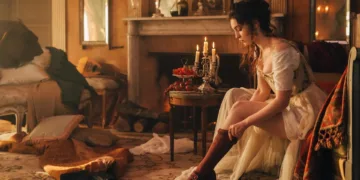
The series looks extraordinary. Director Jessica Palud gives each of the six episodes a big-screen finish, favoring meticulous compositions and patient camera movement. Lighting carves faces and silk with painterly care. One image of Valmont, poised between curtains, could hang beside an 18th-century portrait without raising an eyebrow. French-language dialogue and location shooting add texture that feels lived-in rather than staged. The craft speaks with confidence. The furniture has opinions.

The sexual content aims for maturity and lands there. Lust plays as a transaction of leverage, with bodies trading status and safety along with pleasure. A contradiction keeps humming underneath: the scandal promises heat, and the acts often sit at a mild temperature. Schemes unfold with cool calculation, which suits the characters’ polish, yet the air rarely crackles. Performances and visuals keep the series afloat and sometimes glide it forward. They give shimmer and shape. The missing piece is the constant thrum of feeling that turns a well-plotted gambit into a gasp.
The Seduction reaches for a fresh angle on a familiar duel of love and power, pairs that never stop circling each other on television. The question is simple and sharp: in a world built on performance, who controls the spotlight long enough to win the scene?
The Seduction (French title: Merteuil) is a six-episode French historical drama series freely adapted from the classic 1782 novel Les Liaisons Dangereuses by Pierre Choderlos de Laclos. The series centers on Isabelle de Merteuil, who is betrayed by her lover Vicomte de Valmont and begins a daring quest for power by seducing her way up the social ladder to become Paris’s leading courtesan. It premiered on November 14, 2025, and is available to watch on HBO Max (Max).
Credits
Title: The Seduction
Distributor: HBO Max
Release date: November 14, 2025
Rating: TV-MA
Running time: 6 episodes (Approx. 52 minutes per episode)
Director: Jessica Palud
Writers: Jean-Baptiste Delafon, Jessica Palud, Gaëlle Bellan
Producers and Executive Producers: Clément Birnbaum, Joachim Nahum, Marie Guillaumond
Cast: Anamaria Vartolomei, Diane Kruger, Vincent Lacoste, Lucas Bravo, Noée Abita, Fantine Harduin, Samuel Kircher, Sandrine Blancke
Director of Photography (Cinematographer): Florian Sanson
The Review
The Seduction
The six-episode series excels in technical execution, boasting cinematic visuals and striking performances, particularly from Anamaria Vartolomei and Lucas Bravo. Its attempt to ground the classic Liaisons Dangereuses story in psychological exploration is commendable. However, the narrative’s emotional temperature often runs cold. The series effectively dissects power dynamics, but it sacrifices character dimension and palpable stakes, leaving the viewer admiring the scenery while wishing for more fire and substance.
PROS
- Exquisite, cinematic visual style and direction.
- Strong, committed central performances, especially from Vartolomei and Bravo.
- Intelligent reconfiguration of the classic source material's plot.
- Thoughtful exploration of gendered power dynamics among the aristocracy.
- Impeccable costume design and on-location French setting.
CONS
- Lack of visceral emotional connection and low narrative stakes for most characters.
- The sexual seductions, despite being explicit, lack savvy or intensity.
- Many characters lack unique, dimensional identities outside of their scheming roles.
- The thematic critique of female empowerment through sexuality feels limited and sometimes dour.