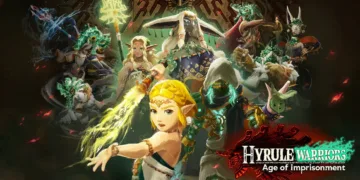

























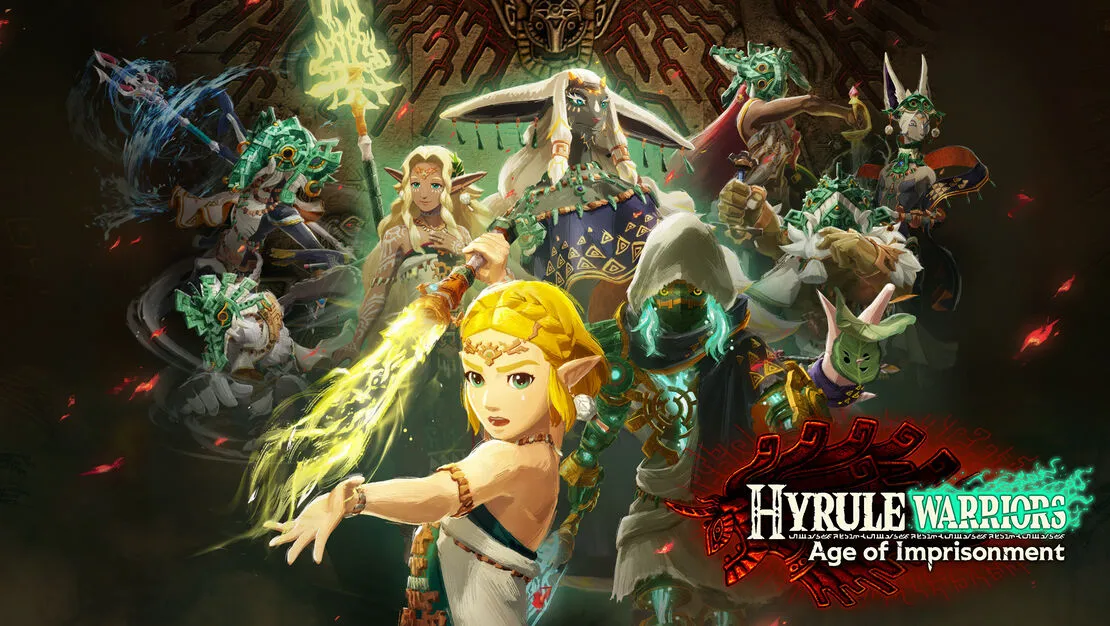

Hyrule Warriors: Age of Imprisonment positions itself as a direct canonical prequel to The Legend of Zelda: Tears of the Kingdom. It charts the Imprisoning War, a tragic era previously shown through fragmented flashbacks. The hack-and-slash structure places Princess Zelda at the center, following her accidental time travel and her effort to help a fledgling Hyrule secure alliances against Ganondorf’s spreading malice.
As a musou title, it asks players to cut through large enemy forces in broad battles. Developer Koei Tecmo adds engagement to a repetition-prone format with systems that encourage planning and a story that clarifies existing lore. The tone stays serious while making space for playful beats, which keeps the adventure grand in scale and welcoming in feel.
The Imprisoning War: A Canonical Retrospective
The story begins immediately after Zelda’s time shift, with Rauru and Sonia finding her in the ancient past. The primary thread focuses on building political and military alliances across regions such as Zora’s Domain and Death Mountain. Its strongest narrative move is to give names and shape to the historical figures of this era.
Qia the Zora Queen, the Korok Calamo, and Goron Chief Agraston gain definition, which supplies personality and real stakes to the conflict. Faces and voices appear where memory once stood alone, and the result carries emotional weight. Canon places firm rails on the arc.
Ganondorf’s rise and several key triggers are already known from Tears of the Kingdom, so the pace settles into deliberate rhythms and predictable turns. Long cutscenes deliver key dialogue, and even player movement slows at times so scenes can land. The structure prioritizes gravity and asks players to focus on the path taken to reach a foreknown endpoint.
Musou Refinement and Elemental Synergy
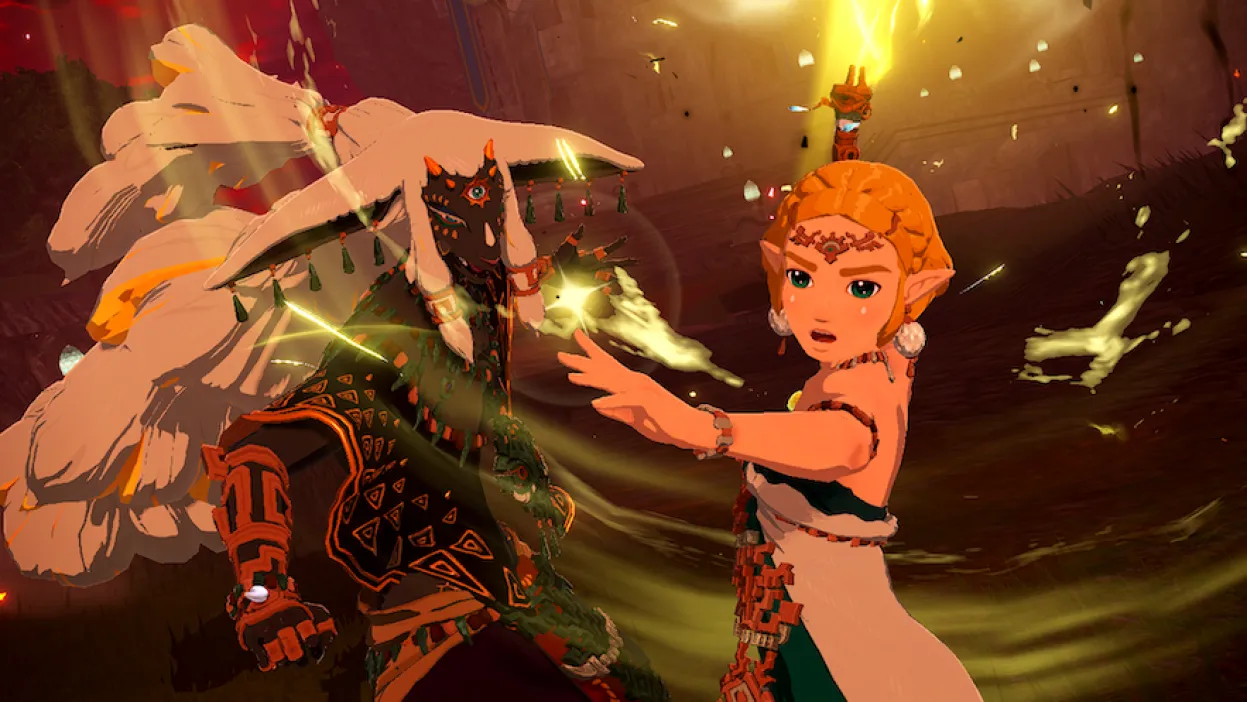
Combat follows the familiar musou template, with light and heavy strings, weak point smashes, and a constant flow of foes. Inputs feel snappy, which supports the 1-vs-1000 fantasy. A deeper elemental layer drives many decisions in the thick of battle.

Fire, ice, and lightning weaknesses crack stagger gauges with speed, opening clean windows for special attacks. Encounters reward choosing the right character or tool for the threat at hand, and the roster backs that up. From Zelda to Mineru, each fighter reads as distinct and invites experimentation. Zonai devices add another tactical tier.
Players deploy gadgets such as flamethrowers or bombs on a rechargeable battery, turning arenas into managed spaces with turrets and traps. Mineru’s auto-build approach further defines her identity through devices.
The Sync Strike mechanic welds theme and system. Swapping characters mid-fight to trigger a coordinated, cinematic strike supports the idea of an army acting in concert. Timed switches replace lone-hero timing with team execution, so major clashes hinge on planned cooperation.
Linear Battlefields and Performance Gains
Missions are chosen from a world map with goals that include capturing outposts and eliminating lieutenants. The minute-to-minute design often narrows those goals into simple tracks. Many stages feel straight and contained, with routes that play like corridors and rooms.
Limited variety and scale undercut the sweeping tale, and earlier entries in the series provide a wider sense of space by comparison. Signature landmarks from Tears of the Kingdom receive light use as primary arenas. The Sky Islands appear most clearly through Flight Mode sorties that play like an on-rails shooter.
These segments create a short break from ground combat, yet their style sits apart from the main loop. Technical delivery offsets that structural shortfall. Performance marks a large step up from the prior game. Docked mode holds a smooth 60 frames per second with only minor dips during heavy action. Stable output lets the art style stand up under crowd density and preserves the feel of the refined combat systems without distraction from frame pacing or slowdown.
The Review
Hyrule Warriors: Age of Imprisonment
Hyrule Warriors: Age of Imprisonment succeeds as a necessary expansion of the Zelda universe. Its canonical story effectively builds out the Imprisoning War, giving depth to Rauru and the ancient Sages. The combat is the best the musou series has offered, enhanced by fluid performance and clever use of Zonai tactics and Sync Strikes. However, the experience is hampered by overly linear missions and limited map scope, preventing it from achieving a true sense of scale. It is a triumphant prequel for series fans.
PROS
- Excellent 60 FPS technical performance
- Canonical lore expansion is substantial
- Deep, satisfying musou combat
- Strategic use of Zonai devices
CONS
- Linear, repetitive mission structure
- Maps and environments lack scope
- Story beats are often predictable
- Sky/Depths zones are underused