





























A floating banana photographer, snapping selfies of its own peels, stands guard outside the Elmore Junior High yearbook club. That small act of self-adoring absurdity sets the tone for season two of The Wonderfully Weird World of Gumball on Hulu, where the series sustains the familiar narrative fingerprint associated with creator Ben Bocquelet.
The stories stay anchored to the Watterson household: Gumball, a blue cat, and his brother Darwin, a goldfish who developed legs, carry the pressure of each twelve-minute segment. Their daily life treats domestic stability as a rumor, with Anais supplying the sharp intellect at their side and parents Nicole and Richard filling the home with emotional ricochets and logistical collapse.
Alkaio Thiele voices Gumball, Hero Hunter voices Darwin, and the wider cast includes Kinza Sayed Khan, Teresa Gallagher, and Dan Russell. The episodes move at a sprint, with jokes that slice through family friction and community irritations without pausing to catch breath. Across twenty stories, the season operates as a set of standalone vignettes that still thicken the internal history of Elmore, keeping the Wattersons in constant contact with the town’s wider population and letting familiar school faces remain active engines of the unfolding nonsense.
The Kinetic Polyphony of Mixed Media
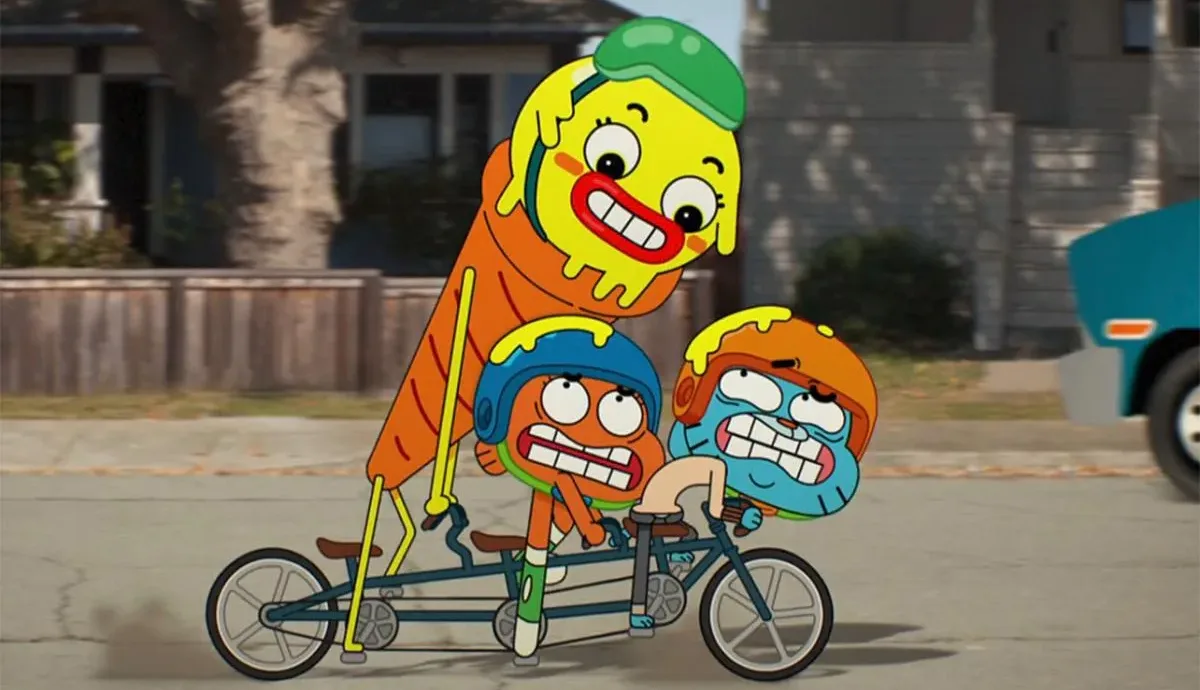
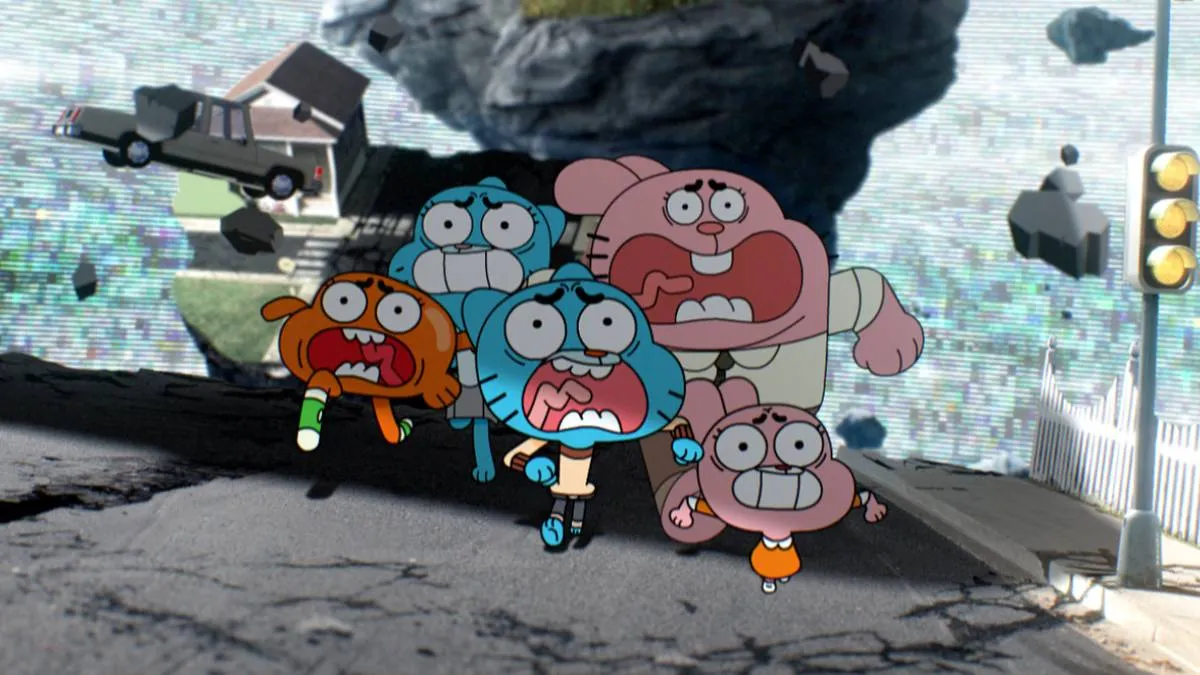
The series’ visual identity thrives on collision. Hand-drawn 2D figures share space with 3D computer-generated models and live-action photography, and that deliberate mismatch grants each resident of Elmore a specific material presence. Banana Joe reads as a three-dimensional piece of fruit. Masami arrives as a simple cloud. Set against real-world photographic backgrounds, these mismatched bodies create a grounded chaos: the environment feels touchable while its inhabitants break every rule that would normally govern it.
The mixed-media approach fractures the world into competing textures, a formal echo of fractured modern attention, where the eye keeps switching channels even while staring at a single frame. Elmore’s citizens look like arrivals from different television networks, locked into the same shot by force of format. The density of visual information demands constant focus, as if the show expects the viewer to keep up with an argument being made through materials and movement.
Certain segments lean into the medium’s memory with clear intent. In “The Unfollow,” the protagonists shift into a style reminiscent of early twentieth-century cinema, adopting a fluid hand-drawn look that leans on classic squash-and-stretch technique associated with the early Disney era. Motion turns bouncy and elastic, with bodies behaving like rubber and timing behaving like music.
“The Synthesis” introduces another sharp stylistic pivot during a confrontation between Nicole Watterson and Yuki Yoshida, using the visual language of Japanese anime. Dramatic shading and high-speed motion lines push the sequence toward the intensity of a shonen battle: designs sharpen into angular shapes, and the background collapses into streaks of light. The change arrives without warning, keeping the viewer in a steady state of visual alertness, where a scene can reformat itself mid-thought.
Character design keeps functioning as a primary instrument of expression. Secondary figures such as Mr. Small appear built from plush-like material, while others register as puppets or photorealistic household objects. Each choice strengthens the town’s unpredictable atmosphere, and the visual style shifts to match a scene’s emotional temperature. The constant flux blocks the eye from settling into a stable rhythm and keeps attention pinned to the screen’s textures. Animation becomes a playground of options, with the season holding onto that restless experimentation across all twenty episodes.
Live-action background elements sharpen the separation from the colorful protagonists, amplifying the strangeness of bodies that feel dropped into a mundane world. Lighting and shadows often appear carefully rendered to help these clashing styles share a single space, and the attempt to blend puppet-like movement with CGI models signals technical ambition. Frames arrive packed with small details that reward repeat viewing, since the show treats visual overload as part of the joke and part of the world’s logic.
Satirical Lenses on the Digital Age
Season two keeps returning to contemporary social habits through sharp exaggeration. “The Unfollow” examines the hunger for digital validation by pushing it into crisis: Gumball and Darwin spiral into an identity collapse after Sarah, their dedicated stalker, removes them from her social media feed. The plot captures the warped logic of internet fame, where attention holds value even when it arrives in ugly forms, and being ignored carries the sting of erasure.

The narrative also engages with the spread of artificial intelligence, presenting characters who lose themselves in pursuit of AI-generated perfection. Sarah shifts from stalking real people to fixating on a digital fox, and that move frames modern technology as isolating, pulling attention away from physical life and into curated reflections. The characters become absorbed by what their screens say they are, treating the digital mirror as the only mirror that matters.
“The Labels” turns social expectation into a literal device. A school counselor applies physical tags to students and teachers, and the tags force them into roles defined by whatever word sits on their bodies. External categorization becomes an engine that dictates behavior and shrinks agency. Gumball chooses to lean into his assigned “bad” label, transforming himself into a social media influencer, presented here as the peak expression of vacuous modern existence.
The episode’s critique targets society’s urge to reduce complex people into quick descriptors, then treat those descriptors as destiny. Even flattering labels carry damage, since they lock individuals into a narrow script. The tags become a physical prison, shaping how characters move and speak, turning social pressure into choreography. That literalization functions as a signature move for the show, using cartoon logic to expose how easily identity becomes a costume handed out by institutions.
“The Sonder” shifts attention to background narratives and narrative entitlement. Gumball begins experiencing the hidden histories of strangers on a bus, and the episode mocks the storytelling habit that assumes every person carries a secret tragic origin designed for emotional payoff. By revealing that some people are simply existing without grand narrative architecture, the series pushes back against clichés that modern drama keeps recycling.
The commentary points toward the observer’s ego, where the urge to assign meaning to strangers functions as a projection rather than insight. People receive permission to exist without being drafted into protagonist status. A sequence involving the bus driver and a princess sharpens the parody: the driver’s heartbreak is staged like an epic, then re-framed as ordinary life. The episode argues for the value of the ordinary, with no mandatory trauma required for a person to count.
Rituals of the Suburban Absurd
Darwin becomes a pivot point for the season’s interest in school social structures. In “The Summoning,” he is drawn into a secret student coven made up of Masami, Teri, and Clare, who use occult rituals in an attempt to control the school yearbook. The plot plays as a parody of supernatural cinema, with a specific nod to the aesthetics of the nineties. Darwin’s relentless positivity works as a foil for the group’s darker intent, presenting optimism as a disruptive force capable of short-circuiting sinister plans.
The episode mentions his relationship with a ghost as a comedic explanation for his ease with the supernatural, and the image of a fish practicing witchcraft is treated with a straight face. That commitment to the premise is the mechanism that makes the comedy hit, since the show refuses to blink at its own ridiculousness.
Holiday structures become a way to explore communal stress. “The Cheapmas” follows Elmore’s residents wrestling with the financial weight of Christmas, drawing humor from the tension between festive desire and economic scarcity. Santa Claus appears working multiple jobs to stay afloat, a detail that grounds the holiday fantasy in harsh material reality.
“The Fools” watches social order collapse during an April Fool’s Day prank war, turning a calendar date into a fuse for civic disaster. These episodes use public rituals to expose the town’s volatility, where a small joke can swell into municipal catastrophe. The escalating pranks read as commentary on competition itself, with residents willing to wreck their environment for the satisfaction of winning a meaningless game.
Domestic rivalry keeps supplying narrative fuel. The friction between Nicole Watterson and Yuki Yoshida stands out, dominating “The Synthesis,” where a routine school career day becomes a staged battlefield powered by competitive drive. That scale of conflict sits beside quieter failures from Richard and Anais, and the parents spend much of the season reacting to the children’s frantic momentum, feeding a cycle of household escalation.
The family unit emerges as a site of constant negotiation, with occasional spectacular collapse built into the rhythm. The children repeatedly end up solving problems created by adults, and that reversal deepens the family dynamic by treating maturity as a behavior rather than an age bracket. The Wattersons remain chaotic, and they remain functional, in the specific way Elmore defines functionality.
The Scripted Abyss and the Meta-Void
“The Rewrite,” the season finale, brings back Rob as the franchise’s primary antagonist. He appears aligned with the owner of the Awesome Store, a figure that has hovered at the edges of the show’s logic, and their alliance centers on manipulating the literal screenplay that governs Elmore’s citizens.

Treating the script as a physical object turns storytelling into a fight for survival, since they work to keep the fictional world from being consumed by an encroaching nothingness. The boss of the Awesome Store is positioned as a significant player in Elmore’s fate, operating as a bridge between the mundane town and the cosmic horror of the Void.
Self-awareness becomes a tool for staying alive as characters begin naming the inconsistencies of their existence. They comment on shifting octaves in their voices and notice subtle redesigns in their physical forms across the years. The meta-humor points directly at the reality of a long-running animated series, where time appears through technical updates rather than biological growth.
Elmore’s logic reads as a fragile construction held together by audience attention and adherence to narrative rules. Characters realize they never celebrate birthdays, and that recognition sharpens the static nature of animated sitcom life, trapping them in perpetual childhood. The season uses that stasis to generate existential unease, treating the lack of growth as a kind of quiet horror.
The Void functions as a graveyard for forgotten ideas and cancelled projects, and the finale uses it to confront the threat of a series ending. Survival becomes tied to studio guidelines, since the characters must stay relevant inside the plot to avoid being swallowed. The choice connects the season’s present to unresolved tensions from the original series, framing existence as a battle against story’s end. The narrative presents interest as a lifeline: characters remain safe when they remain interesting, and the cycle of renewal continues.
A plot hole becomes a literal obstacle, something that must be crossed through narrative importance. The high-concept approach separates the show from conventional children’s programming by asking questions about reality and the value assigned to a story. The final moments keep the door open to future conflict: Elmore stands intact for now, with the threat of the script’s end still hanging in the air.
The second season of The Wonderfully Weird World of Gumball premiered on December 22, 2025. As a direct continuation and revival of the original cult classic, this season further explores the surreal adventures of the Watterson family in the town of Elmore. In the United States, all episodes are available to stream exclusively on Hulu and the Hulu on Disney+ bundle. International audiences can watch the series on Cartoon Network and HBO Max, with the second batch of episodes rolling out globally in early 2026. The series remains a standout for its innovative blend of 2D, 3D, and live-action animation styles.
Full Credits
Title: The Wonderfully Weird World of Gumball
Distributor: Hulu, Cartoon Network, HBO Max
Release Date: December 22, 2025
Rating: TV-PG
Running Time: 11 minutes
Director: Matt Layzell, Erik Fountain, Luke Allen, James Lancett
Writers: Ben Bocquelet, Todd Michael McClintock, Bryan Caselli, Jessica Combs, Michele Cavin, Joe Parham, Joe Markham, Tobi Wilson
Producers and Executive Producers: Ben Bocquelet, Matt Layzell, Erik Fountain, Sarah Fell, Sam Register, Emma Fernando, Ryan Slater
Cast: Alkaio Thiele, Hero Hunter, Kinza Syed Khan, Teresa Gallagher, Dan Russell, Max Cazier
Director of Photography (Cinematographer): Joe Sparrow (Art Director)
Editors: Andy Goodman, Steve Hughes
Composer: Xav Clarke, Ben Locket
The Review
The Wonderfully Weird World Of Gumball Season 2
This second season of The Wonderfully Weird World of Gumball maintains its status as a premier example of subversive animation. By balancing hyper-kinetic mixed media with a sophisticated critique of digital culture and narrative tropes, the series avoids the staleness often found in long-running revivals. The writing remains sharp, utilizing its meta-framework to explore existential themes while keeping the domestic chaos of the Wattersons grounded in recognizable family friction. It is a dense, imaginative, and intellectually honest expansion of the Elmore universe that rewards attentive viewers.
PROS
- Exceptional use of mixed media to create a distinct visual identity.
- Sharp, relevant satire regarding social media and AI culture.
- Meaningful expansion of the show's long-term meta-lore.
- High production value in genre-specific parody sequences.
CONS
- Occasional reliance on dated internet memes.
- The rapid pace can feel overwhelming during binge-watching.
- Some secondary characters receive limited screen time.
- The release schedule can make holiday themes feel ill-timed.







