
























![Kingdom Hearts Collection [I-III] Review](https://gazettely.com/wp-content/uploads/2026/10/Kingdom-Hearts-Collection-I-III-1-360x180.webp "Kingdom Hearts Collection [I-III] Review: KHII Holds Steady as Newer Entries Fluctuate 37")





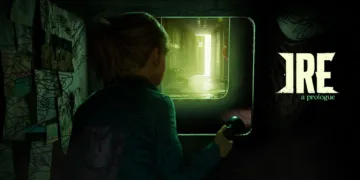
The Bermuda Triangle myth gives Ire: A Prologue a charged stage for a psychological endurance test. You play through Emily’s eyes as she boards her father’s expedition ship in search of a missing crew. The vessel, Emily’s Dream, reads like a floating mausoleum for remembered pain. It hangs still inside an isolation that feels endless, with ink-stained corridors and traces of an earlier struggle pressed into the metal. Moving through tight, light-starved passageways, Emily learns that this mission tracks two routes at once: the practical hunt for answers about the crew, and a more intimate pursuit of her own history.
The game leans hard on sustained tension. Emily speaks constantly, reacting to what she sees and hears, and that steady vocal presence pulls the player into her fear and disorientation. Progress is organized around thirteen numbered doors, each one framed as an entry point into pieces of her subconscious. Survival depends on staying out of reach of a single roaming entity that patrols the ship. Stealth becomes the language of play, and reconstruction becomes the larger purpose, with each step forward tied to piecing together what pushed this expedition into silence.
Architectural Memory and the Thirteen Portals
The thirteen doors form the spine of the story’s structure. Each numbered threshold stands for a distinct shard of Emily’s memory, turning progression into a guided walk through internal fragments. Opening them requires meeting specific conditions pulled from the captain’s logs, which ties the act of remembering to the act of reading, checking, and proving you belong in the next space. When a door flashes green light, it signals a return to the start of the loop. The result echoes the cinematic idea of a dream nested inside another dream: each passage forward doubles as a drop deeper into a mind trying to surface what it buried.
That loop structure also shapes the game’s rhythm. It shifts between high-tension horror and a gentler “cozy horror” mode when Emily drifts into memories of her father. Those stretches slow the pulse for a moment, offering relief from the constant pressure created by the monster’s presence. Emily’s voiced performance anchors these tonal swings. Her delivery brings warmth and vulnerability into a cold shell of steel and ink, making the environment feel less like a neutral level and more like a lived-in interior that remembers.
Exploration carries narrative weight through collectibles. Notes and cassettes sketch out the crew and the path the expedition took toward collapse, making those finds necessary for following the plot. The hunt for them turns every search into a psychological excavation, with cabinets, corners, and side rooms functioning like filing drawers for a damaged mind. The game avoids leaning on cheap jolts. It commits to atmosphere, to the heaviness of what came before, and to the Bermuda Triangle mystery as a shared mythic frame that can hook players across different horror traditions.
The Vessel as a Haunted Microcosm
Emily’s Dream is a small yacht, reshaped into a compact world that supports repeated returns and incremental unlocking. The progression model recalls Resident Evil: you circle familiar rooms, then reopen them with keycards that reveal fresh routes. That pattern teaches the ship the way a city teaches a commuter. Shortcuts become knowledge you earn, and hiding spots become tactics you internalize. The map stays modest, with two floors and a limited set of rooms, yet the layout feels larger through careful spatial framing and how the game pushes you to re-enter areas under new conditions.

The ship’s visual identity is decay. Darkness dominates, and ink stains spread across surfaces like infection. Dead birds scattered on the floor add another note of contamination, suggesting an environment turning against its inhabitants. Storytelling lives in the space itself. Desks, boards, and scattered clues communicate the unraveling of a crew that has begun to lose its grip. The yacht becomes an archive, with each object positioned to imply a prior decision, a rising panic, or a routine that broke.
The architecture reinforces captivity through its looping design. The ends of the map cycle back toward the middle, keeping you close to danger even when you think you have created distance. That structural choice keeps threat as a constant nearby possibility, shaping how you move and how long you dare to stay in any single room. The ship functions like a quiet character, mirroring the rot threaded through the story and treating every corridor as a pressure chamber for memory.
The Inconsistent Ghost in the Machine
The game’s central threat is a monster that seems to blink between presence and absence. Emily has no weapon, so the rules of survival stay focused on concealment. You hide in vents or lockers, and you rely on small tools to redirect attention. Egg timers and thrown items, like rolls of tape, can pull the creature away from your route. The idea is clear: the game wants stealth to feel like problem-solving under stress, with the ship itself serving as your toolkit.

Execution turns uneven once the AI enters the picture. The creature’s behavior can swing from readable to baffling. It may ignore a distraction, or it may investigate a spot far from where the object landed. Its senses can feel erratic, catching you through walls or from another floor in a way that breaks the logic the game asks you to trust. Some encounters collapse into friction rather than fear, especially when the monster gets stuck on geometry or locks itself into patterns that block progress.
A particularly punishing scenario appears when it camps in front of a hiding place. In those moments, the cleanest option may be taking a death simply to reset the situation, which disrupts the fantasy of a careful, no-mistakes run. The game introduces a proximity bracelet late in the experience, giving you a buffer that makes movement feel more manageable.
Before that point, difficulty spikes because the tools meant to support stealth do not consistently deliver. Spaces that look safe, like the cover of an engine block or a counter, can fail to protect you. Emily’s screams when the AI spots her underline that loss of control, turning a stealth plan into a sudden alarm you did not choose.
Technical Craft and the Value of Polish
Unreal Engine underpins the game’s visual sharpness, and the presentation holds steady with few technical blemishes like frame drops. One standout choice is giving Emily a physical body. Her arms and legs remain visible during movement and cutscenes, and that embodiment adds immersion that many lower-budget horror titles skip. The ship gains tangibility through that decision, since you feel placed inside the space rather than floating through it.
Sound design carries much of the dread. Silence and restrained music stretch tension over long walks, and the monster’s footsteps work as practical audio cues for tracking its patrol. The playtime lands around seven hours for a full run, longer than the price might suggest.
At twenty dollars, it presents itself as strong value for horror fans. Replay motivation sits in clean completion goals: finding every collectible, or finishing without dying. Animation work and environmental detail reflect care and attention across the production. The stealth system falters in key moments, and the technical craft still lands as impressive through consistency, clarity, and mood.
The Review
Ire: A Prologue
Ire: A Prologue builds an evocative, localized atmosphere within its maritime setting. The loop-based narrative and "cozy horror" elements offer a fresh take on psychological trauma. Technical friction within the stealth systems frequently breaks the immersion. Inconsistent AI behavior and unreliable distraction tools transform genuine tension into mechanical frustration. It remains a visually polished and affordable entry for fans of atmospheric exploration, provided they can tolerate the finicky stealth. It is a promising start for a new series that requires more refinement.
PROS
- Atmospheric environmental storytelling
- High visual polish for a budget title
- Engaging narrative structure involving memory doors
- Strong vocal performance by the lead actor
CONS
- Unpredictable AI detection and vision cones
- Unreliable distraction items and stealth mechanics
- Significant frustration caused by the monster getting stuck in geometry