























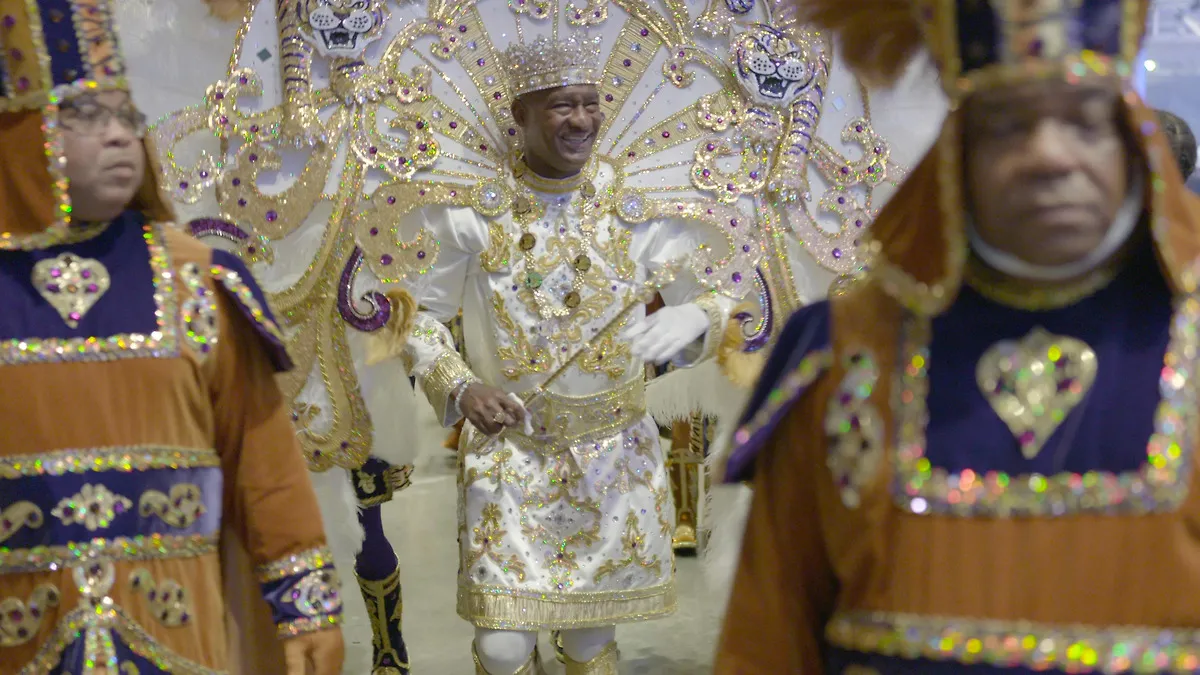

In New Orleans, the air tastes of salt and carries a heaviness that settles on the tongue. The Zulu Social Aid & Pleasure Club endures inside that atmosphere as a living monument, one that keeps breathing through a history that refuses burial. Matthew O. Henderson’s documentary, A King Like Me, observes the fraternity as it prepares for the 2022 Mardi Gras parade, an event shadowed by earlier absences. The naming of a King Zulu arrives with staggering gravity, a title once held by Louis Armstrong, and the film watches how it turns a single man into a symbolic vessel for the community.
After years of forced stillness, the return to the streets feels like a reclaiming of psychic space. Celebration carries necessity in its bones. The fraternity is over a century old, a cultural pillar in a city defined by fluidity, and Henderson keeps his attention on what that permanence costs. Inside the ritual, Black brotherhood pulses alongside the pursuit of joy under historical weight.
The parade reads as defiance against the silence of the previous years, and the crown carries responsibility that sits beside reward. This becomes a study of how an organization anchors its members when the world around them feels fractured, and how joy survives as something practiced, guarded, and passed hand to hand.
The Anatomy of Endurance
Existence in New Orleans can feel like a long negotiation with erasure. The Zulu Club lives with tragedy as a recurring neighbor, and the brotherhood answers with a stoic resolve that looks learned through repetition. During the recent global health crisis, the organization took on a brutal, measurable toll. Out of a membership of 800 men, over 70 contracted the virus and 16 died, leaving gaps in the parade line that no costume can fill. The numbers read like scars on a collective body, and the film treats them as wounds with names, faces, and missing voices.
Grief sits alongside wreckage. Hurricane Ida leaves physical damage behind it. Hurricane Katrina lingers as jagged memory, present in the way people speak and in the way they pause. Man-made sorrow enters too, as gun violence thins the ranks and adds another layer of despair to the disasters. Henderson lets these losses share the same air, and the accumulation creates a dark philosophical pressure: a life measured by what remains after impact, and by the choice to keep moving anyway.
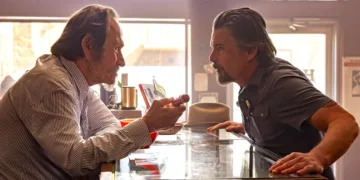
Terrence Rice offers a raw perspective from his own porch, speaking with the weariness of someone who has carried the weight for a long time. He describes the exhaustion that comes with chasing the American Dream while living in a world designed to impede that pursuit. His words hold the psychological cost of being stepped on daily while trying to keep dignity intact and provide for a family.
The club holds tight to the ethos of letting the good times roll, and the documentary presents that ethos as a sophisticated survival strategy, built with intention. Joy becomes a shield held with both hands against a relentless tide of adversity. Henderson treats this section as witness to the labor of hope, a labor that asks for endurance from the body and from the spirit, and offers no easy answers about how long a person can keep paying that price.
Masks of Necessity and Rebirth
The club’s origins reach back to 1909, when a group of laborers known as “The Tramps” began parading with improvised regalia that mocked their own poverty. A lard can served as a crown. A simple banana stalk became a scepter. Henderson presents these objects as evidence that majesty can rise from spirit, and that performance can turn scarcity into ceremony.
From those beginnings grew a mutual aid society that provided essential services such as burial insurance and financial support. In an era when mainstream institutions denied Black residents dignity in life and death, the Zulu Social Aid & Pleasure Club ensured a proper homecoming. In the film’s framing, this is an ethics of care made concrete, a community building its own structures of protection when the world refuses to offer them.
The documentary also examines the complex and often misunderstood history of blackface within the organization. The tradition began as a practical choice for workers who could not afford the expensive manufactured masks worn by wealthier white krewes. Over time, it became a satirical tool used to reclaim and mock the racism of minstrelsy.
The practice remains a point of intense internal debate, carrying the tension between historical reclamation and the weight of American racial imagery. Henderson does not treat this as a tidy lesson. He presents it as a living argument inside a living institution, the past refusing to stay sealed.
During the 1960s, the club faced significant boycotts from civil rights leaders who saw the imagery as regression. The organization persisted through dwindling numbers, and the historic right to parade on Canal Street arrived in 1969. The film frames that moment as a transition from social exclusion toward civic leadership and authority, a shift in where the fraternity could stand and be seen.
Even the famous decorated coconuts carry this logic of resourcefulness. They began as a solution when glass beads were an impossible expense, and they remain a symbol of ceremony made from limited means. Henderson shows how scraps from a restrictive society can be shaped into pride, and how that pride carries humor and pain in the same breath.
The Quiet Lens of Brotherhood
Henderson adopts an observational style that respects the sanctity of the group. He behaves like a quiet guest, keeping the film’s presence light enough for the members to speak in their own cadence. Heavy explanation stays off the table, and the men articulate their reality with the rhythms of lived experience.
The vérité approach brings the viewer into alleyways and clubrooms where camaraderie is forged through shared memory and honest conversation. The camera finds intimacy away from the bright lights of parade floats, in the unglamorous spaces where brotherhood is built through time, repetition, and care.
Terrence Rice emerges as the emotional anchor of the narrative, his devotion to his brothers visible in gesture and tone. A scene in his backyard captures him in vulnerability as he acknowledges the pain of his path. Tears arrive without ornament, carrying the weight of his history and the relief found in communal support. The film holds steady on that moment, letting it exist as proof of how much endurance asks from a person.
Henderson’s discipline stays intact across the story. The documentary keeps its focus on the Zulu perspective, finding something universal inside the specific struggle of these men. Collective strength appears as a living force built through decades of mutual support and shared burdens, and it lingers after the credits roll as a quiet question about what it takes to keep joy alive while carrying grief. A King Like Me is currently available for viewing on Netflix.
A King Like Me premiered to a wide audience on June 19, 2025, following its successful run through the international film festival circuit. This documentary provides an intimate and powerful look at the Zulu Social Aid & Pleasure Club, New Orleans’ oldest Black Mardi Gras krewe, as they navigate the immense challenges of a global pandemic and natural disasters to bring their parade back to the streets in 2022. The film is currently available for streaming exclusively on Netflix, where it serves as a testament to the enduring strength of community and Black brotherhood in the face of systemic adversity.
Full Credits
Title: A King Like Me
Distributor: Netflix
Release date: June 19, 2025
Rating: TV-MA
Running time: 1 h 30 m
Director: Matthew O. Henderson
Writers: Halil Efrat
Producers and Executive Producers: Fisher Stevens, Darcy McKinnon, Maura Anderson, Zak Kilberg, Jenny Raskin, Paris Kassidokostas-Latsis, Terry Dougas, Julie Nives, Kevin Hart, Bryan Smiley
Cast: Terrence Rice, Jay Banks, Dr. Takeisha Davis, Elroy James, Jacques Morial, Chuck Perkins, G.E. Rainey, Oliver Thomas, Asali DeVan Ecclesiastes, Anthony Michael Frederick
Director of Photography (Cinematographer): Jeremy Blum, Omar Guinier, Paavo Hanninen, Matthew O. Henderson
Editors: Halil Efrat, Jason Sager
Composer: Osei Essed
The Review
A King Like Me
Henderson’s work functions as a meditation on the heavy cost of communal identity. It captures the tax levied on Black joy by a world of recurring crises. The film finds dignity in the grime of history and the sweat of preparation. It avoids easy answers, choosing instead to sit with the weight of the crown. This is a vital record of endurance.
PROS
- Unfiltered access to the club members and their private spaces.
- Direct exploration of the heavy toll taken by systemic disasters and loss.
- Avoidance of typical historical lectures, favoring lived experience.
- Intimate, observational cinematography that captures subtle emotional shifts.
CONS
- Pacing occasionally slows during the necessary historical sections.
- The narrow focus feels insular to those completely outside the culture.