






















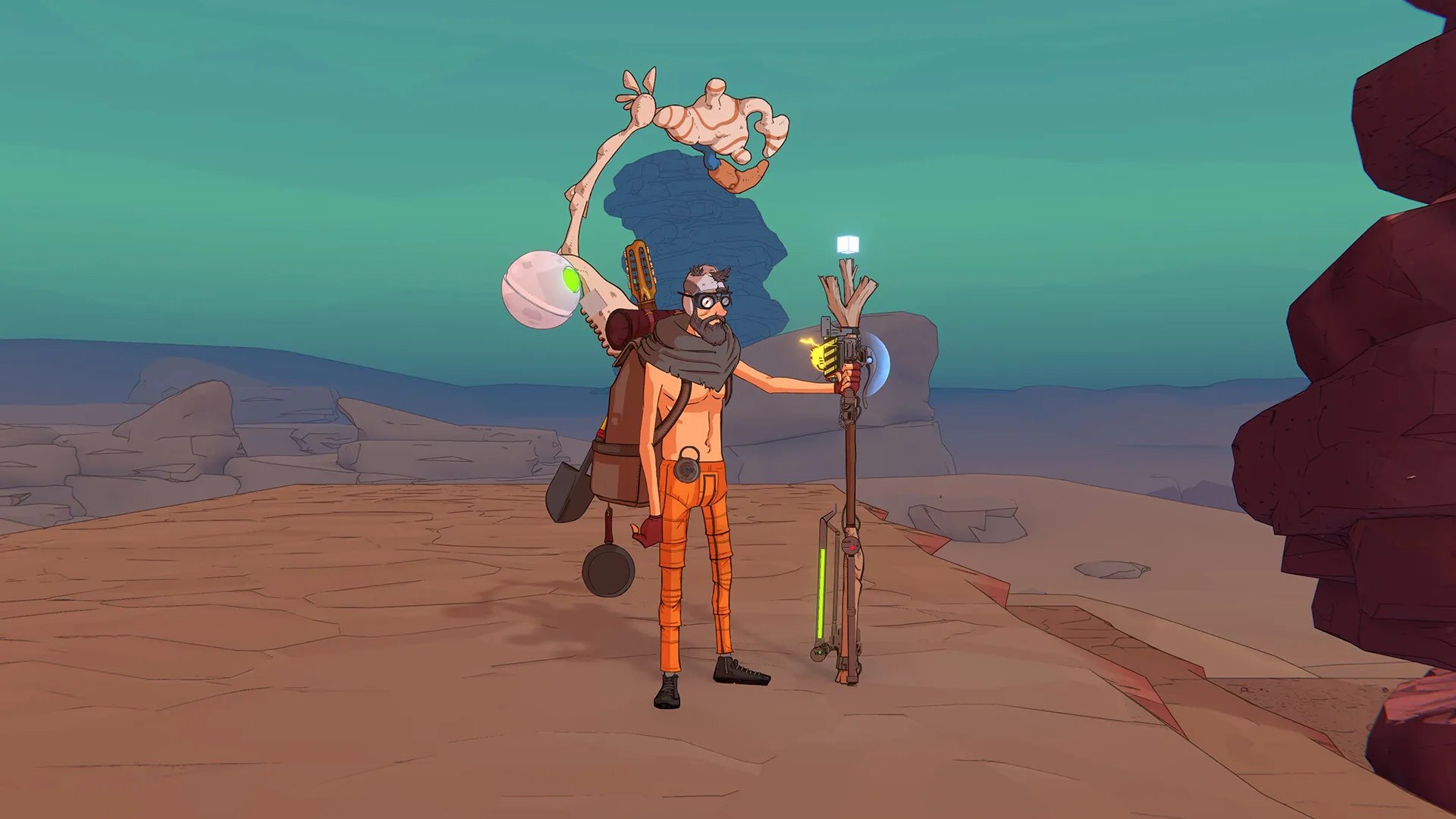

Kent is a low-level employee at Tlön Industries who believed he could play the system. He tries to hack his cryopreservation pod to squeeze out a few extra centuries of sleep and accidentally skips several millennia. He wakes up ten thousand years late, with his malfunctioning ship plummeting toward a desolate, post-human Earth. The crash kills his original body instantly, yet the corporate mission stays active.
ORB, a sarcastic shipboard AI, uses the on-board cloning technology to print a new version of Kent so the outstanding contract can be fulfilled. Now operating as a string of disposable clones, Kent is tasked with repairing a massive planetary monolith and collecting the resources needed to give a self-destructive civilization a second chance.
The game plays as a side-scrolling trek that ties ruin-scavenging exploration to the logistical depth of a factory builder. You arrive with a wooden staff and the clothes on your back. Survival becomes the first job on the docket as you move through a world of mutated wildlife and erratic weather patterns.
The tone leans hard into dark corporate satire, turning the end of the world into a list of chores assigned by an indifferent employer. Kent has to manage hunger and physical health while slowly transforming the wreckage of his ship into a sprawling industrial hub. Progress comes from persistent scavenging, where every scrap of metal pushes the same objective: corporate restoration.
Hazards of the Craftervania
The world uses a structure the developers call a craftervania, and the label fits because progress is locked behind what you can build and what your body can do. The connected map has a fixed backbone of cliffs and caverns, but the ecosystem inside it stays in motion. Enemy placements can change, and environmental features can shift with them, including bounce-blobs and fragile platforms. Revisiting areas stays active because the space can demand a new approach from one day to the next, even if the route looks familiar on paper.
The planet itself acts like an enemy through exposure. Kent deals with acid rain, searing heat waves, and freezing nights that drain health without the right protection. Food sits alongside weather as a constant pressure point. You hunt wildlife like the passive future-emus, or you forage for wild plants, keeping the hunger meter from bottoming out. These systems create meaningful choices during every trip. A deeper push can pay off with better materials, and it can also stack risk through weather damage and predator density, so planning becomes a survival skill.
Combat reinforces how disposable a clone feels. Kent lacks the defensive comfort of a traditional action hero, and many enemies can kill a clone in two or three hits. Encounters become tests of positioning. The staff has a short attack arc, forcing you to fight up close against the mutated bugs and slugs that roam the surface. Environmental tools help, and electroshrooms are the standout option. Striking one releases a powerful electrical discharge that can stun or wipe groups of predators if your timing is clean. The shock does not care who it hits, and standing too close can fry your own clone just as easily.
Failure is managed through the cloning system, which makes death a mechanical consequence instead of a simple reset. When a clone dies, it drops its entire inventory at the location of the accident. Dying deep inside a dangerous biome creates immediate dread because your hard-earned materials remain out in the threat zone. You can print a new Kent back at base, but recovering your haul means trekking back to your old corpse. The penalty lingers because some items are lost during the cloning process, so repeated deaths become a real setback for your industrial goals.
As you progress, mobility tools change how you interact with the terrain. A hoverboard enables fast travel across flat ground, while air-dashes and gliding let you reach high-altitude secrets and carve cleaner routes through hostile zones. Over time, movement shifts from cautious survival steps to planned efficiency, where the map starts to feel like something you can master with the right kit and a good route.
Industrializing the Wasteland
The primary mechanical arc tracks Kent’s climb from desperate scavenger to industrial builder. That shift runs through the Space Module Terminal and the Research Brain, two key nodes that act as gateways to technological progression. You feed specific resources into these machines to unlock new crafting recipes and base components.
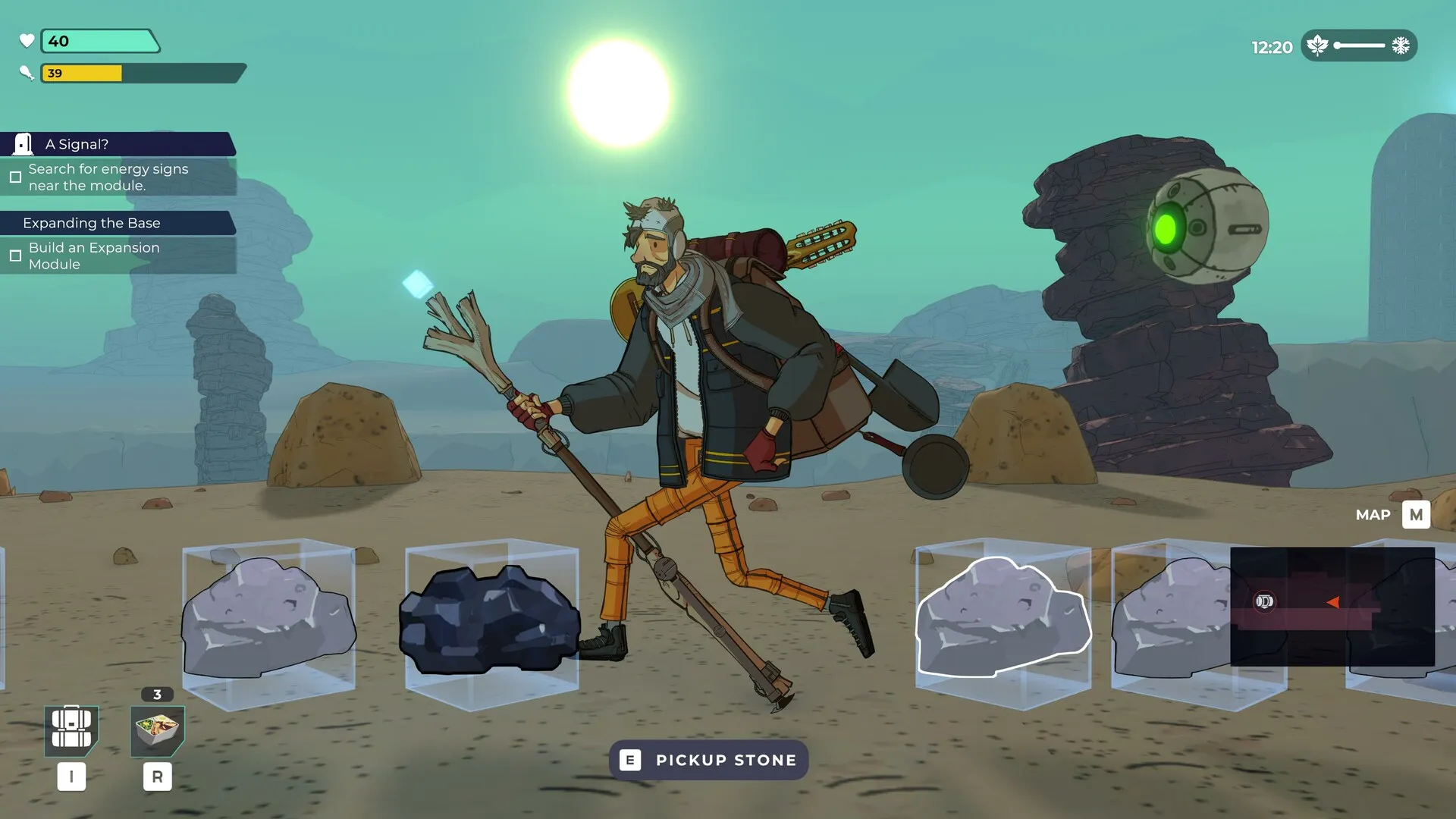
The tech tree is vast, and it forces you to weigh immediate survival needs against long-range investment. A day spent securing food and protection can slow research, and a day spent chasing research inputs can leave you underprepared for the next storm cycle.
The higher-tier upgrades sharpen that tension by demanding rare organic materials like wild rice bulbs, which grow only in specific dangerous locations. Early on, you cannot cultivate them in your home plots, so even a base that looks self-sufficient still depends on field runs. Exploration stays in the rhythm because your research pipeline keeps requesting ingredients that refuse to appear in safe territory.
The early hours are built on manual labor. You spend a lot of time smashing mineral outcrops and scrap piles with your staff to gather basic ores and wood. Mining units change that tempo. Placing these machines on ore deposits provides a slow, steady flow of materials, freeing you up to focus on higher-level construction. The automation suite is where the factory-builder identity comes into full view. Conveyor belts, robot arms, and funnels let you build production lines that handle refining for you, turning repetitive tasks into systems you design once and then improve.
Farming automation follows the same principle. You can set up specialized platforms where harvester arms pluck mature crops automatically and drop them onto belts that lead straight into storage boxes or processing machines. These setups make player choice feel tangible. You decide what to produce, how to route it, how to store it, and how much complexity you can maintain without the line choking on its own throughput.
Efficiency becomes a requirement for keeping the whole operation functional. The inventory rules discourage blind overproduction through decay. Organic materials like food and plant fibers break down over time. A powered refrigerator keeps them usable, while ordinary storage eventually turns them into piles of rotten produce. That creates a logistics puzzle where production rates need to match real consumption, or your base turns into a landfill of spoiled output.
The simulation adds another constraint by tracking physical objects left in the world. Dumping huge stacks of excess items on the ground outside your base can cause a frame rate dip as the engine struggles to track clutter. The game still offers a smart relief valve: rotten produce and other organic waste can be converted into fuel for your hoverboard.
That turns a logistical mistake into faster exploration, feeding back into the gathering loop. Scavenge, refine, automate, expand, then head back out for the next set of inputs. Each small improvement feels earned because it reduces friction in a world that keeps asking you to do more work for the Tlön Industries brand.
The Aesthetic of Corporate Decay
The presentation blends 2D character sprites with a 3D-layered environment, giving the side-scrolling format a stronger sense of depth and scale than many titles in the space. The art style stays bright and cartoony, and it still carries the atmospheric weight of a world that has moved on from humanity.
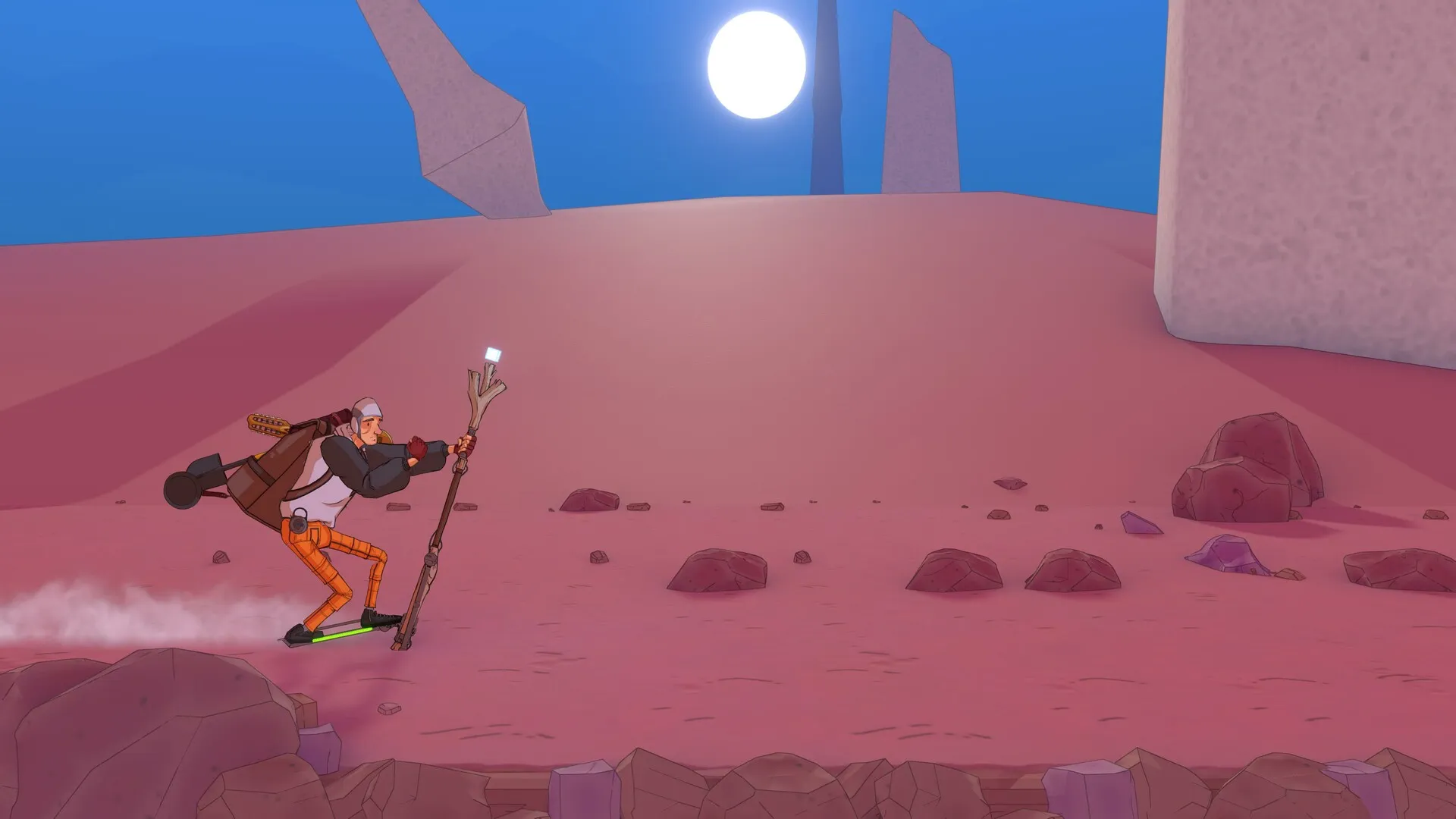
Small details sell the fiction, including changes to Kent’s physical model over time. Season shifts and the time since the last cloning event show up as visible wear and tear, reinforcing how temporary each clone is inside a company that treats itself as permanent. Many environments run dark, and deeper caves often demand a torch, which tightens tension once your battery starts running low.
Sound design and voice work become highlights of the narrative experience. Kent reads as a lovable disaster, clearly out of his depth, still committed to his mundane tasks because the contract says the shift continues. His voice acting has a professional quality that makes his panics and small triumphs feel grounded. The relationship between Kent and ORB is the emotional center.
ORB serves as a sarcastic, dry foil to Kent’s frantic energy, and the AI keeps reminding him of his status as a disposable asset with lines that call him a “flesh sack” and a “temporary worker.” The banter lands as sharp and funny, bringing relief to the grim routine of scavenging a dead planet.
The writing balances dark comedy with existential reflection by tying its themes to the mechanics you repeat constantly. Repairing the monolith pushes you further into the history of Earth’s fall and puts attention on the ethics of cloning. Each death and respawn places you in control of a new person carrying the memories of a dead one, working for a company that does not care if you survive the shift. The idea hits because the systems make you live it: inventory loss, recovery runs, and the steady churn of disposable bodies in service of a contract.
On the technical side, the game runs cleanly. It maintains a consistent 60fps on modern consoles, even when your base becomes a complex web of moving machinery. Load times are nearly instantaneous, which matters in a game where death is frequent and the world encourages long travel. That stability keeps your attention on the hazards of the wasteland and the satisfaction of a production line that finally runs the way you built it.
The Review
Kentum
Kentum succeeds by wrapping its mechanical complexity in a coat of sharp corporate satire. The transition from a fragile scavenger to an industrial master is earned through persistent effort. While the late-game grind demands patience, the cycle of discovery remains satisfying. The technical stability and the stellar banter between Kent and ORB make the experience stand out among standard crafting titles. It is a confident, witty, and mechanically sound exploration of a world that has moved past its creators.
PROS
- Sharp, satirical writing supported by high-quality voice acting.
- Satisfying progression from manual labor to complex automation.
- Polished technical performance with steady frame rates on consoles.
CONS
- Significant resource grind required during the middle stages.
- Fragile player health makes early combat encounters punishing.
- Manual tasks like watering can feel tedious before full automation.