



















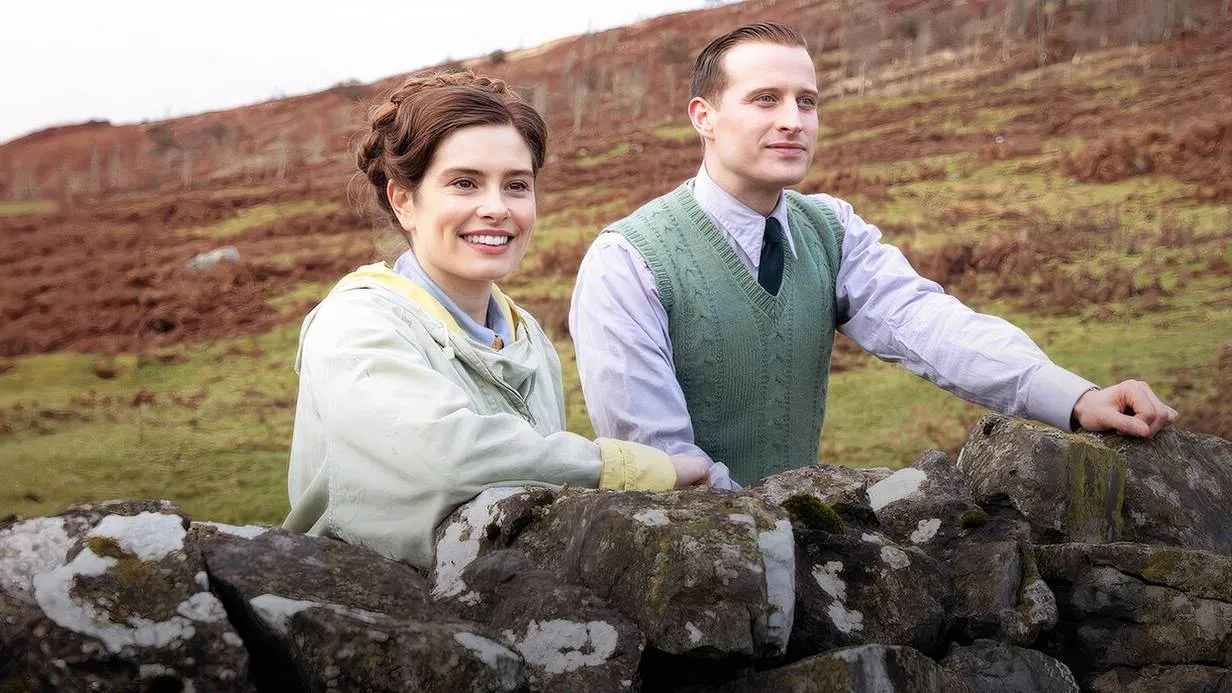

The sixth season begins on a small, startling marker of time: a child’s face that no longer belongs to a baby. Jimmy Herriot now stands as a young boy beside a new sister, an image that quietly announces how much life has happened offscreen. The jump from 1941 to 1945 operates as a clean narrative hinge.
The series steps past the war’s bleakest stretch and commits itself to recovery as story engine. It opens with Europe’s liberation and closes with Japan’s surrender, placing each episode inside a span of history that feels like a long-held breath finally released. Peace arrives here as work, not as a curtain call.
Darrowby remains the frame for those global shifts, and the choice carries real weight. A small community can hold history in the palm of its hand, giving it edges and texture. The show keeps attention on a veterinary practice and the farms around it, tracking how the war’s aftershocks land on ordinary routines.
The Herriot household anchors that movement. James and Helen face parenthood while social expectations continue to rearrange themselves in the background. The end of a world conflict registers as something lived: a sequence of local recalibrations, the kind that ask for repairs in homes and hearts, sometimes in the same hour.
Echoes of Service and the Architecture of Brotherhood
Tristan Farnon’s return brings a hard, immediate maturity into Skeldale House. The buoyant, carefree spark associated with him has thinned into something heavier, visible in posture and presence. His passage from a young man chasing fun to someone marked by the front line gives the season its most forceful emotional trajectory.
The writing treats his post-traumatic stress with plain directness, keeping sentimentality at arm’s length. Tristan’s homecoming demands a reckoning from everyone around him, because the household must learn how to live with a person who has changed in ways the family did not witness. Service becomes a long shadow here, cast across a single individual and then across the rooms he walks through.
Also Read





Siegfried Farnon carries a fracture of his own. Erratic behavior and sharpened anxiety point to the strain of holding the home front together while the world lurches. He values precision and leadership, and that self-image makes his stumbles feel sharper. Pressure pushes him into stretches of searching thought, and the season tracks that interior struggle as a slow, painful process. Defensiveness becomes his armor, and the armor reads as a cover for something raw underneath.
James Herriot moves between these tensions with a quiet weariness that never asks for applause. He functions as connective tissue: the surgery’s clinical demands on one side, a wife and children on the other. His development reads through steadiness and sustained care, the endurance required to keep showing up for people whose needs arrive without a schedule. Through it all, the relationship between the Farnon brothers holds the season in place. Their bond becomes a structure that has to be rebuilt, plank by plank, as they learn each other again after being pulled into different lives.
The Quiet Strength of the Skeldale Circle
Mrs. Hall remains the practice’s essential pulse, and the season gives her steadiness a more reflective shading. Her brief departure to Sunderland works as a turning point, because the absence makes visible what her presence usually disguises: the gaps she fills without fanfare. When she returns, purpose comes with her, along with a calmer appraisal of what it takes to keep a household functioning when it has been strained and rearranged by years of uncertainty.
Helen Herriot stands beside that with warm pragmatism. She runs the home and tends to a growing family with patience that recognizes hardship as part of the air people are breathing. The performance of stability matters here, because it gives James something solid to return to while he carries professional burdens that follow him past the practice door.
The younger characters search for their own footing in the same shifting terrain. Jenny Alderson leans toward independence, making choices that reflect the unsettled feeling of stepping into adulthood during transition. Richard Carmody continues his attempt to settle into the community, with academic confidence rubbing against the social codes of rural life. He plays two roles at once, student and disruptor, and his charm points back to earnestness as a local virtue worth protecting.
New figures widen the town’s social space. Charlotte Beauvoir arrives with wealth and a strong interest in local horse culture, and that combination presses on existing dynamics in Darrowby. Alongside her, familiar presences such as Mrs. Stokes and her mischievous goat keep the community textured and alive, a place that feels inhabited beyond the plot’s immediate needs.
Landscape as Character and the Symbolism of Care
The Yorkshire Dales are filmed with an eye for natural texture, not ornament. Cinematography favors the grit of stone walls and the steadiness of hills, creating a visual language that supports the show’s grounded tone. The landscape functions as a constant presence, a kind of silent witness that offers permanence while the people within it struggle to adjust to change.
That setting also shapes the season’s animal cases, which frequently echo human experience without forcing the parallel. A grieving parrot and the medical needs of a pampered Pekingese become vessels for themes of loss and responsibility. The veterinary work turns into a community grammar: care as daily practice, empathy as a form of labor, connection as something maintained through repeated, imperfect acts.
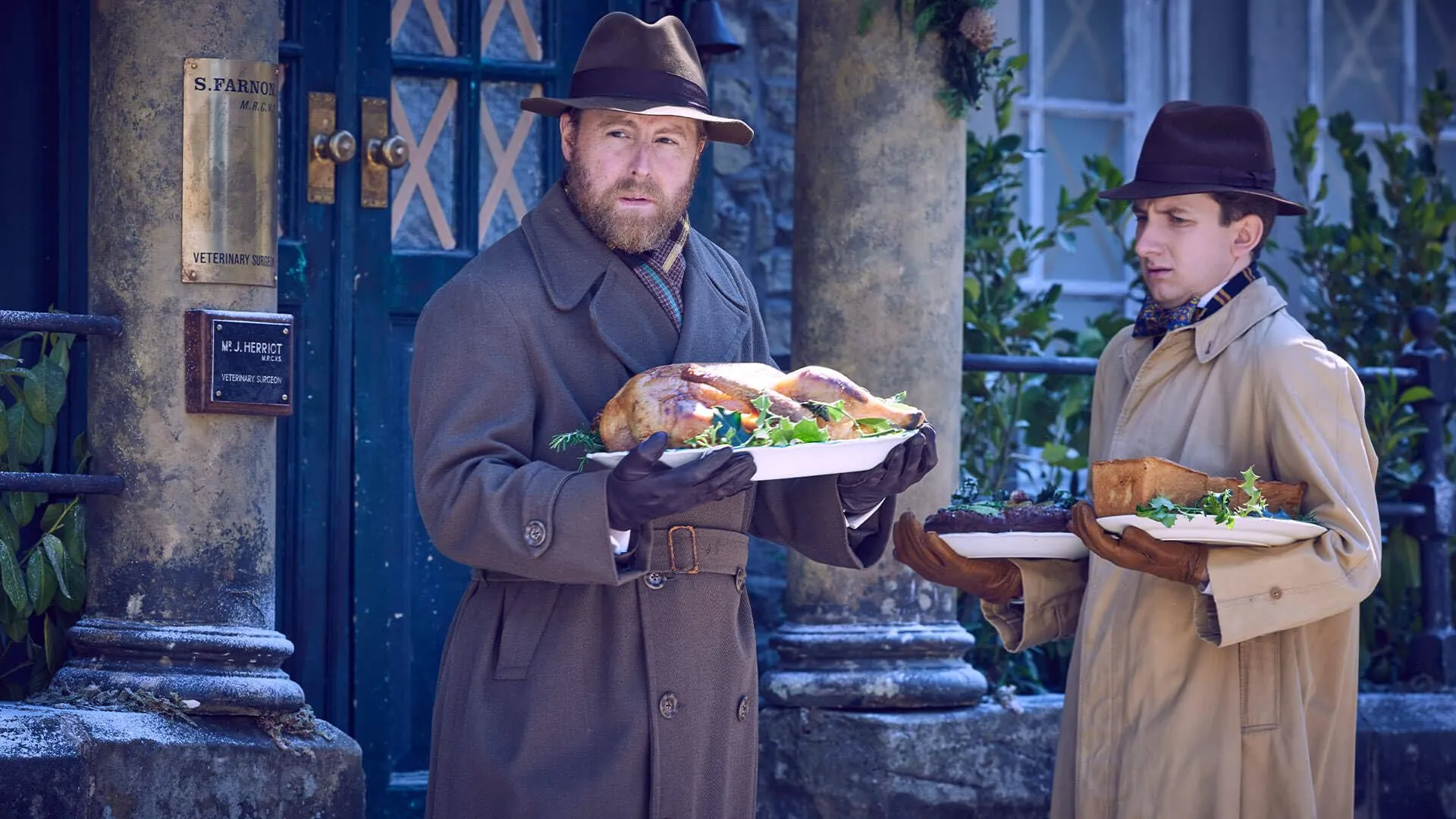
The season holds darker emotional beats alongside its familiar peaceful core, treating grief as part of the period’s texture and allowing small joys to matter. The Christmas special captures that tonal balance with particular clarity, pairing festive warmth with the lingering realities of rationing. The “murkey” dinner, a vegetable-built substitute for turkey, stands as proof of ingenuity and communal spirit.
It points to resilience as something enacted through returning home, feeding others, and continuing to care. Holiday lightness offers relief from the heaviness that preceded it, and the season’s portrait of solidarity suggests that recovery often happens in quiet increments, measured in ordinary kindness.
The sixth season of this historical drama premiered on PBS Masterpiece on January 11, 2026. Fans can watch the series on local PBS stations or through the PBS Passport streaming service. The story returns to Skeldale House as the residents find their footing at the end of the global conflict. It focuses on the domestic lives and professional duties of the veterinary team as Darrowby enters a period of reconstruction.
Full Credits
Title: All Creatures Great and Small Season 6
Distributor: Channel 5, PBS Masterpiece
Release date: January 11, 2026
Rating: TV-PG
Running time: 45 to 50 minutes per episode
Director: Brian Percival, Stewart Svaasand, Andy Hay
Writers: Ben Vanstone, Jamie Crichton, Helen Raynor, Debbie O’Malley
Producers and Executive Producers: Melissa Gallant, Richard Burrell, Ben Vanstone, Colin Callender, George Ormrod
Cast: Nicholas Ralph, Samuel West, Rachel Shenton, Anna Madeley, Callum Woodhouse, James Anthony-Rose, Patricia Hodge, Tony Pitts
Director of Photography (Cinematographer): Erik Wilson, Al Beech
Editors: David Thrasher, Yan Miles
Composer: Alexandra Harwood
The Review
All Creatures Great and Small Season 6
The sixth season confirms the enduring power of quiet storytelling. By grounding historical upheaval in the mundane rhythms of veterinary medicine, the show offers a masterclass in narrative restraint. It respects the slow, often invisible process of emotional healing following global conflict. The performances remain sharp, capturing the friction of a family relearning itself in a world transformed. While the pacing occasionally feels compressed, the emotional payoff remains genuine and earned. This installment reinforces the series as a necessary anchor of warmth and resilience.
PROS
- Sophisticated portrayal of post-war recovery and its psychological impact.
- Deepened character dynamics between the Farnon brothers.
- Stunning visual representation of the Yorkshire landscape that maintains a grounded feel.
- Intimate, character-driven approach to significant historical events.
CONS
- Short six-episode structure limits the breathing room for certain character arcs.
- James Herriot occasionally occupies a secondary role compared to the development of others.
- Occasional shifts into overly sentimental territory during romantic subplots.