




















The opening chapters sit in the wreckage of a failed state. Tokyo reads as a hollowed shell, with curses in the streets and civilians gone. The start runs cold. Satoru Gojo is locked away, and his absence leaves a political vacuum the established order cannot fill. Yuji Itadori stands alone. His future as a student has collapsed. He lives as a target with a price on his head, and the world turned against him while he was unconscious.
That tonal pivot carries the shape of a broken system. The series steps away from flashy heroics and stays with the weight of loss. The Culling Game approaches as a ritual of death, with Kenjaku positioned as the architect of the chaos. The mission narrows to survival. The stakes land on bodies and ethics at the same time. The shift feels honest because it treats collapse as a lived condition, not a spectacle. The old rules have died, and a cruel era begins.
The Visual Language of Internal Collapse
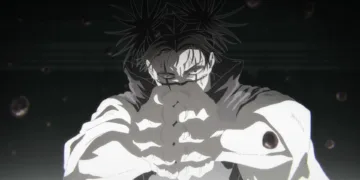
The opening scene frames Yuji’s mental state with blunt clarity. He washes his hands. The blood stays. It runs through the sink and refuses to disappear. The metaphor is direct: trauma that does not rinse off. He carries the Shibuya Incident with him. He killed many people while his body was controlled by another, and the guilt registers like a physical presence.
His movement communicates the rest. He was a bright kid, and now he reads like a shadow. The body language turns functional, as if he’s conserving energy just to keep moving. He looks tired. He looks older. The lighting locks into that exhaustion, with pink sunrises that echo the blood on his skin. The environment starts to share his pain, so the world feels stained alongside him.
Yuji lives in exile and hunts spirits to pay a debt. He wants atonement, and the story lets that desire sharpen into something harsher. He feels he must die. Choso stays with him, an odd ally who creates a strange family bond. Yuji has nobody else. Choso sees him as a brother, and that connection keeps Yuji from giving up. The dynamic stays quiet and sad, with the animation giving it room. Pain sits in Yuji’s eyes, and the visuals carry the point without speeches.
Patriarchy and the Rot of Tradition
The sorcerer world is falling apart, and its leadership responds with the same old reflex: control. Yuta Okkotsu returns, once framed as the hero of the prequel, now reshaped into something colder. He is described as a Special Grade killer. He smiles less. He arrives with a directive to kill Yuji, setting a collision between two protagonists that feels dangerous from the start. The Jujutsu Council sits behind the move, chasing certainty and fearing the unknown. They fear the power Gojo represented, and Gojo’s removal exposes how fragile their authority really is.
Also Read





With Gojo gone, the old families fight for dominance, and the Zen’in clan becomes the clearest window into the rot. Naobito Zen’in is dead, and the scramble for his chair begins. The struggle exposes deep misogyny baked into the culture: contempt for women and contempt for weakness, treated like tradition. Naoya Zen’in becomes the face of that rot. He is a narcissist who mocks his own family, and he lands as a villain because the show makes him easy to loathe. He wants the clan head position, and he treats birthright as destiny.
The rules favor Megumi Fushiguro, placing him in leadership. That promotion paints a target on his back. He has to save his sister, and he has to lead a family that hates him. The political mess adds weight to the action because it shows systems failing during crisis. The series uses that collapse as a critique of old hierarchies, where cruelty survives even as the world burns. These characters stay trapped in cycles of hate that mirror real-world power struggles, where status outranks responsibility. Tokyo is on fire, and the elders still track rank. The irony stings because it feels familiar.
The Cinema of Kinetic Dread
The studio shifts its style for this arc, and the result carries a filmic texture. The framing opens wide. Still shots linger. Empty stairs and broken buildings become recurring images, building dread through space rather than noise. That visual patience gives the episodes a refined confidence, and it suits a story interested in aftermath.

Combat follows the same recalibration. Smear lines push speed into blur, and the technique clicks with Naoya’s powers. Movement becomes hard to hold in the frame, which turns velocity into anxiety. The fights communicate panic through rhythm, not just impact.
The “Aizo” opening plays like a piece of art. It uses images from history and tucks in secrets about the plot. King Gnu’s song fits the mood, dark and energetic. Sound design leans experimental, with heavy synths shaping tension. The track stays quiet during conversation and surges during bloodshed, treating volume like a moral pressure gauge.
Shadows carry more weight now, and characters look like they belong inside the space. They register with physical presence rather than flat figures pinned to a background. The visual shift is a bold move that steps away from standard television looks and signals a team willing to try new things. The production values land at a top tier, with frames that feel planned and lighting that sets emotional temperature with intention.
The Gamification of Survival
The Culling Game presents an adaptation problem: long rules, dense text, and a structure that can choke momentum. The show handles it by putting the rules on screen fast and demanding attention. Viewers are told to keep up, and the method keeps the action moving. The pace runs very fast, and some viewers may read it as rushed, especially with how quickly new people arrive.
Humor drops out. The story treats survival as the genre, and the characters speak with a colder tone that matches the circumstances. Dialogue turns toward rules and the math of the game, reflecting the grim reality they face. That approach carries a risk. The season can slide toward a list of fights, and the series needs to protect the heart of the story by holding onto why these people matter.
The goal stays clear: find Master Tengen, then find Hakari. That target gives the plot direction while preparation ramps up with the pressure of an approaching war. The format shifts into a battle royale with magic, and the series commits to it with speed. The industry tends to play it safe, and this story chooses complexity and momentum instead. It takes a complex source and turns it into fast television. The transition feels jarring and effective.
This season of the supernatural thriller marks a turning point in the series as it moves into the complex Culling Game arc. Premiering in early 2026, the season continues the story following the devastating Shibuya Incident. Fans can watch the series on Crunchyroll, which holds the global distribution rights, while Netflix remains a streaming option in select Asian territories. The production by studio MAPPA continues to push the boundaries of high-fidelity animation, maintaining the high standards set by the preceding seasons and the 2021 prequel film.
Full Credits
Title: Jujutsu Kaisen Season 3 (The Culling Game: Part 1)
Distributor: Crunchyroll, MBS, TBS, Netflix (Select territories)
Release date: January 8, 2026
Rating: TV-MA
Running time: 24 minutes per episode (Season premiere was a one-hour special)
Director: Shota Goshozono
Writers: Hiroshi Seko, Gege Akutami
Producers and Executive Producers: Hiroaki Matsutani, Makoto Kimura, Yuuriha Murai, Manabu Otsuka, Akifumi Fujio, Akito Takahashi, Kazutaka Yamanaka
Cast: Junya Enoki, Yuma Uchida, Megumi Ogata, Yuichi Nakamura, Junichi Suwabe, Takahiro Sakurai, Daisuke Namikawa, Mikako Komatsu, Koji Yusa
Director of Photography (Cinematographer): Teppei Ito
Editors: Keisuke Yanagi
Composer: Yoshimasa Terui
The Review
Jujutsu Kaisen Season 3
This season marks a bold evolution for the series, trading the vibrant energy of its youth for a mature, cinematic dread. While the narrative transitions are occasionally jarring and the lore-heavy exposition requires significant focus, the technical ambition and thematic weight are undeniable. It is a haunting exploration of atonement within a collapsing society, proving that the series can grow alongside its traumatized characters. Despite the jagged pacing, the production remains a masterclass in visual storytelling.
PROS
- The shift toward wide shots and atmospheric "stillness" creates a sophisticated, arthouse quality.
- Innovative use of smear lines and lighting adds physical weight and a sense of blistering speed to combat.
- A grounded, empathetic look at Yuji’s survivor’s guilt and the rot within traditional sorcerer hierarchies.
- An experimental, synth-heavy score that perfectly heightens the season's pervasive sense of dread.
CONS
- The rapid-fire delivery of complex Culling Game rules can feel like a dense history lecture.
- Quick cuts and "speedrunning" certain setup chapters occasionally disrupt the emotional rhythm.
- The total disappearance of the series' trademark levity may alienate those who enjoyed the early camaraderie.