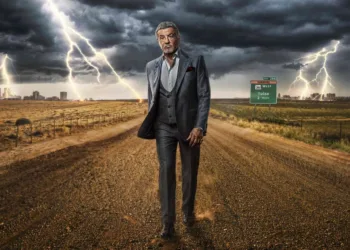































The third iteration of this collegiate psychodrama arrives with the cold precision of a hangover. It refuses tidy closure. The action slides between the 2015 wedding of Bree and Evan and the 2009 spring semester at Baird College. Lucy Albright and Stephen DeMarco remain trapped in a recursive orbit. The season studies parasitic attachment. Their shared past operates as a closed loop of betrayals. The narrative reads like a fractured mirror, each shard throwing back a lie. The view of early adulthood is scorched and unromantic.
Characters become marooned by their own decisions. This installment stages a grim inspection of internal rot. Secrets that began as youthful indiscretions now threaten to devour these adults. The series turns away from facile redemption. It examines the cost of being seen by the wrong person. The result feels like sociopathy-lite for the streaming age.
Anatomy of a Parasitic Bond
Stephen DeMarco has shed the thin veneer of charm that once masked a predatory core. He advances toward a state of pure malice. The tactical elegance of his earlier maneuvers has eroded. He favors blunt reputational destruction. He stages power plays through small domestic humiliations, even chores such as washing dishes. Those petty dominations map onto a larger disintegration of humanity. He qualifies as a stagnant-predator, a coinage for someone who consumes his surroundings until nothing remains.
Lucy Albright follows a parallel path of dissolution. She insists she has the upper hand. She treats her return to Stephen as a choice. Where others see a victim, she positions herself as a collaborator. That tension shapes her arc. She slowly recognizes that darker impulses may be intrinsic, not merely imported by Stephen’s influence. The realization chills her. She fears her own capacity for cruelty.
The show practices what might be called exhaustion-theater. Their scenes play like endurance tests. Romantic language has evaporated. What remains are ritualized humiliations. Those sequences are painful and instructive; they expose the mechanics of control.
Stephen hoards the secret of Lucy’s infidelity with Evan and uses it to maintain a constant psychological siege. Power is concentrated and absolute. The bond takes on a masochistic geometry. Occupation replaces love. The series advances the idea that some relationships function as mutual haunting, that information can become a cage.
Sincerity and the Truth-Vandal
At the margins of the rot there is a notable contrast. Bree and Wrigley form a relationship grounded in their mutual status as outliers. They inhabit the edges of an affluent social circle. Wrigley carries the burden of his brother’s death. Bree searches for a connection that sidesteps the transactionality that marked her past. Their friendship operates as an island of sincerity, and in doing so it exposes how performative most other bonds have become.
Pippa and Diana register a shift in the show’s sexual politics. Their chemistry rests on something substantive. It supplies a necessary reprieve from the usual toxicity. Friction remains: Pippa’s history with Wrigley complicates a future with Diana, even as they make progress. This complication reflects the messy reality of identity in motion. Past selves do not fall away on command.
Alex’s arrival alters the group’s chemistry. As a graduate student and Bree’s foster brother, he brings an outsider’s vantage. He functions as a truth-vandal, a label the season wears like a badge. He punctures the triviality of the group’s drama. His blunt directness acts as a mirror for Lucy; he reveals the person she has become. His presence adds a note of mystery to the college timeline.
Professor Oliver remains a ghost in the machine. His physical absence does not reduce his influence. Bree is haunted by their affair, which illustrates the long tail of exploitation. The series treats him as the embodied residue of a failing system. The show resists flattening him into a simple antagonist; he stands for institutional failure rendered human.
The Chronology of Stagnation
Temporal dissonance drives the narrative. The 2015 wedding timeline moves with agonizing slowness, registering the immediate shock of Stephen’s intervention. The wedding air is saturated with the residue of 2009. Adult masks prove fragile. The series refuses to hand over catharsis in quick, neat parcels. The result is a persistent suspense.

Switching between eras permits a precise look at cause and effect. We watch the slow genesis of the couples assembled in 2015. The question of how Lydia and Stephen became engaged hangs over the past. The 2009 timeline strips bare the present’s justifications and isolates the exact moments when characters chose darker paths.
Pacing remains deliberate. The series resists the frantic energy of typical teen soaps. By withholding answers, it forces attention on discomfort. Viewers witness characters repeating mistakes. Repetition functions as argument: time does not heal every wound. Some hurts are cultivated.
Visually the season adopts a more austere palette. Baird College has lost any golden haze; the campus reads cold and clinical. Cinematography tracks a bleaker emotional terrain. The setting has surrendered its promise and become a site of damage. The tonal shift signals the series’ move toward tragedy measured by restraint. The season captures the unsettling truism that youth may feel less like a beginning and more like a dead end.
The Ethics of the Unreliable Witness
Moral ambiguity serves as the season’s chief currency. Lucy’s false accusation against Chris Montgomery sits at the center of the conflict. The show refuses easy routes to forgiveness and demands that the viewer live with the consequences of her lie. We observe the ways she injures others while protecting a friend. The result is ethical vertigo.
Bree develops a tentative self-awareness. She recognizes patterns that lead to her own undoing. That recognition does not stop her from self-sabotage; it converts her into a witness of her own collapse. This condition gestures toward a broader social fact: knowing the right course is distinct from walking it. The series asks whether genuine growth can occur within an ecosystem shaped by deception.
The handling of sexual assault narratives is deliberately uncomfortable. The series sidesteps didacticism and remains anchored in character perspectives. Morality here bends into survival logic, a logic that rationalizes betrayal. That choice makes viewing unpleasant. It also prevents sanitization of the messy realities involved.
Stephen’s arc registers profound loneliness. His outbursts operate as defenses. He has exchanged intimacy for control and sits in rooms filled with people he has manipulated. He is alone in a structural sense. The season shows that physical proximity does not equal emotional closeness; the walls characters erect are the true separators. Lies become more than tools; they function as mechanisms of self-imprisonment. The final images privilege isolation. Every sin carries cost. The characters begin to confront an arithmetic they cannot afford.
The third season of the hit drama Tell Me Lies premiered on January 13, 2026, continuing the toxic and addictive saga of Lucy Albright and Stephen DeMarco. Based on Carola Lovering’s novel, the series is available to stream exclusively on Hulu in the United States and on Disney+ internationally. This season dives deeper into the fallout of the group’s collegiate choices at Baird College while shifting more focus toward the high-stakes 2015 timeline, where the long-term consequences of their manipulation and secrets finally reach a breaking point.
Full Credits
Title: Tell Me Lies (Season 3)
Distributor: Hulu, Disney+
Release date: January 13, 2026
Rating: TV-MA
Running time: 45–55 minutes
Director: Jonathan Levine, Erin Feeley, Sam Boyd, Isabel Sandoval, Ed Lilly, Robin Wright, Tyne Rafaeli
Writers: Meaghan Oppenheimer, Samir Mehta, Mona Mira, Sinead Daly, Chisa Hutchinson, Bill Kennedy
Producers and Executive Producers: Meaghan Oppenheimer, Emma Roberts, Karah Preiss, Matthew Matruski, Shannon Gibson, Samantha Schlaifer, Laura Lewis, Stephanie Noonan, Jonathan Levine, Dan Attias, Tyne Rafaeli, Mathew Hart
Cast: Grace Van Patten, Jackson White, Catherine Missal, Spencer House, Sonia Mena, Branden Cook, Alicia Crowder, Tom Ellis, Costa D’Angelo, Iris Apatow
Director of Photography (Cinematographer): Luc Montpellier, Charles Gruet, Kat Westergaard, Sean McElwee, Jason King
Editors: Julie Cohen, Joe Leonard, Jeff Israel, Bradley Cheyne, Bridget Case, Genevieve Butler, Rebekah Fridman, Annette Davey
Composer: Jay Wadley
The Review
Tell Me Lies Season 3
The season functions as a clinical observation of human failure. It strips away the false glamour of toxic romance. It leaves a raw look at how people consume one another (a spiritual cannibalism of sorts). The show avoids the trap of easy redemption. It prefers the uncomfortable truth of permanent psychological damage. It acts as a grim portrait of early adulthood. Jackson White and Grace Van Patten deliver performances that feel like a meticulous autopsy of the soul. It is an effective look at the cost of being seen by the wrong person.
PROS
- Direct exploration of parasitic trauma bonds.
- Cynical humor from the introduction of Alex (the truth-vandal).
- Specific development of secondary friendships like Bree and Wrigley.
- Bleak yet consistent visual style.
CONS
- The relentless malice of the leads feels claustrophobic.
- Stephen is difficult to tolerate as his charm disappears.
- The 2015 timeline moves with frustrating slowness.