








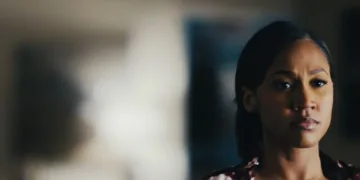










Eleanor Wilson and Alex Huston Fischer conjure a surreal adult folk tale that feels hauled up from a 1600s fever vision, still dripping saltwater. Set in a seaside village unmoored from any tidy sense of era, Wicker tracks a social outcast known as Fisherwoman. Olivia Colman plays her with prickly fatigue, planted in a community ruled by rigid patriarchal customs and archaic naming rules. Fisherwoman takes daily ridicule for her work and her unkempt, fish-scented body.
The story sparks when a wedding ritual marks her out through a superstitious omen. She opts out of courtship and hires the local master basketmaker to weave her a husband out of wicker. The finished product arrives as a sentient, devoted, physically capable partner. A provocation on paper turns into a layered look at marriage and the disorder created by an ideal match. The fable swings between ribald jokes and real tenderness, using the wicker husband as a funhouse mirror for the villagers’ human failings.
The Taxonomy of a Woven Hegemony
The directors build an “other-earth” village that plays like a warped Elizabethan England. This society runs on a strict linguistic hierarchy where men get reduced to their trades. We meet the Bakerman and the Butcher. Women get treated like chattel, named by proximity to men and re-labeled with marital ownership, moving from the Doctor’s Daughter to the Tailor’s Wife (Elizabeth Debicki). It becomes a system of “relationary-erasure,” stitching the social fabric into something tight, airless, and proudly provincial.
Patriarchal ritual sets the village’s mood like a permanent storm front. The wedding ceremony clamps a heavy metal collar around the bride’s neck, a blunt visual metaphor for “marriage debt.” Single women throw wicker eggs filled with colored powder to forecast their marital future. Fisherwoman lives at the edge of this order, a pariah whose “unfragrant” state and fierce independence read, to these people, like a biological and social threat. Her refusal to bend creates friction the villagers keep trying to scrub away, like grime they can smell.
Peter Dinklage plays the Basketmaker as the resident artisan and a kind of secular wizard. His craft enables the story’s supernatural hinge, offering a technological fix for a social crisis. He treats Fisherwoman with a modest baseline of dignity, which lands as its own commentary: the people who make beauty can sometimes recognize loneliness as a real condition, not a punchline. (Empathy, here, comes with calloused hands.)
The Rattan Adonis: An Exercise in Wooden Soul
The Wicker Husband stands as a practical-effects triumph. Crafted by the WETA Workshop, his face looks like a woven espadrille pulled taut over a human skull. The design stays strange and fundamentally sweet, leaning into its handmade origins. His expressive eyes suggest a consciousness that feels impossible inside this braided shell. Call it “organic-automation” in its most romantic form, a love object built from craft and wishful thinking.
Alexander Skarsgård gives a deadpan performance that stays remarkably taciturn. He communicates emotion and something like soul through a restricted wooden exterior, without depending on familiar facial signaling. His movement has deliberate grace, set against the frantic, bumbling hustle of the village’s human men. The sound design seals the illusion. Andy Neil makes each motion arrive with the creak of wood, like an old rocking chair remembering its age. That sonic texture gives him vulnerability and weight, an audible reminder that this partner has a body with limits, joints, and friction.
He is effectively designed to be the perfect partner: doting, helpful, emotionally intelligent. The film turns that into an indictment of the nearby husbands, whose neglect becomes easier to see once a wicker man starts doing the basics with care. He embodies “curated-masculinity,” and the village reacts with fear because selflessness reads as subversion in a place built on ownership. He speaks little. His actions carry devotion in a way that makes the local men look replaceable, like outdated tools left out in the rain.
Log-Rolling and the Liberation of the Bedframe
Fisherwoman and her husband begin on transactional terms. She places an order for a mail-order groom to spite her neighbors, a petty act with revolutionary consequences (spite, cinema’s underrated accelerant). The arrangement shifts into a genuine bond between misfits trying to build a shared life. Colman slides between broad comedy and sharp, aching drama. She plays a woman lowering her guard by inches, revealing “vulnerability-latency” shaped by years of solitude.
The film adopts an irreverent, Monty Python-style attitude toward the physical side of their marriage. The “bed-breaking” romance lands as explicit, hilariously loud, and strangely character-revealing. Sexual liberation becomes part of Fisherwoman’s selfhood on screen, framed through a long-neglected woman receiving a lover’s attention for the first time. The creaking wood in these scenes works as punchline and proof, a running reminder that the husband’s body is real inside the film’s logic, not a metaphor floating above it.
Their private domestic happiness becomes a public scandal. The couple’s tenderness plays like quiet rebellion against the village’s performative misery, the kind of misery worn like a badge of moral fitness. Watching Colman find joy with a man made of sticks stays absurd, then becomes moving, then snaps back to absurd again. The film allows that wobble. It suggests that happiness shows up in places the culture trains you to sneer at, and that training can look a lot like social control dressed up as “common sense.”
The Domino Effect of Uncomfortable Progress
The Wicker Husband’s kindness functions as a catalyst for upheaval. His presence pushes the village women to reassess marriages that have trained them into resignation. The men watch him dote on his wife and perceive a threat to the established gender hegemony. The film frames his existence as a dark-fantasy social treatise on equal partnership, delivered in the simplest language possible: care changes expectations, and expectations change power.
Debicki is magnetic as the Tailor’s Wife, the village queen bee whose authority depends on the status quo staying intact. She tries to poison the relationship with rumors of infidelity, channeling the special fury reserved for anyone living outside the rules. The role plays like the Iago of this story, driven by a dawning recognition that her own marriage is a hollow construct. The film tags that impulse as “status-panic,” and it lands with an uncomfortable modern sting. (The wigs may be old; the insecurity is fresh.)
As a fable, the film carries a merciless edge. It explores the “terrible perils of coupling” and the transactional logic that seeps into romance. The moral stays clear and pliable: systems built to suppress individuals collapse once a person experiences joy and refuses to give it back. The satire keeps its peppery bite, withholding easy forgiveness for small-minded cruelty and the petty bureaucracies of humiliation.
Gilded Trappings and the Magic Hour
Lol Crawley’s cinematography lifts the “quirkfest” into something with polish and intention. The images carry a “magic hour glow,” carefully saturated so the village looks like a living painting that somebody forgot to varnish. The Academy-ratio framing concentrates attention on intimate, cramped spaces, matching Fisherwoman’s constricted social life with a visual box she keeps trying to break open. That formal discipline stops the whimsy from turning saccharine.
Renátó Cseh’s production design matters just as much, building hovels and workshops that feel lived-in, grimy, and functionally oppressive. Anna Meredith’s score arrives as jauntily invasive, steering mood through percussive energy that sometimes risks swallowing dialogue. The music’s liveliness still matches the film’s “loopy-originality,” the sense that the whole enterprise runs on mischief and menace in equal measure.
Wilson and Fischer keep firm control of this strange ecosystem. They handle a large ensemble, making even the smallest roles contribute to the feeling of a cloistered, judgmental community. Their direction holds dark comedy and poignant fable in the same grip, tight enough to keep them aligned, loose enough to let them scratch at each other. The film stays “fiber-rich” in metaphor while moving with surprising lightness, a folk tale that laughs, winces, and keeps walking.
Wicker is a twisted, unconventional romance that premiered at the Sundance Film Festival on January 25, 2026. Based on the short story “The Wicker Husband” by Ursula Wills-Jones, the film stars Olivia Colman as a social outcast in a coastal village who commissions a local artisan to weave her a sentient life-partner. Following its successful festival circuit run, the film is expected to be picked up for wider distribution later this year. Currently, you can keep an eye on streaming platforms like Prime Video or specialized indie distributors for its general release.
Full Credits
Title: Wicker
Release date: January 25, 2026 (Sundance Film Festival Premiere)
Running time: 105 minutes
Director: Eleanor Wilson, Alex Huston Fischer
Writers: Eleanor Wilson, Alex Huston Fischer, Ursula Wills-Jones (original story)
Producers and Executive Producers: Ryan Heller, Jennifer Westin, Michael Bloom, Maria Zuckerman
Cast: Olivia Colman, Alexander Skarsgård, Peter Dinklage, Elizabeth Debicki, Marli Siu, Nabhaan Rizwan, Richard E. Grant, Gustav Lindh
Director of Photography (Cinematographer): Lol Crawley
Editors: Myron Kerstein
Composer: Anna Meredith
The Review
Wicker
Wicker is a daring, artisanal provocation that manages to be both "fiber-rich" in its symbolism and refreshingly bawdy. By utilizing a "woven-automaton" to dismantle the rigid "relationary-erasure" of its village setting, the film offers a piercing look at the marriage debt and social conformity. While the second act occasionally stalls in its own whimsy, the raw vulnerability of Olivia Colman and the deadpan grace of Alexander Skarsgård anchor this fable in a recognizable human truth. It is a rare, beautifully textured piece of cinema that turns a ridiculous logline into a poignant social treatise.
PROS
- Masterful practical effects and sound design bring the wicker husband to life with vulnerability.
- Olivia Colman delivers a grounded, heart-wrenching performance that balances the film’s absurdity.
- Sharp, irreverent satire that effectively deconstructs patriarchal social hierarchies.
- Lush, saturated cinematography that lends the folk tale a prestigious and timeless feel.
CONS
- The narrative pacing occasionally drags during the middle sections.
- Certain secondary character arcs feel thin compared to the central duo.
- The "jauntily invasive" score can sometimes compete with the dialogue.