







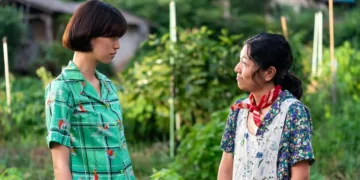

















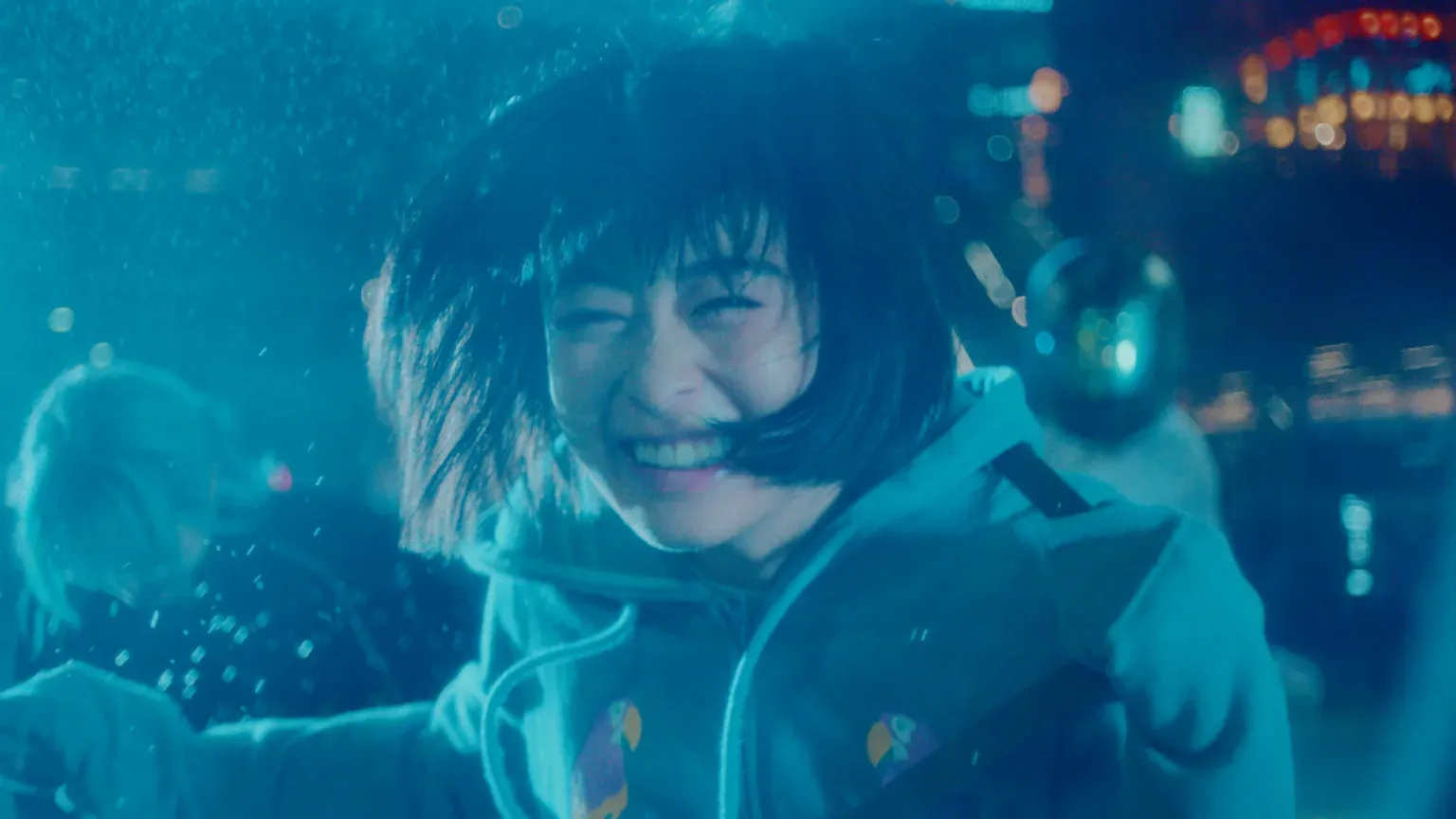

Makoto Nagahisa plants his camera in Kabukicho, tracking the Tōyoko kids who live on the edges of Shinjuku’s entertainment district. They cluster behind blue plastic barriers, turning a patch of street into a temporary camp beneath the huge presence of the Shinjuku Toho Building. Nana Mori plays Ju-Ju, a girl running from a home shaped by physical abuse.
She enters this neon corridor after a social media account called “Kami” promises safety and constant support. The city reads as shelter for people with nowhere else to go, and it also feels like a place that stores them out of sight.
Nagahisa stays close to the immediacy of Ju-Ju’s escape, charting her move from one kind of confinement into another, only now it happens in public. Abandonment hangs in the air. The theater lights glare without offering comfort to kids sleeping on concrete. Ju-Ju arrives looking for a reset, with no clear sense that this refuge rests on unstable terms.
The Economy of a Misfit Family
Inside the square, Ju-Ju falls in with a makeshift family of outcasts, each person marked by a private routine for getting through the day. She meets Wris, whose scars carry the trace of self-inflicted pain, and Ora, who keeps brushing her teeth as if repetition can scrub the world clean. The group also includes the “Animal Gals,” bouncing rope in onesies, a strange flash of childhood play staged against a setting that offers little protection. Ju-Ju connects most closely with Mitsuba, a disabled teenager who becomes her guide to the local sex industry.

That bond sits at the center of Ju-Ju’s plan to save 10 million yen, money she believes can purchase her sister’s freedom from their violent parents. The trauma she carries from both her father and mother drives that goal with the stubborn focus of a quest marker you cannot turn off. “Kami” provides lodging and kindness, and the film keeps showing how this help carries a hidden price. The warmth works as a cover for predatory exploitation, turning care into a system that extracts value from the kids it claims to protect.
Mitsuba functions like a veteran player who has taken too much damage for too long. She teaches Ju-Ju the rules because she has already lost the ability to register their weight. Survival here has a cost that keeps rising. Friendship exists, and it also gets tangled up with earning money through dangerous work, so even tenderness starts to feel transactional. Nagahisa presents this community as a fragile support network built inside an economy that feeds on desperation.
A Game-Like Lens on Trauma
Nagahisa and cinematographer Hiroaki Takeda build a visual language that holds intimacy and distance in the same frame. Their “frames within frames” approach boxes action into vertical rectangles that resemble a smartphone view. The effect plays like forced spectator mode. We watch Ju-Ju from behind a screen-shaped barrier, and that shape echoes the way society keeps these kids legible as images while staying detached from their lives.
The film slides between raw, documentary-style surveillance footage and sequences with the polish of high-budget music videos. Sets take on a diorama-like look, making Kabukicho feel like a constructed level where the stakes stay brutally real. Rico Iwai’s electronic score pulses with narrational urgency, humming with the anxiety sitting under Ju-Ju’s skin.
The pacing follows changes in frames-per-second, creating a jittery, unstable rhythm that matches her rootlessness. It avoids easy sentiment and goes for something harsher: a clear picture of a digital generation forced to live in physical spaces that treat them like disposable icons.
In genre terms, this approach borrows from the grammar of “screen” storytelling and surveillance aesthetics without handing the audience a safe distance. The camera language keeps insisting on connection, then interrupts it with the chill of observation. That push-and-pull becomes part of the story’s mechanics. Form carries meaning. The technical design keeps returning to the idea that life inside the blue barriers continues while the world outside acts like it cannot see.
From Pink Flames to Ashes
The story veers into more distressing territory as Ju-Ju sinks deeper into street trade. Nagahisa brings in animation and stop-motion to render bursts of extreme psychological pain, blending digital textures with physical reality.
The most traumatic events are handled with controlled distance, often through overhead security-camera angles that record exploitation without turning it into spectacle. Ju-Ju’s passivity in these moments lands with a heavier impact because she stays resigned to what is happening, holding on to the reason she gives herself: her sister.
Images of “pink flames” start to haunt the film, building toward a literal burning of the structures that signify Ju-Ju’s imprisonment. The destructive act named by the title becomes her attempt to seize control of a life that has been commodified by the men of the district.
The ending stages a collision between the real and the digital, with destruction framed as the only remaining exit from a system designed to consume her. The film’s empathy sits in the physical weight of what gets left behind, the wreckage treated as proof of what survival demanded. The transition into ash lingers, and the cost stays visible long after the fire takes hold.
The film Burn premiered at the 2026 Sundance Film Festival on January 23, 2026, as part of the NEXT program. Directed by visionary filmmaker Makoto Nagahisa, this Japanese drama dives into the lives of the “Tōyoko kids,” a group of marginalized runaways inhabiting the Kabukicho district of Shinjuku. The story follows a young girl named Ju-Ju as she navigates a precarious world of found family and exploitation. As of early 2026, the film is primarily available through festival screenings and limited online festival passes for authorized regions, though its critical success suggests a wider streaming or theatrical release may follow.
Full Credits
Title: Burn
Distributor: Giant Artists, Sundance Institute
Release date: January 23, 2026
Running time: 103 minutes
Director: Makoto Nagahisa
Writers: Makoto Nagahisa
Producers and Executive Producers: Yasuo Suzuki, Kazunori Seki, Takeyasu Koganezawa, Kako Kuwahara, Ryusuke Nakajima, Hayato Arizono
Cast: Nana Mori, Aoi Yamada
Director of Photography (Cinematographer): Hiroaki Takeda
Editors: Shunichi Sone
Composer: Rico Iwai
The Review
Burn
Burn is a searing, sensory-heavy exploration of a youth culture left to rot in the neon glow of Shinjuku. Makoto Nagahisa crafts a film that feels like a glitching video game, blending heartbreaking naturalism with explosive, stylized rebellion. While its descent into graphic trauma is difficult to stomach, Nana Mori’s hauntingly passive performance grounds the chaos. It is a loud, messy, and deeply empathetic cry for the forgotten, proving that sometimes the only way to be heard is to set the entire system on fire.
PROS
- The use of smartphone-style framing and diorama sets is masterfully disorienting.
- Her portrayal of Ju-Ju is gut-wrenching in its quiet resignation.
- Rico Iwai’s electronic music perfectly captures the protagonist's internal anxiety.
CONS
- Some of the late-film trauma sequences feel unnecessarily graphic.
- The momentum dips slightly when the story shifts focus to the financial grind of the sex trade.
- The relentless grimness may be overwhelming for many viewers.