


























February 14 often plays like a mass-produced pageant of sentiment, and Gina carries that noise in her bones because the date marks her birthday. The calendar collision hardens into something organized and habitual, a practiced resentment that frames the holiday as commerce with a battering ram. In Los Angeles, she keeps herself at a deliberate remove from anything that smells like tradition, which makes her relationship with Andrew read like a mismatch she tolerates on paper.
Andrew moves through romance with open-faced sincerity. He treats a proposal as a destination worth climbing toward, complete with the gleam of inevitability. Gina senses the diamond-shaped pressure building and chooses distance as defense, booking a flight to Greece. Officially, she is visiting her mother, Wendy. The real goal is to keep her life as it is by putting an ocean between herself and the question she does not want to answer.
Greece becomes an active setting, not simple scenery, because it delivers Johnny back into Gina’s orbit. He is a pizza delivery man she met before, during a moment where her money moved faster than her attention. He arrives in the Mediterranean through a freak run of luck, bringing his sister Mickey along. Removed from home and sheltered by sunlit anonymity, Gina sees a way to jam the gears of Andrew’s proposal plan.
She builds an arrangement with the crisp logic of a con: she and Johnny perform a romance in daylight hours while Andrew is paired off with Mickey for companionship and distraction. The trip turns into a romantic shell game played among ancient stone and bright water. Moving across islands, the light has a cruel honesty to it, highlighting how thin their motivations really are. The story follows four people trading truth for temporary escape, tightening their own knots each time they choose performance over candor.
The Architecture of Artificial Cynicism
Gina is drawn as a contemporary screen archetype who treats cynicism as both armor and weapon. The script presents her as someone who defines herself through rejection of the mainstream, and that posture carries the sheen of performance. Her anger at Valentine’s Day functions as cover, a way to claim an airy intellectual distance from the people who submit to the holiday’s rituals.
The screenplay leans on a familiar “not like other girls” attitude, building her identity out of her dislikes instead of her values. The result is a protagonist constructed from contradictions: she speaks in the language of truth while living inside a carefully maintained system of lies.
That contradiction sharpens through her rapport with Johnny. Gina and Johnny share a streak of compulsive dishonesty and treat fabrication as recreation, spinning elaborate stories for unsuspecting tourists with an almost athletic confidence. The film frames this as a charming recognition between kindred spirits, a private language that signals compatibility. It also opens a serious likability gap.
Emotional access becomes difficult with characters who treat human connection as raw material for a hustle. Gina’s side business of selling restaurant reservations to frantic couples at a markup carries a similar chill. The act does not land as clever commentary on a commercial holiday. It reads as cruelty aimed at sincerity, exploiting people who may be misguided but still operating from genuine feeling.
Andrew’s presence throws Gina’s abrasiveness into sharper focus. He becomes the narrative’s offering, a man defined by good faith and punished for it. His only real “crime” is belief in the romantic structures Gina despises. The absence of chemistry between them seems intentional, yet the script never supplies a persuasive reason for a woman this committed to independence and cynicism to spend a year with her opposite.
Where their connection should live, there is a blank space, and that emptiness makes the central conflict feel assembled rather than discovered. The film asks the audience to watch Gina run from a man she appears to actively dislike, while drifting toward someone who mirrors her most corrosive habits. The picture of intimacy that emerges is bleak: partnership becomes a search for someone fluent in the same lie, someone who can keep pace inside the same shared deception.
Mechanisms of Narrative Convenience
The film’s framework runs on contrivances that strain narrative discipline. Its main engine is a financial mistake built on an implausible detail: Gina, described as sharp and observant, hands over a five-thousand-dollar gift certificate as a tip after mistaking a smudge for a decimal point.
That single error funds Johnny’s Greek trip and links their worlds, and it plays like a writerly lever yanked hard to force the meeting. Plot momentum depends on clerical confusion, which signals a screenplay more invested in where it wants to go than in the integrity of how it gets there.
The next major device arrives in a shell. Gus the tortoise functions as metaphor and mechanism, applied with heavy pressure. The animal’s health becomes a ready-made excuse for characters to tumble into “high-stakes” emotional scenes that are meant to feel urgent and come out absurd. Andrew’s assignment to administer rectal medication to the tortoise pushes the film into physical comedy that clashes with the sharp, cynical register Gina’s dialogue works to establish.
These sequences sit like slapstick pockets inside an attempted satire, and the tone jolts each time the story pivots to reptile crisis. Gus never registers as a character with presence or meaning. Gus exists as a prop that forces intimacy or conflict whenever the story’s natural momentum starts to sputter.
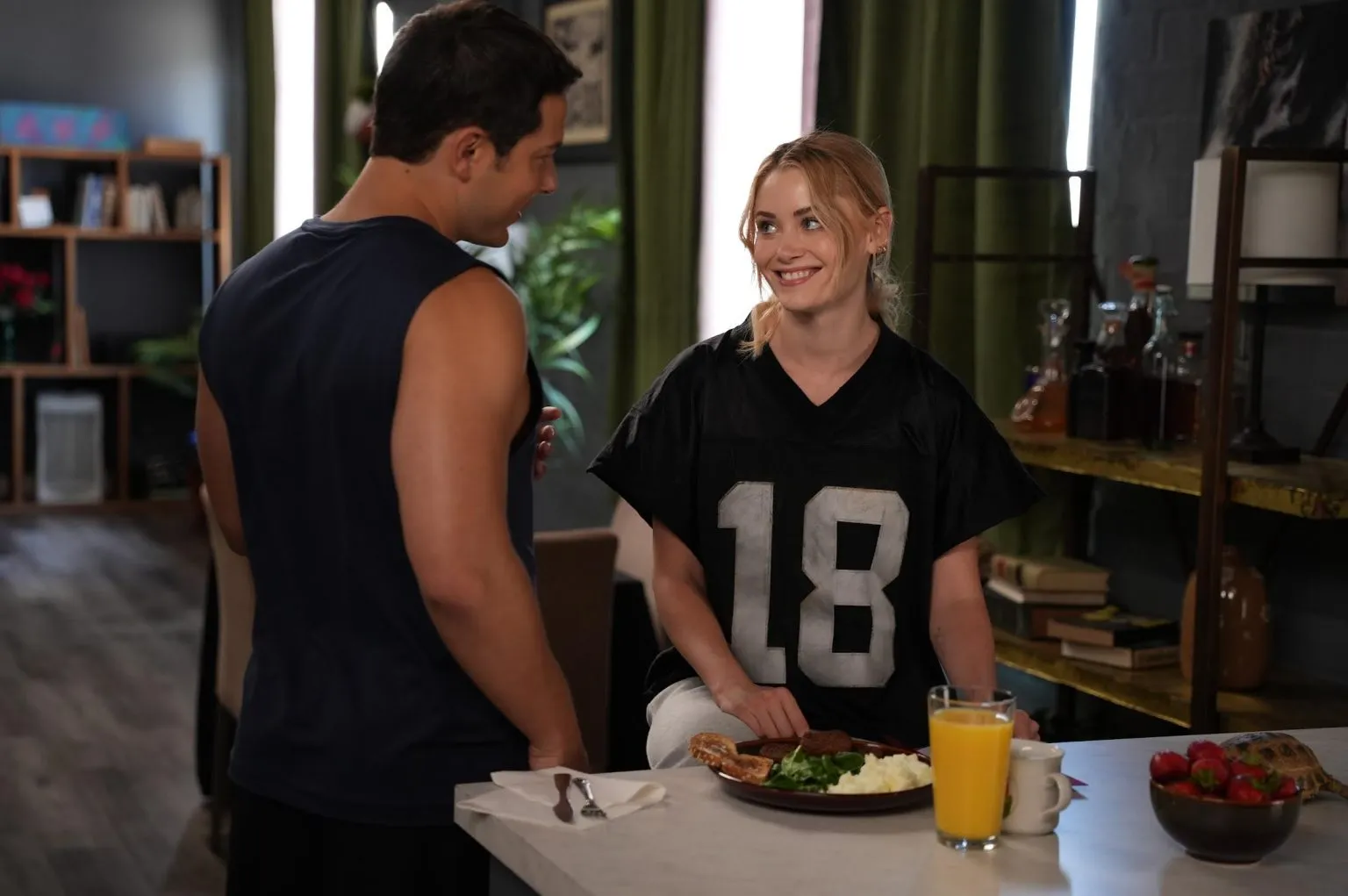
The film also underlines the intellectual gap between characters through a conversation about the Raiders. Gina asks about the football team. Andrew responds with eager talk about Indiana Jones. The intended joke is incompatibility made visible through a misunderstanding, a quick sketch of two people missing each other’s wavelength. The moment feels like a leftover gag from an older script template, a shortcut that labels “wrong person” without any texture.
The plot also asks the viewer to accept selective forgetfulness around Gina’s resources. She behaves as if trapped by circumstances at key moments, sidelining her own wealth and agency to keep the Greek standoff alive. Those artificial barriers are what prevent the story from resolving early. Character logic takes a back seat to the genre’s required beats, and the screenplay drags its people through those marks, regardless of fit.
The Digital Veneer of Romance
The film’s visual identity reads as a catalogue of missed chances and technical compromises. Greece offers natural beauty that could lift almost any production through light, color, and scale. Mark Gantt’s direction often feels caught between that gift and the limitations of a tight budget.
The clearest example is the digital pizza. Johnny’s heart-shaped pies appear with such weak rendering that they resemble flat images hovering inside the frame. The decision feels strange because a physical heart-shaped pizza requires modest effort to create or purchase. Choosing a visibly artificial solution breaks the spell and keeps reminding the audience of the film’s construction.
Tone fractures in the same way. The movie sits between the polished cleanliness of a Hallmark-style romance and the sharper edge of an indie comedy, reaching for sunshine and happy endings while also chasing cynical dialogue and adult situations. The result feels scrubbed even while it gestures toward grit. The Mediterranean light should carry warmth and sensuality. The cinematography often looks flat, leaving the islands without depth or texture. Interiors fare worse, landing as generic spaces that do little to make Wendy’s home feel like a refuge with history and weight.
Pacing suffers too. At ninety minutes, the film has room to move with speed. It slows under repetition and a lack of escalating urgency. Editing does not shape tension into a rising line. Scenes arrive as disconnected vignettes, a hop from beach to villa to taverna with emotional stakes that barely shift. The setting never becomes an active force in the romance.
Greece is treated like a postcard pinned behind the characters, interchangeable with any sunny location. The story’s bones could exist in a parking lot in Encino and function the same. The dependence on digital generative effects for basic props becomes the final irritation, leaving an impression of filmmakers enchanted by the concept of a movie while neglecting the labor and craft of making one.
The Gravity of the Supporting Cast
The supporting players provide the clearest signs of competence inside a shaky structure. Marisa Tomei appears briefly as Wendy and supplies an ease that makes the role feel inhabited. She brings a relaxed authority that exposes the stiffness around her, as if other actors are reciting lines while she is living inside them. In limited time, she gives the film’s talk of family and honesty a pulse that suggests real stakes could exist here. Her performance feels sized for a more thoughtful project, and her long absence drains energy from the runtime.
Lil Rel Howery and Natasha Leggero serve as a comedic lifeline. Playing neighbors Steven and Tricia, they operate with sharper dialogue, cleaner timing, and chemistry that reads as believable. They embody the settled life Gina fears, and they carry themselves like the only people enjoying their own scenes. Their contributions, especially in reactions to the tortoise chaos, generate the film’s clearest laughs. Their subplot ends up pulling more weight than the central story, a case where the side material feels more alive than the main machinery.
Skylar Astin performs his own rescue operation by keeping Andrew likable. The script frames Andrew as a burden, treating sincerity as a flaw that needs correcting. Astin supplies warmth and vulnerability, encouraging the audience to question Gina’s treatment of him. Andrew never plays as a villain. He comes across as the single character acting in good faith.
That shifts the viewing dynamic: attention drifts toward hoping Andrew escapes Gina, not toward hoping Gina finds a healthier way to love. Comedy success depends heavily on these secondary players. While the main plot strains for forced set pieces, the supporting cast finds humor through character observation and fast delivery. They function as scaffolding, holding up a structure that looks unstable even on a calm day.
Formula Under a Different Name
The film’s deepest problem is timidity. Its title and premise advertise an aggressive turn away from romantic comedy convention, then the story repeatedly chooses safety and familiarity. The anti-Valentine posture plays like a marketing surface painted over a standard template.
A late reveal explaining Gina’s hatred of the holiday arrives as a worn trope and does little to account for her behavior across the preceding runtime. The film asks for forgiveness after ninety minutes of manipulation and lying, offering a single emotional wound introduced near the end and left unexplored until the last stretch.
The romantic outcomes feel unearned. The story asks viewers to cheer a pairing grounded in mutual deception and shared cynicism. Gina receives no credible arc of growth. She ends up with someone willing to join the performance. The closing movements follow a genre checklist: grand gesture, sunset, the announcement of true love. Because the characters refuse honesty with themselves and each other, those beats land without emotional weight.
The film also gestures toward the idea that love’s traditional symbols have no meaning, then leans on those same symbols to deliver its happy ending. Heart-shaped pizza returns as both visual motif and punchline, and the film clings to it while undercutting its own stance. By the end credits, the opening’s abrasive charge has been softened into something polite and familiar.
What remains could slide into the very Hallmark-shaped lane the film spends time mocking. The trip to Greece leaves a residue of fatigue, not romantic lift. The title stands out as the project’s clearest truth, a blunt expression of frustration that many viewers will recognize long before the final scene.
F*ck Valentine’s Day premiered on digital and on-demand platforms on February 6, 2026, offering a cynical yet sun-drenched departure from the typical holiday romance. Set against the beautiful backdrops of Greece, the story follows a woman born on February 14th who attempts to sabotage her own life to avoid a romantic milestone. Viewers can currently watch the film on streaming platforms such as Disney+, Hulu, and Fandango at Home, as well as via major digital retailers.
Where to Watch F*ck Valentine’s Day (2026) Online









Full Credits
Title: F*ck Valentine’s Day
Distributor: Shout! Studios, Shout! Factory
Release date: February 6, 2026
Rating: R
Running time: 95 minutes
Director: Mark Gantt
Writers: Steve Bencich
Producers and Executive Producers: Nancy Leopardi, John Ierardi, Bo Youngblood, Michael Leon Cassutt, Arlie Day, Danielle Gasher, Mike Page
Cast: Virginia Gardner, Marisa Tomei, Skylar Astin, Jake Cannavale, Sabrina Bartlett, Natasha Leggero, Lil Rel Howery, Marysia S. Peres
Director of Photography (Cinematographer): Andrew Russo
Editors: Carsten Kurpanek
Composer: Woody Pak
The Review
F*ck Valentine’s Day
The film is a hollow exercise in performative cynicism that ultimately retreats into the very clichés it purports to despise. Despite a vibrant Greek setting and a capable supporting cast, the narrative is anchored by unlikable protagonists and a script reliant on baffling contrivances. The technical shortcuts, particularly the jarring digital effects, further erode its credibility. It promises a subversive edge but delivers a generic, emotionally stagnant experience that fails to justify its abrasive posturing. It is a holiday card with a provocative cover and nothing but blank space inside.
PROS
- Marisa Tomei, Lil Rel Howery, and Natasha Leggero provide much-needed charisma and genuine humor.
- Astin manages to remain likable and grounded despite being trapped in a thankless "wrong guy" role.
- The natural beauty of the Greek islands offers a pleasant, if underutilized, visual backdrop.
CONS
- The protagonists’ penchant for pathological lying makes it impossible to root for their romantic success.
- The use of poor CGI for simple props like pizzas feels cheap and distracting.
- The plot relies on improbable coincidences and clerical errors rather than organic character growth.
- The movie struggles to balance "edgy" cynicism with the formulaic sweetness of a standard television rom-com.