

















The Huntsman drops us into the somber, quiet atmosphere of Antrim, New Hampshire. It feels like the kind of place where a secret sits in the air with the same weight as winter. Max, played by Shawn Ashmore, works as an ICU nurse with a singular focus. He asks to be assigned to Lincoln Raider, a man played by Garret Dillahunt who lies in a deep coma.
Lincoln is the primary suspect in the brutal murders of six young women, a case that has left the community locked in fear. When Lincoln wakes, his recovery shifts from the sterile hospital ward to his home. Max continues caring for him there, working alongside Lincoln’s wife, Jolene. Elizabeth Mitchell gives Jolene a quiet intensity, playing a woman who stays beside a man the rest of the world has already condemned.
Outside the house, the case keeps moving. Max’s sister, Detective Darby Albright, played by Jessy Schram, pushes to find the real killer. She operates under a ticking clock and under the pressure of a public that already believes it knows who the monster is. The film keeps these threads running in parallel, letting the town’s fear press in from the edges while the home care scenes tighten like a room with the door closed.
Translating the Internal to the Screen
Adapting a novel like the one by Judith Sanders comes with a specific challenge. The book builds suspense through the internal thoughts of its characters. Steven Jon Whritner’s script tries to carry those private currents onto the screen through a stripped-down narrative. The film splits its time between Max’s quiet, clinical observation and Darby’s loud, frantic procedural work. That two-track design sets the film’s rhythm.
Inside the Raider home, scenes play like a slow-burning fuse. The camera watches people talk, pause, and choose their words, and the tension comes from waiting for a slip or a sudden revelation. Early on, the movie uses theatrical opening sequences and quick montages to establish the history of the crimes.
They supply the needed background before the story settles into a more grounded pace. Suspects like the mysterious Sam Miller keep uncertainty alive. The plot asks the audience to keep looking for what is missing from the obvious facts and to stay open to a hidden truth. The chapter-to-chapter feel reminded me of reading a mystery late at night, where each shift in perspective rearranges the same pieces and changes what you think you know.
Also Read




A Study in Silence and Suspicion
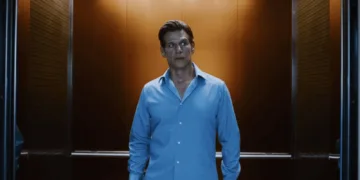
The film’s strongest work comes from how the cast handles silence. Shawn Ashmore plays Max with an earnestness that feels slightly off-balance. His attachment to Lincoln is easy to sense, while his reasons stay tucked behind a professional mask. The film encourages you to keep testing your read on him, scene by scene, because the care he gives can carry more than one meaning.

Garret Dillahunt brings a heavy presence to Lincoln even before he speaks. Motionless in a hospital bed, he still feels like a force in the room. Once he begins talking, his distinct, careful delivery deepens the unease. He stays enigmatic, and that choice keeps the character from settling into familiar shapes. Elizabeth Mitchell works as the counterweight.
Her Jolene’s devotion lands as touching and unsettling in the same breath, and her restraint suggests she holds back information without giving the game away. Jessy Schram’s Darby anchors the world beyond the house. Her scenes carry the high-stress pulse of a police department where everyone is braced for the next call. Placing that pressure beside the tight quiet of the home care scenes makes the central characters feel sealed off from the town that wants an answer.
The Visual Fog of Moral Uncertainty
Director Kyle Kauwika Harris leans into a visual approach that matches the story’s grim mood. The cinematography favors a dark, influenced look, with colors that appear almost drained of life. The effect creates a fog over what we see and what we think we understand.
In the first act, the editing moves quickly and lands in choppy bursts, using montages to set the situation in motion. Once the story settles into the Raider household, the camera holds longer. Those lingering shots make you scan faces and corners of the frame for clues, for micro-shifts in expression, for any sign that the story is about to tip.
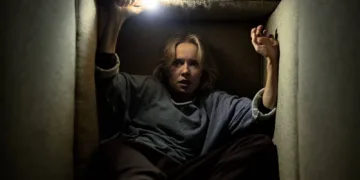
The production design supports that emptiness. Interiors look sparsely furnished, shrinking the characters inside their own lives. A recurring motif returns to an unnamed woman held in a cellar. These moments arrive like flashes from a nightmare, a blunt reminder of the stakes that refuses to fade into the background.
Cory Perschbacher’s score lays a constant, droning bed under the film. The sound design echoes a cold wind and rarely changes its temperature. The music carries across scenes, binding them into one continuous experience of dread. It keeps insisting that even a quiet pause has weight.
The Weaponization of Care
The film circles a harsh idea: compassion can turn into a tool for something far less noble. Max’s work as a caregiver puts him in a position that holds power and vulnerability at once. The story tracks how a person can become tangled up with someone who might be a monster, and it keeps the moral space around that connection murky.
Antrim lives in paranoia, fueled by the memory of the Huntsman. Every secret held by the Raiders or by Max feeds a sense of rot that seeps through the rooms and into the investigation. The film keeps returning to obsession, to the way fixation can warp what a person notices and what a person avoids.
When the resolution arrives, it tries to gather the film’s threads into something coherent without smoothing away every rough edge. The audience is left to decide if the answers feel sufficient to clear the air. The questions that linger about who these people really are suggest that some secrets resist full exposure. That lingering ambiguity fits a modern thriller impulse: an ending that sits with internal damage, with what remains after the case file stops moving.
The Huntsman is a psychological thriller that made its limited theatrical debut on February 6, 2026, followed by a wide release on various Video On Demand (VOD) platforms on February 10, 2026. Directed by Kyle Kauwika Harris and based on the novel by Judith Sanders, the film follows an ICU nurse who becomes entangled in a dangerous game of obsession while caring for a comatose patient suspected of serial murder. You can currently watch the film by renting or purchasing it on platforms like Amazon Prime Video, Apple TV, and the Google Play Store.
Where to Watch The Huntsman (2026) Online









Full Credits
Title: The Huntsman
Distributor: Epic Pictures Group
Release date: February 6, 2026 (Theatrical), February 10, 2026 (VOD)
Rating: TV-MA
Running time: 1 hour 35 minutes
Director: Kyle Kauwika Harris
Writers: Kyle Kauwika Harris, Steven Jon Whritner, Judith Sanders
Producers and Executive Producers: Garret Dillahunt, Judith Sanders, Frank Malinoski, Patrick Ewald, Katie Page, Kalani Kauwika Harris, Shawn Ashmore
Cast: Shawn Ashmore, Garret Dillahunt, Elizabeth Mitchell, Jessy Schram, Todd Jenkins, Laci Kaye Booth, Amy Arburn, Austin Rising
Director of Photography (Cinematographer): Jacob Leighton Burns
Editors: Kyle Kauwika Harris
Composer: Cory Perschbacher
The Review
The Huntsman
The Huntsman is a moody, slow-burning exploration of moral rot that thrives on its hushed atmosphere and strong lead performances. While the transition from novel to screen results in some narrative thinning and a occasionally frustrating pace, the central tension between Shawn Ashmore and Garret Dillahunt remains genuinely unsettling. It is a quiet, indie thriller that prioritizes the "moral fog" of its characters over traditional genre explosive beats. If you appreciate a mystery that lingers in the shadows rather than rushing toward the light, this clinical study of obsession is worth the watch.
PROS
- Dillahunt and Ashmore create a palpable, eerie chemistry.
- The visual and auditory choices effectively build dread.
- Interesting exploration of the "weaponization of compassion."
- Avoids many typical "serial killer" movie tropes.
CONS
- The "slow-burn" approach occasionally feels stagnant.
- Some of the novel's depth is lost in the script.
- The persistent drone can sometimes overwhelm the dialogue.
- Talented actors are sometimes given one-dimensional dialogue.