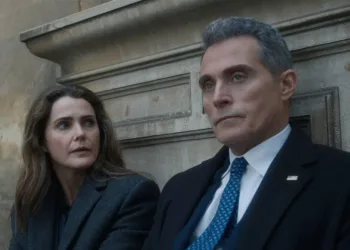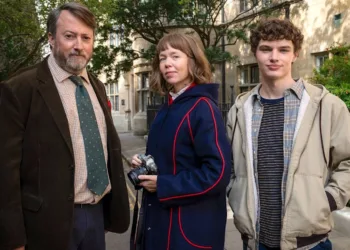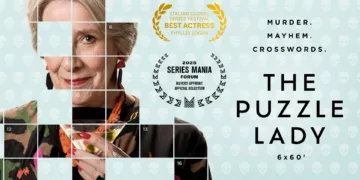























Murder Most Puzzling lands as a peculiar entry in contemporary television, carrying Parnell Hall’s literary setup into the fictional village of Bakerbury. A serial killer leaves cryptic crossword clues on the bodies of victims, a morbid flourish that ruptures the town’s surface calm.
Cora Felton arrives in the middle of that rupture, played by Phyllis Logan. Publicly branded as The Puzzle Lady, Cora stands as a national celebrity with biscuit endorsements and a polished, razor-bright persona. DCI Derek Hooper, portrayed by Adam Best, faces crimes built around ciphered messages and reaches for outside help, pulling Cora into the casework. Sherry, Cora’s niece and assistant, enters as a steadying presence, played by Charlotte Hope.
The series draws on substantial source material, yet the adaptation frames itself as a cosy crime drama that pairs grisly murder with a familiar rural mystery posture. The show tries to keep both registers active at once: the unease of a serial killer plot and the reassurance of village procedure. That tension defines the viewing experience, staking a claim inside a genre already crowded with well-established rhythms.
A Study in Character Friction
The series runs on the collision between Cora Felton’s public presentation and her private conduct. Phyllis Logan plays Cora as a woman who performs a demure, grandmotherly image for commercial partners while living with disorder, heavy drinking, and a temperament that snaps at the edges. Cora reads as a nosy amateur with an abrasive streak, and the persona sold to the public operates as a mask she wears with practiced control.
Charlotte Hope’s Sherry serves as the corrective force: an intelligent, grounded counterweight who keeps the work moving when Cora’s impulses threaten to derail it. Their partnership functions through necessity rather than warmth, and the strain between them becomes a steady engine for the investigations.
DCI Derek Hooper embodies local policing under pressure. Adam Best plays him as perpetually unprepared for the crimes in front of him, his professional insecurity intensified by a domestic life that never loosens its grip. The supporting cast widens the social texture of Bakerbury’s crisis. The reporter Anton Grant enters as a cynical foil and shifts into a reluctant collaborator as the cases unfold.
Yasmin Seky turns up the voltage as a manipulative solicitor, bringing a sharper energy that cuts through scenes where tonal balance can wobble. The production’s relocation to Northern Ireland adds its own complication. Belfast-adjacent accents leak into the soundscape, and the clash with Bakerbury’s supposed English identity creates a faint but persistent sense of dislocation.
The Mechanics of the Mystery
Crosswords operate as the show’s signature hook, yet the puzzles often sit behind the real detective work. The clues establish a theme and a pattern, then the resolution tends to hinge on Cora’s habit of noticing details and her comfort with stepping past social limits.

Her investigative method relies on intrusion, confidence, and a willingness to treat etiquette as optional. The brand of “Puzzle Lady” sits uneasily inside that structure, because the fame attached to puzzles becomes a burden that shapes how others treat her and how she moves through the community. The series builds a running irony from that contradiction, letting the persona define her access while draining her patience.
The 90-minute format strains the show’s pacing. Several episodes stretch thin material across a long runtime, which produces repeated loops of questioning, side conversations, and village gossip used as filler between key beats. A separate friction emerges in the sound and tone.
Jaunty music leans toward comfort viewing, while the scripts introduce harsher notes, including profanity and conversations about sexual assault. Those elements arrive with a bluntness that unsettles the cosy template and can push the audience out of the intended mood when the show swings too quickly between levity and menace.
Structural trouble does not erase craft. The scripts frequently land on coherent solutions to the mysteries, and the show understands the pleasures of closure inside an episodic format. A mid-series reveal about Cora’s lack of genuine puzzle skills reframes her professional identity and exposes a rawer vulnerability beneath the commercial mask. That disclosure pressures her standing with the authorities and shifts the terms of her collaboration with the police, forcing characters to reassess what her reputation has actually purchased.
The Landscape of the Procedural
Bakerbury appears through Northern Irish locations, with the look of Ballymena shaping the town into a postcard market setting. The cinematographic choices follow cosy-mystery conventions closely, presenting a welcoming visual environment that sits beside the violence of the cases. The series takes a recognizable position alongside other female-led procedurals and uses age as a practical tool inside its storytelling.
Cora exploits her senior status to slip past security and extract information that younger investigators might fail to access. Her age reads as camouflage, and the show builds small investigative advantages out of the way people underestimate her.
Cora remains distant from the reclusive genius model common in puzzle-centered dramas. She functions as a reluctant sleuth pulled into crime through professional obligation and personal habit, with curiosity behaving like reflex. That characterization keeps the series aligned with accessible, Sunday-style television that prioritizes comfort and familiarity.
The show holds a steady, uncomplicated rhythm even in prime time, with the cadence of an afternoon procedural built into its scenes and solutions. The result is an undemanding, familiar experience that aims to satisfy an expectation: a traditional mystery that resolves its tension cleanly within a single sitting.
Murder Most Puzzling is a crime mystery series that premiered on the UK’s Channel 5 on June 19, 2025, and recently made its debut for North American audiences on PBS on February 20, 2026. The series is adapted from the popular Puzzle Lady book series by Parnell Hall and follows the chaotic adventures of Cora Felton, a woman who has achieved national fame as a crossword genius despite a secret disdain for puzzles. Filmed against the scenic backdrops of Northern Ireland, the show blends the traditional charm of a British market town with the darker elements of a serial killer investigation. Viewers in the UK can catch the series on the My5 streaming platform, while US audiences can stream it through PBS Passport and associated digital channels.
Full Credits
Title: Murder Most Puzzling (released in the US as The Puzzle Lady)
Distributor: Channel 5 (UK), PBS (US), Paramount
Release date: June 19, 2025 (UK Premiere), February 20, 2026 (US Premiere)
Rating: TV-14
Running time: 94 minutes per episode
Director: Tom Dalton
Writers: Dominique Moloney (Screenwriter and Creator), Parnell Hall (Original Novels)
Producers and Executive Producers: Tom Dalton, Emily Dalton, Jonathan Ford, Shane Murphy, David Nath
Cast: Phyllis Logan, Charlotte Hope, Adam Best, Alistair Brammer, Nick Danan, Jack Weise, Simon Haines, Yasmin Seky, Richard Croxford
Director of Photography (Cinematographer): Michael Lavelle
Editors: John Murphy
Composer: Sheridan Tongue
The Review
Murder Most Puzzling
Murder Most Puzzling remains a fragmented experience, struggling to reconcile its sun-drenched aesthetic with a darker serial killer narrative. Phyllis Logan provides a nuanced performance as a character built on a lie, yet the sluggish pacing and inconsistent tone hinder the impact of the mystery. While the final solutions offer satisfying logic, the series feels like a familiar procedural that lacks a distinct identity. It serves as a comfortable, if predictable, addition to the genre for those seeking light entertainment.
PROS
- Murder Most Puzzling remains a fragmented experience, struggling to reconcile its sun-drenched aesthetic with a darker serial killer narrative. Phyllis Logan provides a nuanced performance as a character built on a lie, yet the sluggish pacing and inconsistent tone hinder the impact of the mystery. While the final solutions offer satisfying logic, the series feels like a familiar procedural that lacks a distinct identity. It serves as a comfortable, if predictable, addition to the genre for those seeking light entertainment.
- The murder mysteries feature logically sound solutions.
- The visual setting captures a classic rural charm.
CONS
- The 90-minute episodes lead to significant pacing issues.
- Conflicting accents disrupt the sense of location.
- Abrupt shifts between comedy and violence feel jarring.