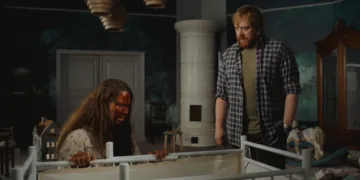




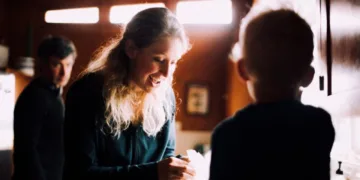












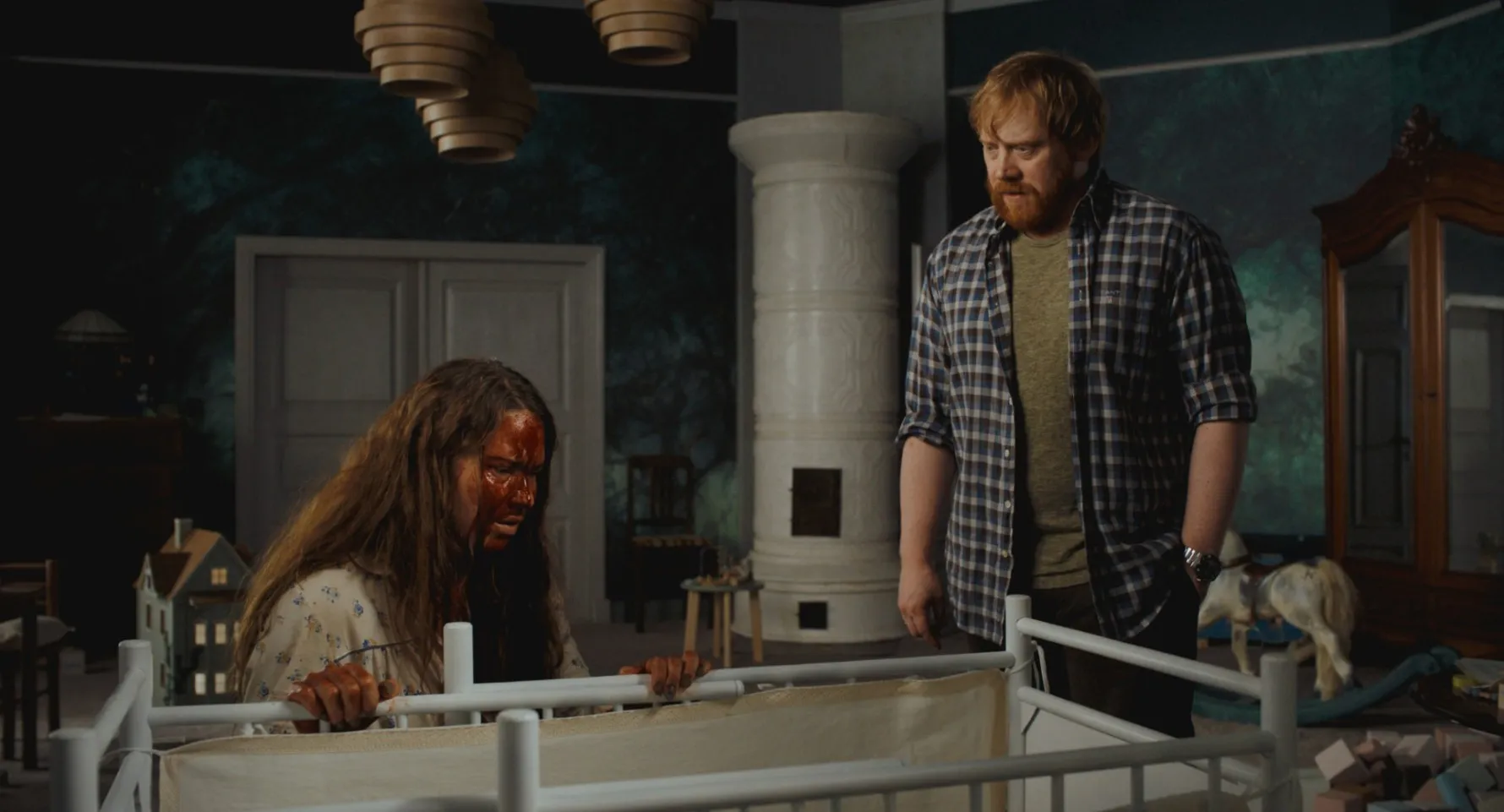

The aspiration for a pastoral reset brings Saga and Jon to a crumbling Finnish estate left to Saga by her grandmother. They cross the threshold carrying a picture of domestic calm, then meet peeling wallpaper and plant life spreading across interior floors. The place stands beside an ancient forest that behaves like an attentive presence. The couple plans to fill the property with a large family, beginning with their son, Kuura.
That hope collapses at the moment of delivery. Kuura arrives as a biological anomaly, an infant whose existence registers as wrong. Saga recoils from him immediately, cut off from the instinctual tether motherhood is supposed to supply. She reads a predatory edge in her newborn.
Jon watches without comprehension. His position as a British outsider inside a landscape weighted with folklore leaves him unable to interpret what is taking root in their home. The Finnish countryside loses its promise, replaced by the sense that something primordial has been invited inside and given a crib.
The Parasitic Nature of the Cradle
Cinema seldom allows motherhood to appear this punishing. The film adopts the language of body horror to tear through the cleaned-up, performative versions of parenting that circulate in public talk. Childbirth appears as trauma, and Saga comes out of it physically broken and emotionally emptied. Breastfeeding turns into a visceral trial as the infant draws blood, converting a ritual associated with comfort into literal consumption.
Saga begins to speak of her child as an object, calling Kuura “it” as a method of survival while fear spreads. That distance sharpens through the absence of communal care. Family members and medical professionals offer reassurance with the smoothness of a script, insisting the child is healthy while the abnormalities remain visible and unaddressed. Kuura functions as a parasite in plain sight, draining Saga’s vitality and scraping at her sanity.
The story sustains a deliberate haze. Postpartum psychosis and supernatural intrusion occupy the same air, inseparable in practice, equally damaging in effect. The fear of a failed bond takes physical form through a monstrous offspring, and the film presses on the quiet desperation of being consumed by a dependent’s relentless needs. It treats maternal suffering as something that can be hidden in language until the body refuses to cooperate.
A Domesticity in Freefall
This descent depends on the sharply divided energies of the two leads. Seidi Haarla shifts from quiet anticipation into feral desperation with a performance that feels like a transformation witnessed in real time. She conveys the isolation of being the sole person willing to name the darkness in the room. Her Saga carries recognition like a burden, and the burden becomes heavier because nobody agrees it exists.
Rupert Grint plays Jon with a carefully tuned benign passivity. He fits the mold of the well-meaning father whose relentless optimism becomes its own kind of gaslighting. The posture of cheerfulness insists that everything can be handled with tone and routine, even as the household slides into terror. That split peaks during a feeding sequence built around the “airplane” game, where Jon’s bright attempts at normalcy collide with the child’s appetites and the scene curdles into something frightening.
Saga’s isolation deepens through her mother, whose dismissiveness frames maternal suffering as a family custom, something endured and then handed down. The marriage fractures under the weight of truths that remain unshared. In that rupture, a new alliance takes shape. Saga begins to recognize parts of herself in her son’s strange violence, and a grim kinship emerges, one that shuts out the civilized world Jon continues to represent.
The Tactile Architecture of Dread
The atmosphere is built through physical presence. Practical artistry takes priority over the sterility associated with digital effects, and that choice keeps the horror close to the skin. Kuura is realized through intricate puppetry with a tactile, retro texture that makes his rapid growth and sharp features feel dangerously immediate. The baby comes assembled from unsettling specifics: fine hair like a coat, nails with a predatory suggestion, and a voice that replaces familiar crying with a rhythmic, animal rasp.
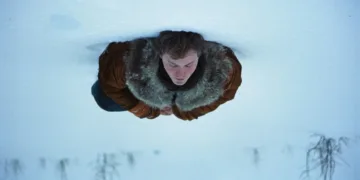
Sound and space work together to show domestic life slipping. Production design supports that unraveling as the house shifts through a slow metamorphosis, forest life pushing through floorboards while shadows deepen in corners that used to belong to ordinary safety. The cinematography leans into a dark fairy-tale register, using the natural gloom of the Finnish woods to hide the creature and stretch tension through partial glimpses.
The film offers no tidy explanation for Kuura’s origin. The mystery stays anchored in the landscape itself. The forest gives no answers. It mirrors the wild, untamable forces that can surface inside a family unit, forces that demand recognition even when the household insists on manners, routines, and a bright voice at the table.
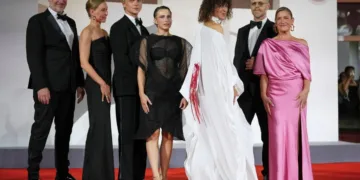
Nightborn premiered at the 76th Berlin International Film Festival on February 14, 2026. This Finnish, British, French, and Lithuanian co-production serves as the English language debut for director Hanna Bergholm. While the film has recently appeared in theaters for its festival run, wider accessibility is anticipated via Goodfellas for international territories and Shudder for domestic viewers.
Full Credits
Title: Nightborn
Distributor: Goodfellas, Shudder
Release date: February 14, 2026
Running time: 92 minutes
Director: Hanna Bergholm
Writers: Hanna Bergholm, Ilja Rautsi
Producers and Executive Producers: Daniel Kuitunen, Noëmie Devide, Brahim Chioua, Nick Shumaker, David Levine, Scott Schooman, Emily Gotto
Cast: Seidi Haarla, Rupert Grint, Pamela Tola, Pirkko Saisio, Rebecca Lacey, John Thomson
Director of Photography (Cinematographer): Pietari Peltola
Editors: Jussi Rautaniemi
Composer: Eicca Toppinen
The Review
Nightborn
Nightborn is a visceral, unflinching look at the shadow side of creation. It succeeds by grounding its folklore in the raw, messy reality of the postpartum body and the psychological strain of isolation. While the central metaphor is heavy-handed, the commitment to practical effects and Seidi Haarla’s haunting performance creates a domestic nightmare that feels both ancient and urgently modern. It is a grim, stylish piece of genre filmmaking that prioritizes emotional honesty over easy scares.
PROS
- Exceptional lead performance by Seidi Haarla
- Tangible, unsettling practical creature effects
- Immersive and claustrophobic sound design
- Bold exploration of maternal taboo and trauma
CONS
- The central metaphor can feel repetitive
- Occasional tonal shifts into dark comedy
- Some secondary characters lack depth
- Narrative pacing feels slow in the first act