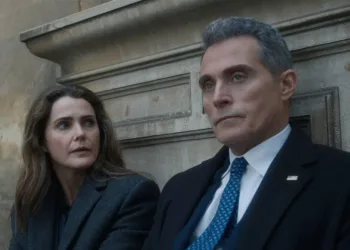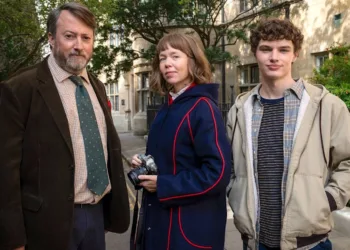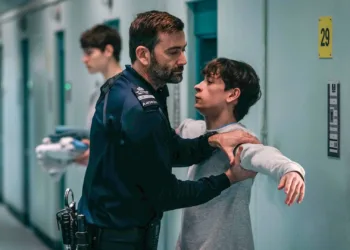


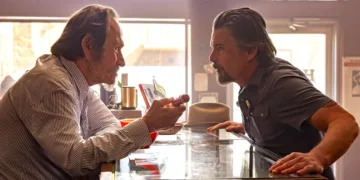




















The sky above Denver holds its blue like a verdict that never arrives. It hangs there, calm and inattentive, while the See You When I See You places the Whistler family beneath a silence with the density of stone. Jay Duplass frames the aftermath of a life that ended by its own hand, shaping Adam Cayton-Holland’s memoir into a film haunted by the permanence of absence.
Aaron Whistler builds his days out of comedy’s temporary architecture, jokes that flash and vanish. Then he is pinned to the leaden knowledge of his sister’s body, and the world begins to feel like a room where the lights have gone out and the walls must be found by touch.
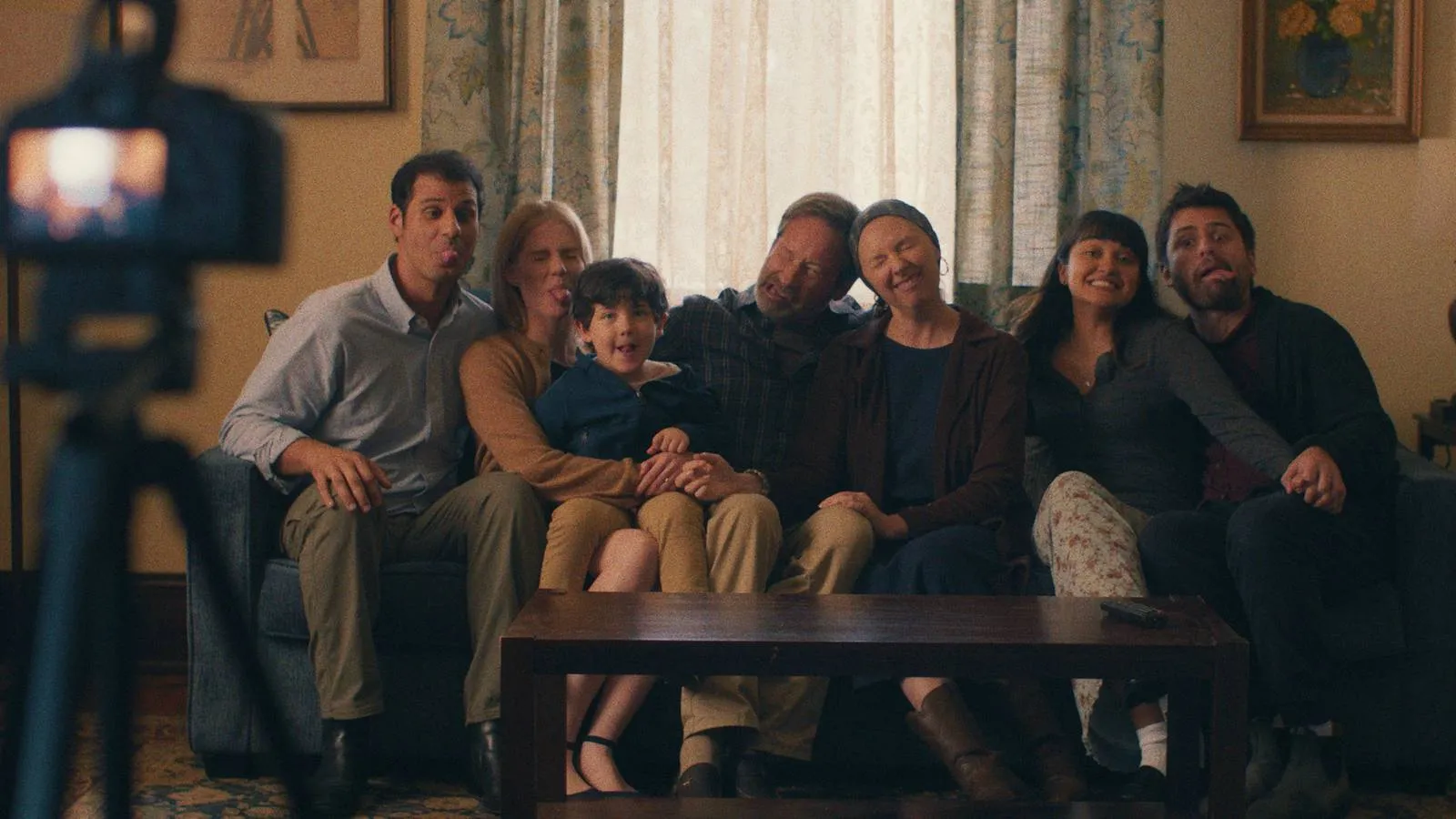
The story begins with refusal. The family splinters around the funeral, as if the ceremony itself carries metaphysical force. Aaron and his mother, Page, read it as a grotesque performance, an enactment of finality that demands their consent. His father, Robert, and his sister, Emily, look for containment, for a ritual strong enough to keep grief from spilling into every corner of the house. The film lives inside that fracture. It keeps its hands off easy comfort and lets the jaggedness stay jagged. Their home fills with the pressure of things unsaid, a heavy stasis where time seems to stop at the moment Leah was found, and every ordinary object becomes a witness that cannot testify.
The Solitude of the Survivor
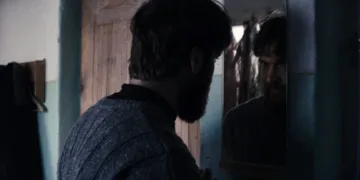
Aaron’s grief moves like a slow solvent, working on the self until the edges soften and the shape begins to fail. He drinks to smear the image that stalks his waking hours, to fog the mind’s relentless replay. Cooper Raiff plays him with boyish openness that sits beside a deep, poisonous avoidance. This Aaron survives by charm and deflection, a man who knows how to make a room like him while carrying the instability of a minefield. His suffering has a kind of inward gravity, pulling every conversation back into his private collapse.
Emily stands on the other side of the abyss. Lucy Boynton gives her a brittle strength, a practiced composure that reads as discipline and panic at the same time. Emily fixes on logistics, turning death into a checklist, a series of tasks that promise order. She clings to rules because rules keep the void from becoming the only language available. The siblings embody two different philosophies of survival: one dissolves into sensation, the other builds scaffolding from procedure.
Their parents redirect agony into objects and causes, each searching for a form sturdy enough to hold what cannot be held. David Duchovny’s Robert becomes a curator of the trivial. He guards childhood macaroni art as if dried pasta could carry ontological weight, as if a scrap of craft time could anchor a lost child to the earth.
His belief has the desperate logic of mourning: collect enough artifacts and the person may remain in the room, at least as a pressure in the air. Hope Davis’s Page turns toward the conservation of the Sage Grouse, finding a cold solace in a species that is vanishing. The disappearance outside her mirrors the erosion within her, and that parallel seems to offer a harsh kind of companionship.
Leah appears through flickers of the past. Kaitlyn Dever plays her as joyful and terrifyingly unreachable, a presence that warms the frame and then retreats into mystery. Leah remains unknowable even to the people who loved her most. Her darkness lived as a silent companion until it hardened into a final statement, leaving the family to interrogate a silence that never answers.
Supporting figures steady the film’s emotional physics. Camila functions as an anchor, refusing to let Aaron’s self-absorption pass for sanctified pain. She pushes back, insisting on the ethical demand the world still makes. Grief can stunt a person, can turn suffering into an excuse for collateral damage, and her presence keeps that danger in view. Through her, Aaron begins to face a difficult truth: pain changes what you can carry, yet it does not grant permission to wreck the lives around you.
The Fissure in the Mundane
The film’s visual language cracks open the ordinary to reveal a mind under siege. Duplass uses surrealist motifs as eruptions of interior reality, as proof that trauma interrupts the present without asking. A fissure opens in the wide Colorado sky. A hole appears in a ceiling and draws Leah upward into a quaking void. These images do not function as decorative flourishes. They translate intrusive thought into physical event, giving shape to the way the brain replays catastrophe as if it is still happening.
The directing remains grounded in mumblecore naturalism, then it shifts under the pressure of a musical score that feels strangely light. The dissonance lands like a cruel principle: the world keeps its tempo even as a family loses its language. The brightness of the music suggests persistence, and that persistence can feel like mockery to the bereaved. The film allows that uneasy sensation to stand without explanation, the idea that indifference can bruise as sharply as malice.
Flashbacks arrive as active negotiations. Aaron does not simply remember Leah. He engages with her, argues with her, demands an answer for the silence she left behind. Memory becomes a space where the living try to bargain with the dead, where questions keep forming even after the addressee has vanished. The pacing follows the erratic pulse of recovery. It lingers inside the stillness of a lonely room, then it rushes past the medical crisis facing Page. That haste carries its own meaning. Secondary pain fades from view when the primary loss fills the frame, and the film registers that narrowing of attention as part of grief’s distortion.
Humor surfaces in sudden, messy bursts. A bird defecates on a man attempting to speak to a therapist, and the moment lands with the bluntness of the absurd. The universe does not pause for decorum. It keeps producing slapstick even in the shadow of death. That absurdity does not read as cruelty; it reads as indifference, as the world’s refusal to synchronize with private catastrophe. The film captures the sensation of existing in a place that continues moving while you remain trapped inside one terrible second. It shows the isolation of a traumatized mind that sees ghosts in the middle of a taco truck line, where everyone else sees lunch.
The Mechanics of Reclaiming the Mind
The second act introduces a clinical ritual that gives form to pain that has resisted language. Aaron begins Eye Movement Desensitization and Reprocessing, a technique aimed at the biological storage of trauma. Poorna Jagannathan plays Dr. Anya, guiding him through sessions using handheld pulsators. The rhythmic buzzing in his palms becomes a tether to the physical world, a simple sensory fact he can hold while his mind pulls him back toward the site of Leah’s death. The method carries an implicit philosophy: the past remains fixed, the body’s reaction can shift, and a memory can move from raw wound to contained file.
The film’s emotional peak arrives when Aaron must mentally approach the bathroom door again. He returns to the threshold of the event that shattered him and forces himself to look without being swallowed by darkness. The title, See You When I See You, comes from Leah’s final text message. Within the film it changes meaning, moving from a symbol of failure into a boundary Aaron defines for himself. He decides when he can face the ghost. He chooses the terms of his encounter with what remains.
The film offers ongoing labor rather than closure. It treats recovery as reconstruction, slow and deliberate, the rebuilding of a life that has been leveled. Loss does not vanish; it reshapes the terrain of the self. The work becomes learning how to exist beside an absence that stays present, how to keep living while carrying the void like an extra organ. By the end, Aaron remains unhealed, yet he becomes present. He stops watching his own destruction from a distance and begins to inhabit his days again, even while the sky above Denver keeps its indifferent blue.
See You When I See You premiered at the Sundance Film Festival on January 27, 2026, as part of the Premieres section. Based on the acclaimed memoir Tragedy Plus Time by comedian Adam Cayton-Holland, the film explores the complex, often absurd landscape of grief following a family tragedy. While it made its debut on the festival circuit to find a permanent streaming or theatrical home, it is currently seeking wider distribution for audiences outside of Park City.
Full Credits
Title: See You When I See You
Distributor: Astute Films, Duplass Brothers Productions, Winter Coat Films (World Premiere at Sundance Film Festival)
Release date: January 27, 2026
Running time: 102 minutes
Director: Jay Duplass
Writers: Adam Cayton-Holland
Producers and Executive Producers: Fred Bernstein, Kumail Nanjiani, Emily V. Gordon, Adam Cayton-Holland, Jay Duplass
Cast: Cooper Raiff, Kaitlyn Dever, David Duchovny, Hope Davis, Lucy Boynton, Ariela Barer, Poorna Jagannathan, Kumail Nanjiani, Skyler Bible, Oliver Diego Silva
Director of Photography (Cinematographer): Jim Frohna
Editors: Jay Duplass
Composer: Jordan Seigel
The Review
See You When I See You
The film is a heavy, uneven examination of the gravity that grief exerts on a family. While the narrative occasionally falters under the weight of its own pacing and a central performance that lacks necessary depth, its commitment to the clinical reality of recovery is admirable. It avoids the easy comfort of a cinematic resolution, choosing instead to honor the slow, difficult labor of existing in the presence of an absence. It is a flawed but deeply earnest portrait of the architecture of loss and the quiet necessity of reclaiming one's own mind.
PROS
- The raw and honest depiction of EMDR therapy provides a fresh, clinical perspective on trauma.
- Strong supporting performances by David Duchovny and Lucy Boynton add layers of familial complexity.
- The use of surreal visual motifs effectively externalizes the intrusive nature of traumatic memories.
- A refusal to provide a tidy, sentimental ending honors the reality of the grieving process.
CONS
- The lead performance feels inadequate for the heavy emotional demands of the subject matter.
- Jarring tonal shifts between dark tragedy and light comedy occasionally undermine the poignancy.
- Significant subplots, such as the maternal health crisis, are resolved with confusing haste.
- The script sometimes relies on familiar indie tropes that feel more constructed than organic.