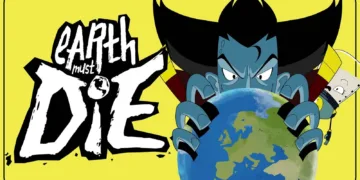





















VValak Lizardtongue is a showcase of hereditary power gone wrong. He ends up on the throne of the Tyrythian Ascendancy through pure circumstance after his older brothers die in a brutal chain of events. He reads as cowardly, lazy, and foolish, with a huge ego and no real curiosity. His one steady relationship is Milky, a floating robot full of milk who was built to nurse him as a baby. That dynamic never changes, and his dependence on her becomes part of the character’s daily routine.
Everything shifts once the Terranoids arrive. Humans from Earth launch a full invasion, and the Ascendancy collapses fast. VValak goes from supreme leader to a small-time figure with zero authority, trapped in a dead-end position. That fall fuels his fixation on revenge.
He wants his throne back, and he commits to a single solution: destroy Earth. The game drops this plan into a setting packed with red tape and strange life forms, playing like a satire of imperial bureaucracy. The plot tracks his attempt to sabotage a regime that outclasses his own cruelty. VValak’s incompetence turns him into a ridiculous villain, and the story leans into that for humor.
The Aesthetic of the Absurd
The visuals pull straight from the golden age of adult animation. Scenes often look like they could be lifted from a late-night Cartoon Network slot. Colors hit loud and saturated notes, while character designs chase the grotesque with confidence. Aliens show up as literal piles of jelly.
Some have eyes placed in ways that feel wrong on purpose. The animation stays smooth, giving a polished surface to material that stays proudly crude. That contrast in presentation and content feeds the specific strain of British humor baked into the script. The comedy lands dry, sharp, and frequently mean, built on the fact that the protagonist is unbearable by design.
The developers lean hard into adult themes. Alien sex shops exist as casual set dressing. An extraterrestrial orgy shows up as part of the world’s texture. Cartoon violence hits often, and VValak kills people over minor inconveniences. Playing as someone openly awful creates a different flavor of momentum.
The game keeps VValak firmly unlikable and uses his nastiness as a constant engine for jokes. A lot of humor aims low on purpose, with gags about anatomy and bodily functions that pair cleanly with the art style. The setting plays like a sandbox for a childish adult mindset, with no interest in safety or polish. Each new location brings another burst of weirdness, and the art direction keeps that chaos consistent from the first room through the final scene.
Delegation as a Game Loop
This point-and-click adventure rebuilds its basic interaction rules around VValak’s arrogance. He treats physical effort as beneath him, convinced his hands are too precious for manual labor. That attitude becomes the mechanical foundation. You do not click on an item to pick it up.

There is no inventory, so you never stash a bucket or a key in your pocket. Progress comes from delegation. You order other characters to do the hands-on work, with Milky covering most physical tasks. Other minions enter the picture too, giving you more tools to boss around, like a giant mosquito or a group of rebels.
The interaction menu mirrors that mindset with three clear icons: an eye to look, a mouth to talk, and a finger to give orders. Moving an object turns into a two-step command. You point the finger at a minion, then point at the target. That structure creates its own logic layer because solutions live in directing people, not collecting items.
Puzzles often resolve through conversation and careful commands, and the Milkypedia becomes a core support system. It is an internal wiki maintained by Milky that collects facts about the Tyrythian Empire and notes on human habits. It also serves as the hint system. Reading entries matters because they teach you how to manipulate characters into doing what you want.
Rooms stay small and self-contained. You solve each puzzle in a single location before the game lets you move on, which keeps pacing tight and reduces the chance of wandering through huge spaces. The puzzle logic stays silly in a way that fits the science-fiction tone. One solution asks you to fix a button by shrinking down to a microscopic scale. Another asks you to use a sex chat line to distract a guard. These moments push you to think like a manipulative dictator, matching the story’s idea of a petty ruler trying to claw his way back up through orders and exploitation.
Auditory Characterization and Scripting
The audio work stands out as one of the production’s strongest elements. The game is fully voiced by a cast of famous British comedians. Joel Fry voices VValak with the exact tone the character needs: unearned confidence that still carries a pathetic edge. Martha Howe-Douglas plays Milky with sharp sarcasm, and the chemistry between the two gives scenes an extra snap. Mike Wozniak and Alex Horne appear in supporting roles as various strange aliens, and their performances help the weirdness feel lived-in.

The writing moves fast and stays witty. Dialogue choices come paired with flavor text that lays out VValak’s inner thoughts, including the petty logic behind each rude or stupid line. Those written asides can land even harder than the spoken delivery, partly because they frame his arrogance as a playable interface. Timing is handled with precision, with punchlines arriving at the right beat before the game moves on.
The full experience runs about eight hours, and that length works in its favor. Jokes rarely have time to wear out before the script pivots to the next gag. One scene has VValak speaking to the head of his dead brother and asking about the brother’s first words. The answer comes back as baby talk, and VValak’s reaction lands with perfect timing.
That level of execution stays steady. The voice cast helps sell moments even when puzzles stay simple, and the game leans on banter to carry you from room to room. The script becomes the driving force, shaping a cynical, funny atmosphere that matches the mechanics: you keep pushing forward by talking, ordering, and manipulating, all while inhabiting a villain whose worst traits power both the story and the play.
The Review
Earth Must Die
Earth Must Die is a sharp, cynical triumph for fans of British comedy and classic animation. While its point-and-click mechanics are intentionally simplified, the focus remains firmly on its hilarious writing and stellar voice cast. VValak is a masterclass in making an unlikable protagonist a joy to inhabit. The lack of an inventory might frustrate genre purists, but the focus on dialogue and delegation keeps the pacing tight and the gags frequent. It is a foul-mouthed, visually striking romp that prioritizes laughter over complexity.
PROS
- Exceptional voice acting from a top-tier British cast.
- Beautifully grotesque adult-cartoon aesthetic.
- Unique "delegation" mechanic fits the protagonist perfectly.
- Genuinely funny, witty script with great timing.
CONS
- Short runtime might feel brief for some.
- Crude humor may not appeal to everyone.
- The ending feels slightly abrupt.