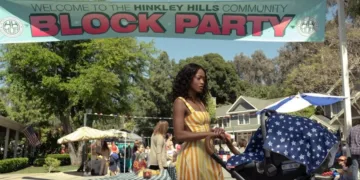






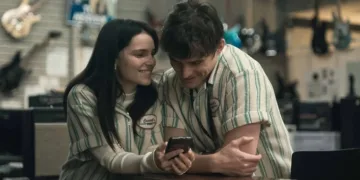






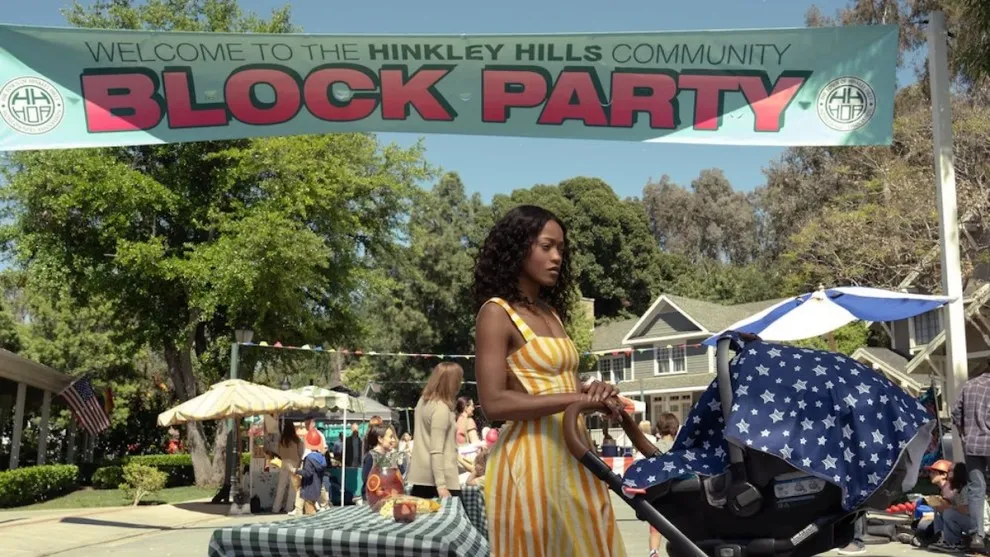

The ’Burbs lands on Peacock as an eight-episode reimagining of the suburban mystery. Samira, a tenacious lawyer played by Keke Palmer, leaves a city loft for the quiet cul-de-sac of Hinkley Hills. Her husband Rob comes with her, a British book editor portrayed by Jack Whitehall, along with their newborn son, Miles.
They settle into Rob’s childhood home, and the shift drops Samira into surroundings that feel sharply removed from her previous life. The neighborhood sells itself with manicured lawns and friendly faces, yet Samira clocks a different signal almost immediately: a dilapidated Victorian house across the street, sitting like a bruise on an otherwise uniform block.
When a secretive new neighbor, Gary, arrives, suburban boredom tightens into investigation. This version keeps a comedic edge, then threads in modern sensitivities and a darker mystery tied to a disappearance from the past.
Domestication and the Architecture of Suspicion
Hinkley Hills presents itself as the ultimate geographic security blanket. It is the “safest town in America,” a slogan that carries the stale perfume of historical “white flight” and the careful exclusion of anything deemed outside. Samira and Rob trade urban verticality for a horizontal expanse of manicured grass. The move reads less like a starry-eyed wish and more like a default setting clicking into place.
Rob returns to his parents’ vacant home (they are currently drifting on a perpetual retiree cruise, which is a delightfully grim image of late-stage capitalism). Inside those walls, the couple tries to make sense of the early, blurry days of parenthood. The suburbs supply silence, and the silence behaves like noise. It presses in.
Suspicion gets its anchor in the Victorian mansion across the street. The structure feels like an anomaly, a “Munster-esque” relic defying the midcentury uniformity of the block. When the reclusive Gary moves in, friction follows. Samira shows up with housewarming brownies, the classic offering of neighborly diplomacy, and the exchange returns a police visit for “trespassing.” A tidy little civic slap on the wrist, served with a smile.
Also Read




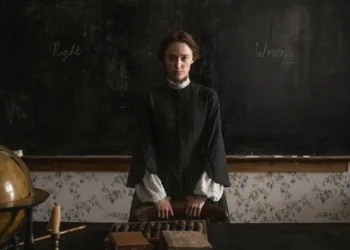
That first clash pulls a name out of the town’s storage closet: Alison Grant, a local girl who vanished decades ago. The house stops being a pile of wood and mortar and starts acting like a repository, holding what the town trained itself to forget. Hinkley Hills loves safety as a brand. Safety has paperwork. Safety has omissions.
The series then weaponizes modern “Suburban-veillance.” Ring cameras and the hyper-fixation of true crime podcasts turn residents into hobbyist detectives. Samira’s maternity leave provides a “boredom-as-catalyst” window; she has the intellectual surplus to watch curtains twitch and treat it as testimony. The eight-episode format gives the mystery room to unspool with a deliberate layering effect, like peeling paint that reveals older paint that reveals older paint.
The Sociology of the Porch Wine Club
Keke Palmer is magnificent. She grounds the series with an energetic intelligence that keeps Samira from slipping into pure plot function. This Samira approaches the neighborhood like a courtroom, demanding evidence while wrestling with her own “maternity-brain” fog. The joke sits right there, then the show lets the joke bruise into something sharper: competence meeting exhaustion, logic meeting hormones, the mind running hot inside a body running on fumes.
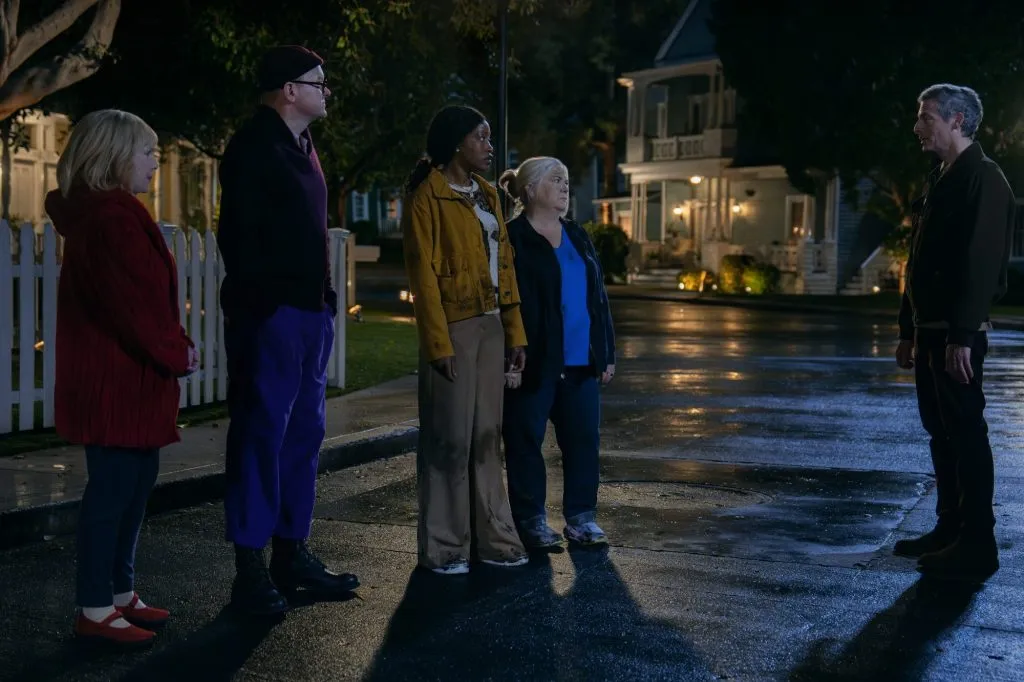
Jack Whitehall plays Rob with a self-deprecating charm that occasionally curdles into something opaque. His ties to the neighborhood’s past create friction in the marriage. He treats the safety of the cul-de-sac as a birthright; Samira treats it as a contract and keeps scanning the fine print. That difference becomes a quiet engine, turning domestic scenes into negotiations. The smiles stay polite. The subtext shows teeth.
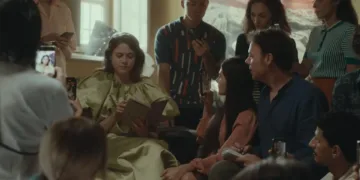
The “Wine Night” support group works as a makeshift Greek chorus of the disaffected. Julia Duffy brings a fragile, Newhart-adjacent warmth to Lynn, a widow using social rituals to keep the void at bay. Paula Pell’s Dana, an ex-Marine, treats investigative sleuthing like a tactical mission. Mark Proksch completes the trio as Tod, an “energy vampire” (if I may borrow a term) who pedals through the narrative on a recumbent bike. The image is ridiculous. It is also weirdly perfect.
These characters form a “Neighbor-hood” in the most literal sense. Proximity binds them. A shared need for distraction binds them harder. Each carries a quiet tragedy, and the mystery provides a communal project with snacks, gossip, and the thrill of feeling useful.
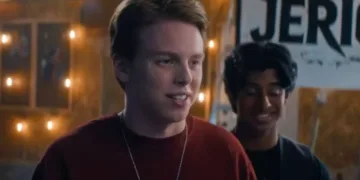
Naveen, played by Kapil Talwalkar, adds kinetic anxiety as the sidekick dealing with his own marital collapse. Then there is Justin Kirk’s Gary. Kirk excels at playing the “jerk specialist,” a man whose coldness reflects the neighbors’ biases back at them like a mirror held at an unforgiving angle. Gary refuses to perform suburban friendliness, and the neighborhood reads that refusal as guilt. Silence becomes a blank wall. They scribble their darkest theories on it.
Tonal Elasticity and the Suburban Gothic
The series pulls off a delicate act of “Genre-Drifting.” It starts with the bright, saturated colors of a network sitcom, then slowly bleeds into the shadows of a domestic thriller. The shift comes through a gradual dimming, like someone lowering the lights during a party and pretending nothing changed. Humor stays present as an anesthetic for the sharper points of the mystery.
We laugh at the absurdity of a dog carrying a human bone. The laugh catches in the throat a second later. The implication sits there, refusing to move.
Creator Celeste Hughey uses her experience with “dark suburbia” to keep the balance steady. The visual language is high-quality and unassuming, mimicking the “ordinariness” of the setting. The music choices land with particular bite. Needle drops function as ironic commentary on the domestic scenes they score, as if the soundtrack is quietly heckling the characters from the corner of the room.
The sun-drenched street and the looming, CGI-enhanced darkness of the Victorian house create a visual tension that persists through the season. The setting looks clean. The frame keeps hinting at rot.
As the story develops, the mystery widens past the simple “creepy neighbor” setup and turns toward a history of missing persons in the town. The twists arrive with a precision that avoids the feeling of cheap “gotcha” timing. They play like the outcome of sustained attention, the kind that makes a community built on secrets start to buckle under the weight of being watched.
The Fragility of the Picket Fence
Samira’s life in Hinkley Hills becomes a constant negotiation across “Micro-Aggressive” terrain. Neighbors coo over her “mocha munchkin” baby, a phrase that lands as cloying and dehumanizing in the same breath. The series keeps its eyes on the racialized nature of suburban security. For white residents, the cul-de-sac plays as fortress. For Samira, it plays as a space where her presence is silently audited.
Community-building here grows from shared paranoia. The Wine Night gatherings carry a “Trauma-Bonding” charge. These people do not necessarily like each other, yet they need each other to validate fear, to keep the dread feeling social instead of solitary. The show tracks the identity-loss that can come with suburban life. Lynn gets defined by widowhood; Samira gets temporarily defined by motherhood. The investigation offers a “Project-Identity,” a way to be something other than a resident stamped with a zip code.
The past keeps intruding. Long-term residents hold secrets that suggest accountability is the one thing the suburbs refuse to metabolize. By pushing toward the truth about Alison Grant, Samira threatens the “safety” the town advertises and protects like a precious heirloom. This reimagining earns its right to exist by pointing at the real horror it wants to name: the dawning awareness that the community sought for protection can become the very object of fear.
Inspired by the 1989 horror-comedy cult classic, this contemporary reimagining is set to premiere all eight episodes of its first season on February 8, 2026, exclusively on the Peacock streaming platform. The series moves the action to present-day suburbia in Hinkley Hills, where a young couple’s move into a quiet childhood home is quickly disrupted by the arrival of mysterious neighbors and the surfacing of long-buried local secrets. Combining dark humor with a modern exploration of suburban paranoia, it features an ensemble of seasoned comedic talent and was filmed on the historic Universal Studios backlot to maintain a visual link to the original film’s roots.
Full Credits
Title: The ‘Burbs
Distributor: Peacock
Release date: February 8, 2026
Rating: TV-MA
Running time: Approximately 30 minutes per episode
Director: Nzingha Stewart (Episode 1)
Writers: Celeste Hughey, Zora Bikangaga, Madie Dhaliwal, Rachel Shukert, Neil Reynolds, Amy Aniobi, William Yu, Hakim Hill
Producers and Executive Producers: Celeste Hughey, Keke Palmer, Seth MacFarlane, Brian Grazer, Erica Huggins, Aimee Carlson, Kristen Zolner, Natalie Berkus, Rachel Shukert, Nzingha Stewart, Dana Olsen (Co-Executive Producer)
Cast: Keke Palmer, Jack Whitehall, Julia Duffy, Paula Pell, Mark Proksch, Kapil Talwalkar, Justin Kirk, RJ Cyler, Haley Joel Osment
Editors: Joseph Ettinger, Ian Lamb
The Review
The 'Burbs
This reimagining succeeds by examining the architecture of modern isolation through a sharp, racialized lens. Keke Palmer provides a magnetic center to a narrative that finds its footing once it moves past early exposition. While the chemistry between the leads occasionally falters, the supporting cast populates this cul-de-sac with recognizable, tragicomic life. It treats suburban paranoia as a legitimate social response rather than a mere plot device. The mystery provides enough weight to sustain the eight-episode run without losing its comedic perspective.
PROS
- Keke Palmer’s commanding and intelligent performance.
- Sharp observations on racial microaggressions in manicured spaces.
- A strong comedic supporting cast that balances the darker mystery.
- Effective use of modern technology to heighten a sense of surveillance.
CONS
- Sluggish pacing in the early chapters of the season.
- Variable chemistry between the two primary leads.
- Some subplots feel like secondary distractions.