












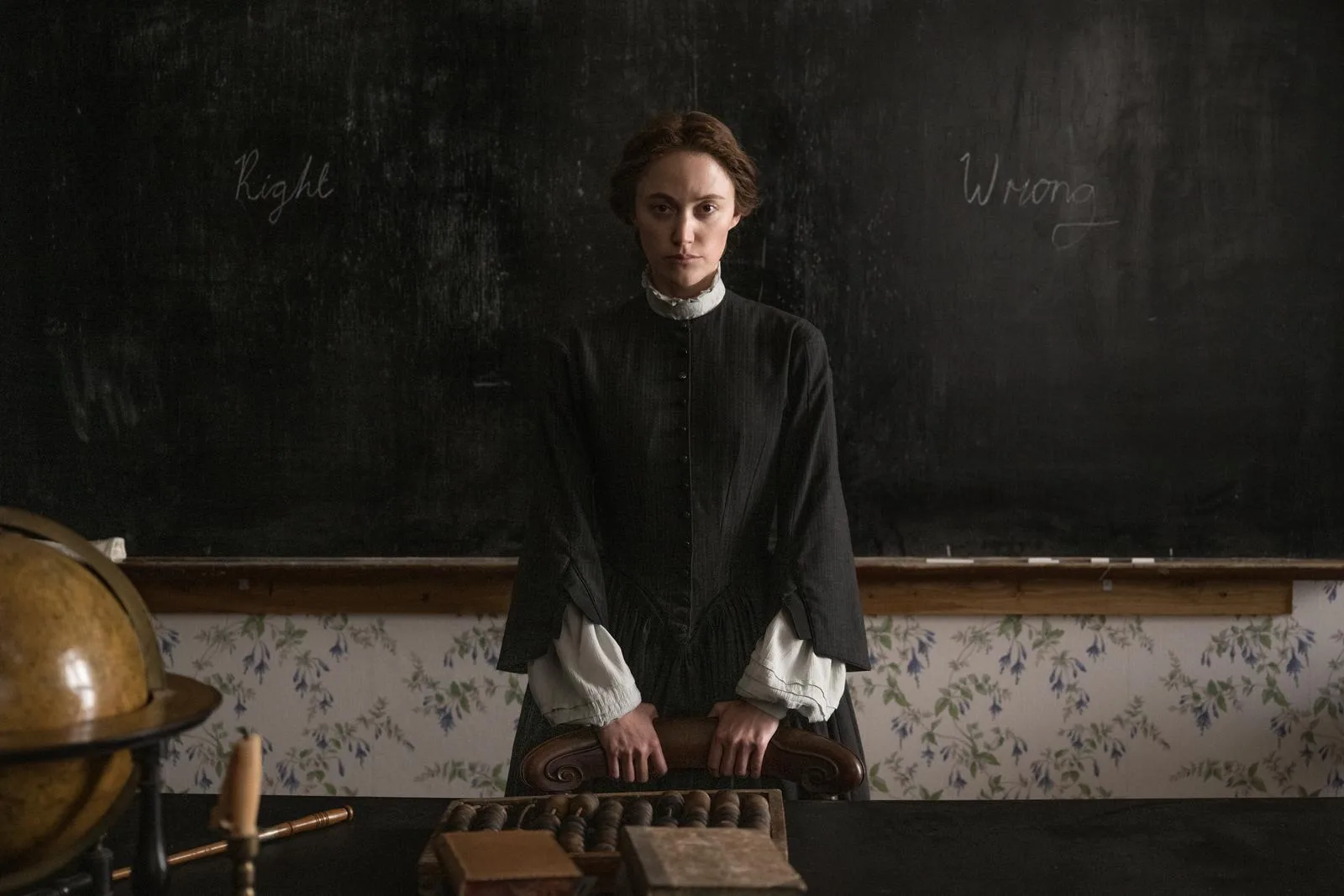

In 1858, a young woman named Winifred Notty arrives at Ensor House, a sprawling manor on the Yorkshire Moors, carpet bag in hand and a smile that doesn’t quite reach her eyes. She is there to govern the children of Mr. and Mrs. Pounds, a family of stiff-backed aristocrats played with relish by Jason Isaacs and Ruth Wilson. What follows is Zachary Wigon’s third feature, Victorian Psycho, adapted by Spanish novelist Virginia Feito from her own 2025 book, and it announces its intentions with something approaching a dare.
This is gothic horror filtered through the sensibility of a serial killer film, the drawing rooms of Victorian England soaked in candlelight and blood in roughly equal measure. Maika Monroe plays Winifred with dead eyes and a cocked head, a woman performing sanity as though it were a second language she has only partially learned. The film premiered in Cannes’ Un Certain Regard section, runs a brisk 90 minutes, and belongs to a specific genre of pitch-black comedy horror that is enormously difficult to sustain. How well it manages that is a question worth sitting with.
The Anatomy of a Performance
Monroe has spent much of her career being hunted. In It Follows and Longlegs, she built a reputation as one of contemporary horror’s most instinctive screen presences, her face capable of registering dread in gradations most actors can’t access. Victorian Psycho flips that entirely. Here, Monroe is the threat, and the recalibration is startling.
Winifred is a construction, and Monroe plays her as such. The physical vocabulary is precise and deeply strange: a jerky, slightly mechanical walk, a grin assembled piece by piece for company, the habit of drifting into bedrooms to stand silently over sleeping people. She is performing humanness rather than inhabiting it, and Monroe finds the comedy in that gap without ever losing the chill beneath it.
Her voiceover narration, clipped and prim and cheerfully matter-of-fact about acts of considerable violence, is one of the film’s genuine pleasures. “I’m the sanest person I know,” Winifred announces early on, and the line lands as both joke and diagnosis. The closest comparison in recent memory is Mia Goth in Pearl, another committed, physically total portrait of a woman unraveling in period dress. Winifred is a different creature entirely, but the ambition of the performance sits in the same register.
Around Monroe, the supporting cast operates at markedly different temperatures. Wilson plays Mrs. Pounds with straight-faced, almost Austenian irony, every line delivered as though she is mildly inconvenienced by the presence of other humans. Isaacs, by contrast, pitches Mr. Pounds somewhere between Dickensian grotesque and Mel Brooks parody, chewing the scenery with visible delight.
The tonal gap between them is wide enough to feel, at times, like two people in separate productions. Whether this is a directorial strategy or a coordination problem is genuinely unclear, though it does generate some of the film’s funniest moments. Thomasin McKenzie brings warmth and useful naivety to Miss Lamb, the nurse whose generosity of spirit makes her catastrophically ill-equipped to recognise danger. And among the children, Evie Templeton’s Drusilla, neglected and quietly feral, strikes an unexpected kinship with Winifred that gives the film one of its more genuinely unsettling notes.
The Gothic Machine
Cinematographer Nico Aguilar treats the camera as an unreliable narrator. Frames tilt without warning. The camera swings like a pendulum through hallways, peers through keyholes, and, in one deeply committed shot, adopts the perspective of a severed ear as it travels into Winifred’s stomach. It is playful, grotesque, and entirely intentional: the visual grammar of the film insists that we are inside a broken perceptual system, that what we see is shaped by a consciousness that does not work the way consciousness is supposed to.
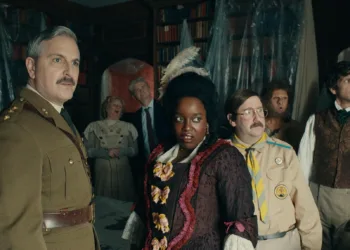
The production design, by Jeremy Reed, and costumes, by Allyson Byrne, achieve something similar through texture and detail. Ensor House is dressed in the full vocabulary of gothic period drama: velvet curtains, ancestral portraits, candlelit corridors. The authenticity of it grounds the film’s more extravagant violence in a world that feels lived-in. But the design is threaded with wrong notes. Tapestries featuring wild-eyed boars stare down from walls. A hallway inexplicably painted in deep, lurid purple interrupts the house’s otherwise sombre palette. These are not accidents. The film’s colour scheme is largely restrained and shadow-heavy, which means that the moments of vivid colour carry real weight: Winifred’s moonlit face during a nighttime scene, the green of her dress in the film’s climactic sequence.
Ariel Marx’s score is orchestral and stormy, pressing the expected gothic buttons efficiently if not always memorably. It functions as atmosphere rather than argument. The editing, by Dustin Chow and Lance Edmands, handles the killing scenes with a brisk, absurdist economy that suits the material. Bodies disappear quickly; the horror is registered and moved past. It is a rhythm that reflects Winifred’s own relationship with what she does.
Where the craft gets complicated is tone. The film is genuinely funny in places. The Pounds family history, delivered in a single breezy monologue, encompasses buggery, pedophilia, and syphilis. A character is named Mr. Poncey-Fancey. The comedy of manners is broad and deliberate. But the horror and the comedy are in negotiation throughout, and the film never quite resolves the tension between them. It neither commits fully to the dread required of a horror film nor sharpens itself into the satirical tool it occasionally resembles.
Class, Gender, and a Climax That Blinks
The satirical architecture of Victorian Psycho is not especially subtle, and it does not try to be. Victorian England, as the film portrays it, is a society arranged to diminish women at every level. The Pounds family pours resources and attention into their son Andrew’s education while treating daughter Drusilla as an afterthought. “We don’t want her wasting her fertility years in some institute,” Mrs. Pounds observes, without apparent irony. Miss Lamb, warm and capable, absorbs condescension from every direction as a matter of routine. Rich women are expected to marry and reproduce; poor ones to serve and be silent.
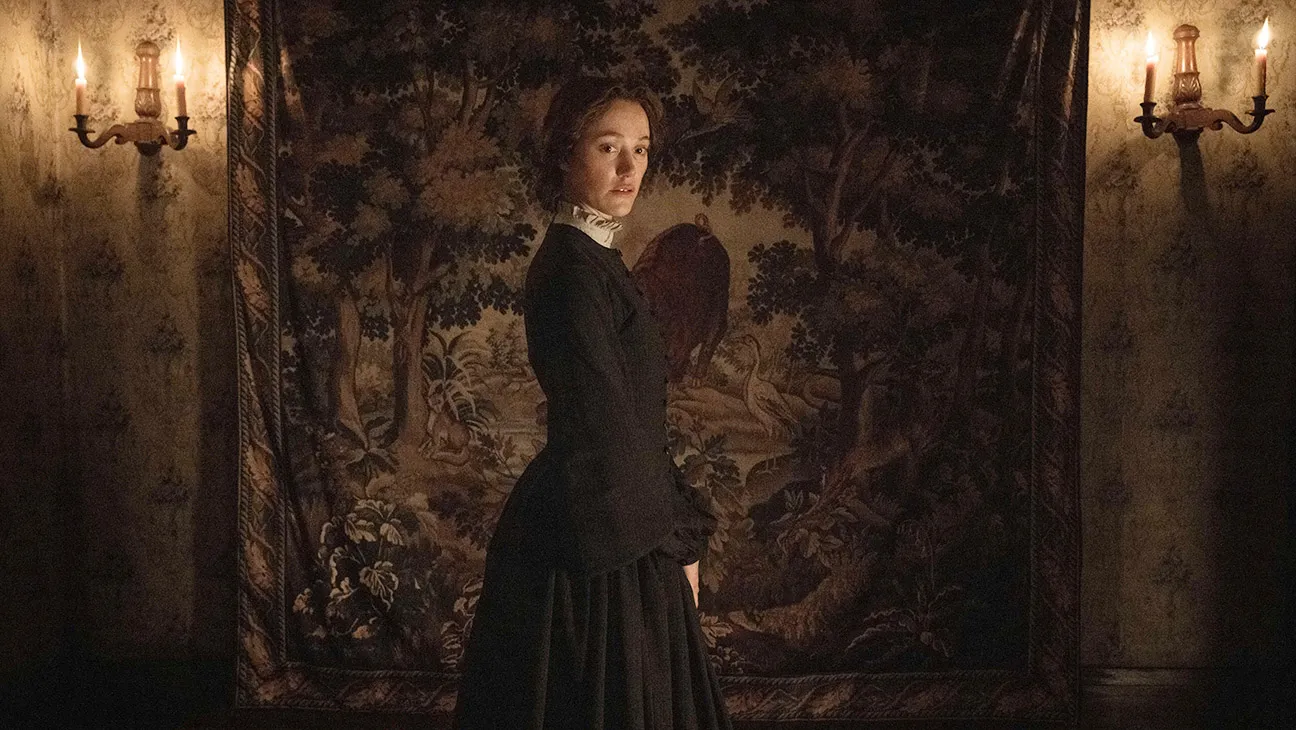
Winifred’s violence, read through this lens, becomes something other than simple pathology. She steps outside the social order entirely, wielding agency in a way that Victorian propriety reserved for men. The traditional “mad woman” of 19th-century literature was locked away or silenced; her hysteria was the problem to be solved. Winifred is not locked away. She acts, and the film treats her actions as a kind of dark, cathartic inversion of that literary tradition. It is a genuinely interesting idea, and the film is at its most pointed when it pursues it.
The structural difficulty is that Winifred is established as fully unhinged from the first frame. She arrives at Ensor House already dangerous, already fractured, already “Fred.” This leaves the film with nowhere particular to go in terms of escalation. When her backstory and motives are revealed in the final act, they arrive too late and do too little to reshape what has come before. The reveals feel like an explanation rather than a revelation.
The finale crystallises the film’s central hesitation. Rather than delivering the carnage that 80 minutes of gleeful setup has promised, the climax turns inward, staging the resolution as a confrontation between competing aspects of Winifred’s psyche. It is a defensible choice aesthetically, but tonally it feels incongruous, a film that has traded in visceral excess suddenly reaching for interiority. Feito’s adaptation also trims significantly from the source novel, removing a Christmas massacre framework and several supporting characters. Something of the novel’s commitment to its own darkness appears to have been lost in the translation.
The comedy-horror film Victorian Psycho recently premiered at the Cannes Film Festival on May 21, 2026, where it received highly positive initial reactions. Adapted by Virginia Feito from her own acclaimed novel, the movie follows an eccentric and polite governess named Winifred Notty who hides her dangerously bloodthirsty, psychopathic tendencies after arriving at a remote gothic manor. For those looking to watch it, the film is scheduled for a wide theatrical release in the United States by Bleecker Street on September 25, 2026.
Where to Watch Victorian Psycho (2026) Online
Full Credits
Title: Victorian Psycho
Distributor: Bleecker Street, True Brit Entertainment
Release date: May 21, 2026
Rating: R
Running time: 90 minutes
Director: Zachary Wigon
Writers: Virginia Feito
Producers and Executive Producers: Dan Kagan, Liz Siegal, Sebastien Raybaud, Zachary Wigon, Nick Shumaker
Cast: Maika Monroe, Thomasin McKenzie, Ruth Wilson, Jason Isaacs, Evie Templeton, Jacobi Jupe, Amy De Bhrún
Director of Photography (Cinematographer): Nico Aguilar
Editors: Dustin Chow, Lance Edmands
Composer: Ariel Marx
The Review
Victorian Psycho
Victorian Psycho is a film carried almost entirely by Maika Monroe's fearless, physically precise performance and some genuinely inspired craft work. The gothic production design is meticulous, the camera work inventive, and the dark comedy lands often enough to entertain. But the film hesitates where it should commit. It establishes its premise at full volume, then pulls back when the moment demands follow-through. The satirical instincts are sound; the execution is uneven. Worth seeing for Monroe alone.
PROS
- Monroe's performance is exceptional
- Inventive, destabilising cinematography
- Rich, atmospheric production design
- Sharp comic timing in the supporting cast
- Brisk 90-minute runtime
CONS
- Tone never fully coheres
- Winifred is too unhinged too early, limiting escalation
- Backstory reveal lands too late
- Finale pulls punches
- Supporting cast operates at mismatched registers