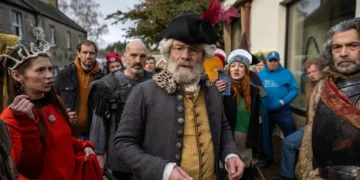































Aberloch appears in the Scottish Highlands like a fabricated antique, fixed in place and already fading. The hills project permanence, and history, with its usual cruelty, keeps disputing that claim. Kenneth Weatherford lives there as a widower and local historian, tending each day to the legacy of his ancestor, Sir Douglas Weatherford.
In Kenneth’s telling, Sir Douglas stands as a light of the Scottish Enlightenment. In practice, Sir Douglas carries a record marked by vivisection and a severe faith in reason stripped of mercy. Kenneth’s devotion binds him to that archive while the present moves to clear the shelf.
Then Emberfell arrives and scrambles the local order. The expensive fantasy production treats the Highlands as sanitized terrain for dragons and manufactured mythology. The tourist center turns with alarming speed. Kenneth’s carefully maintained displays come down so a neon fan attraction can go up.
The insult lands with bureaucratic efficiency. Kenneth is told to trade his period-accurate breeches for garish costumes tied to a fictional franchise. The film presents the shift with the cool scrutiny of a case study in cultural attrition. Its tension comes from the pressure between historical dignity and a market built on disposable spectacle. The diagnosis is bleak. The timing is comic. The wound still hurts.
The Ancestral Specter and the Quiet Hero
Peter Mullan holds the frame with a tired, intimidating gravity that gives Kenneth shape before he speaks. His performance locates the character’s anger in restraint, as if fury has been sealed in delicate glass and set on a shelf no one should touch. His eyes suggest a scholar who has watched the local language of value change while he remained fluent in an older dialect. Kenneth carries a contained rage that hovers near cantankerousness and keeps pulling back from it.
That pressure deepens through the appearances of Sir Douglas as a cynical ghost. The ancestor watches Kenneth with glacial contempt, and those scenes sharpen the protagonist’s sense of failure. Dunn stages this device as private judgment, almost a chamber drama inside the larger satire. The ghost turns memory into surveillance. Kenneth cannot preserve the past without being measured by it.
A brief release enters through his bond with a young wildlife photographer. The connection opens Kenneth up without softening him into sentiment. It brings out his protective impulse and suggests that shared fixation can create kinship across age, even in a place where many local ties have gone slack. Kenneth’s resistance to the Emberfell apparatus reads as a quiet heroism shaped by stubbornness, humiliation, and grief.
He fights for an identity the surrounding culture has already marked for removal. The stance is desperate and dignified at once, which gives the character his tragic scale. He looks heroic in the least glamorous way possible, often while surrounded by promotional nonsense and people wearing costumes that seem assembled during a corporate fever dream.
Cringe Aesthetics and the Synth-Pop Highlands
The film works with the precision of a comedy built from social mortification. Deadpan delivery intensifies the discomfort of Kenneth’s public lectures, and Dunn shows a strong feel for silence as a weapon. He lingers on the dead air of an audience that does not understand him, and the pauses become part of the sound design of shame. Those moments manipulate audience psychology with care. We wait for rescue, then realize the scene has no interest in rescue.
The tonal movement from abrasive satire in the opening stretch to a bittersweet character study feels deliberate. Dunn’s visual language often leans into a watery uncertainty in the Highlands, and the lighting tracks Kenneth’s displacement with unusual clarity. Exterior images carry a damp softness, while the production setup pushes industrial glare into the landscape.
The effect evokes a noir logic translated into rural space: place becomes divided by illumination, with dignity and vulgarity competing inside the same frame. Chiaroscuro appears here in a contemporary register, less alleyway shadow, more floodlight contamination and dim local interiors. The framing often treats Kenneth as a figure cornered by his environment, pinned inside public spaces that used to grant him authority.
The soundtrack pushes the tension further. Sickly synth music throbs against rugged terrain, and the mismatch keeps the film off stable tonal ground. A Jim Steinman needle drop arrives from an angle that feels both absurd and exact, puncturing the scene with theatrical excess.
These choices keep the film away from familiar folk-drama habits. Dunn’s debut shows a real appetite for tonal dissonance and formal play. He pairs eccentric character business with a pointed social critique, and he refuses the comforting cues that rural stories often reach for. The atmosphere comes out jarring, funny, and oddly mournful, which suits Kenneth’s sense that he has become foreign inside his own home.
Folklore Collides with the Industrial Zone
The film studies the impact between fading folklore and postmodern nihilism, and its results vary from scene to scene. The arrival of the crew converts quiet landscape into an industrial field of movement, noise, and light. Trucks, rigs, and production lamps function as visual signs of cultural displacement, plain and effective. Dunn understands the image value of intrusion. A hillside can look ancient in one shot and commercially occupied in the next.
Some of the Emberfell personnel register as cartoon archetypes, and that flattening leaves them with less psychological presence than Kenneth. Mullan’s density throws the gap into relief. The imbalance generates friction in the narrative design, and the film occasionally wavers while searching for the dominant emotional key.
It swings between slapstick and heavy melancholy, sometimes in rapid succession. The ambition earns respect even in uneven passages. A steadier rhythm might have tightened the suspense, yet the instability also reflects the story’s world, where every social interaction feels one cue away from farce or collapse.
The philosophical thread remains clear. Kenneth’s struggle points toward the futility of resistance for people who tie identity to historical continuity in a culture that rewards speed, novelty, and marketable fiction. Free will in this setting looks constrained by economic spectacle and communal fatigue. Kenneth chooses to resist, and the structure keeps showing how little leverage that choice carries. The local boy with unrealized dreams mirrors Kenneth’s failed campaign, giving the film a small but effective echo chamber of disappointment across generations.
The supporting cast can feel thin, though Mullan keeps the film grounded through weight, texture, and timing. He supplies the narrative with flavor and mass whenever a scene threatens to drift into caricature. The story draws its force from his portrayal of a man who refuses erasure, even while the world around him treats that refusal as an inconvenience to be themed, branded, and sold by the weekend.
The Fall of Sir Douglas Weatherford is a dark comedy and drama that had its world premiere at the International Film Festival Rotterdam on January 30, 2026. The story follows a grieving local historian in a small Scottish village whose identity is tied to his 18th-century ancestor, only for his world to be disrupted when a massive fantasy television production takes over the town. The film is currently making its way through the festival circuit, including screenings at the Glasgow Film Festival in March 2026, and is distributed by Mubi in the United Kingdom and Ireland.
Where to Watch The Fall of Sir Douglas Weatherford (2026) Online
Full Credits
Title: The Fall of Sir Douglas Weatherford
Distributor: Mubi, Charades, BBC Film, BFI
Release date: January 30, 2026
Rating: 15
Running time: 103 minutes
Director: Seán Dunn
Writers: Seán Dunn
Producers and Executive Producers: Alex Polunin, Scott Macaulay, Jennifer Monks
Cast: Peter Mullan, Gayle Rankin, Jakob Oftebro, Sid Sagar, Lewis MacDougall, Saskia Ashdown, Cameron Fulton, Kerry Fox
Director of Photography (Cinematographer): David Gallego
Editors: Shakti Bhagchandani, Scott Cummings
Composer: Gazelle Twin
The Review
The Fall of Sir Douglas Weatherford
The film is a somber, intellectually sharp meditation on the death of heritage in the face of commercial artifice. While the supporting characters occasionally veer into caricature, Peter Mullan’s magnetic, suppressed fury provides a necessary emotional anchor. It successfully captures the agonizing cringe of cultural obsolescence through a cold, deadpan lens. It is a messy, ambitious debut that prefers difficult questions over easy resolutions. For those who appreciate psychological weight and the quiet tragedy of a man out of time, this is a compelling, if tonally fractured, experience.
PROS
- A masterclass in "contained rage" and weary dignity.
- Excellent juxtaposition between natural Highland beauty and the harsh, industrial glare of a film set.
- The synth-heavy score and Jim Steinman needle drops create a memorable, dissonant atmosphere.
- Probes the uncomfortable intersection of historical truth and profitable fiction.
CONS
- The shift from biting satire to bittersweet drama can feel uneven.
- The film crew characters lack the nuance given to the protagonist.
- Some sequences of cringe humor feel intentionally "watery" and may test audience patience.







