





















![Kingdom Hearts Collection [I-III] Review](https://gazettely.com/wp-content/uploads/2026/10/Kingdom-Hearts-Collection-I-III-1-360x180.webp "Kingdom Hearts Collection [I-III] Review: KHII Holds Steady as Newer Entries Fluctuate 37")





John Wilson carries a nasal New York sensibility to the 2026 Sundance Film Festival with the premiere of his 101-minute documentary. The project took shape during the 2023 Writers Guild strike, a stretch of industrial friction that left Wilson looking for a different route forward. In that gap, he enrolled in a Hallmark movie-writing workshop and studied the company’s profitable, rigid formula for success.
He then tries to channel that template into a documentary about concrete, using the premise as a practical pitch for funding at a moment when the market is tightening. Moving from his earlier television work into a feature-length form gives him room to stretch his familiar approach.
Wilson uses second-person narration and speaks straight to the audience, setting up an intimate, shared space for his observations. He opens with a plain definition of the material: a composite made of aggregate, water, and cement. The choice of a “mundane” subject links to a French New Wave strain of curiosity, where everyday objects become an entry point for philosophical questions.
The Tension of Permanence and Formulaic Dreams
The film frames concrete through a push and pull between rigid cinematic formulas and Wilson’s free-associative habits. He visits a Canadian soundstage used for Hallmark productions and studies the “aspirational” tone those films sell. The set’s clean, polished surfaces sit beside Wilson’s attention to the gray, crumbling look of urban infrastructure outside the studio bubble.
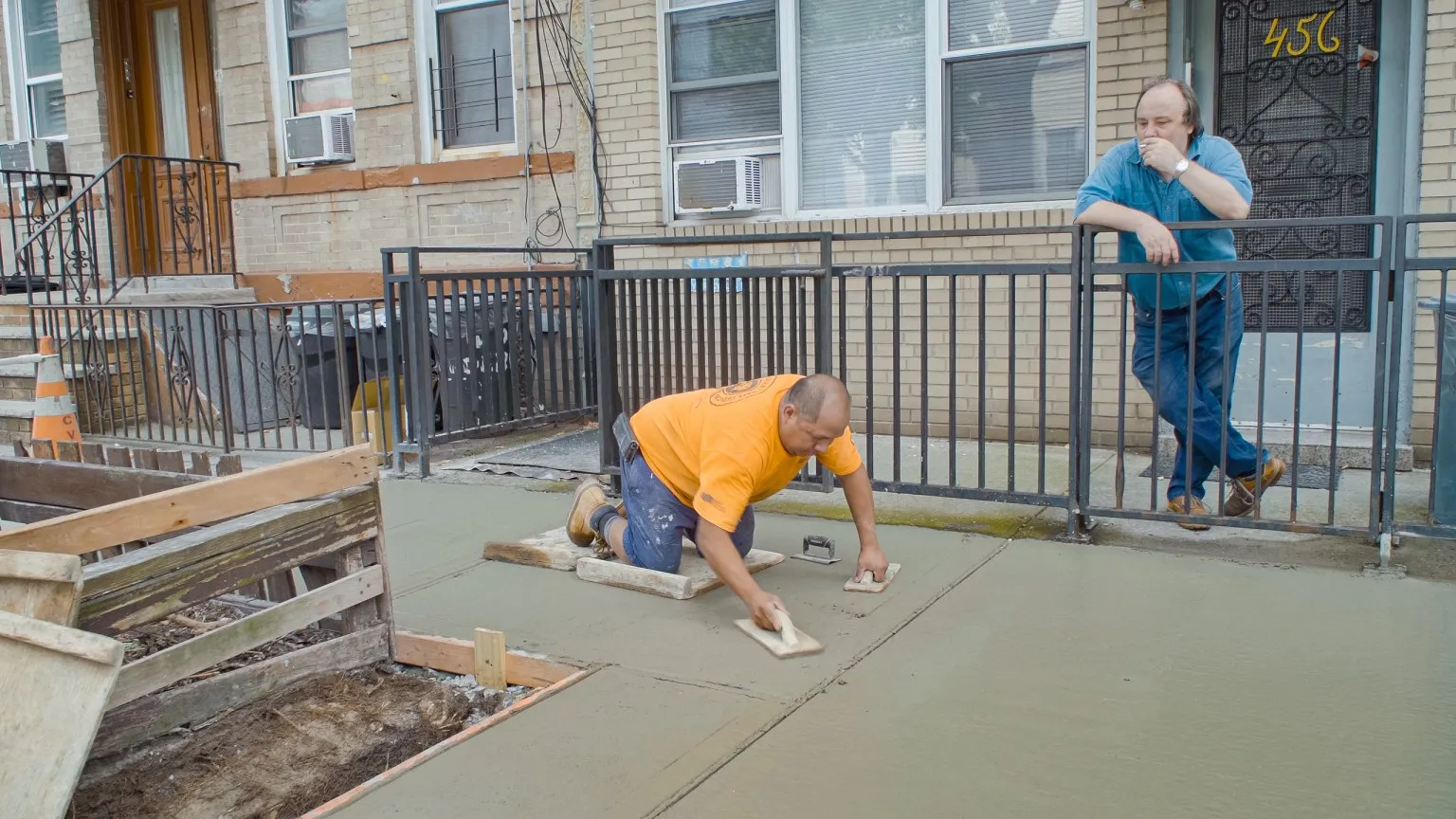
He learns that concrete ranks as the second most consumed material on Earth after water, and he tracks its short average lifespan at about 40 years. That impermanence gains historical weight when he stands under the 2,100-year-old concrete dome of the Pantheon in Rome. Ancient longevity becomes a reference point, and modern building practices look fleeting by comparison.
Wilson carries the idea back home through his own life as a landlord in Ridgewood, New York, where a leaking foundation turns the abstract into something immediate and domestic. Concrete becomes his emblem of human permanence-seeking: people pour it to leave a mark, then watch it crack anyway. The material keeps returning as a metaphor for entropy, one that applies to architecture and to careers built on plans that still erode with time.
Portraits of Decay and the Quest for Meaning
Wilson meets strangers in ways that show his talent for finding depth in passing encounters. Jack Macco, a liquor store salesperson and heavy metal singer for the band Nebulus, grows into a key presence. Macco talks about the tension between creating original art and playing covers, and the dilemma echoes Wilson’s own creative anxieties as he weighs authenticity against market logic.
The film keeps taking detours that extend the same question into stranger corners. Wilson visits a business that preserves the tattooed skin of deceased people, a literal attempt to keep something from disappearing. He also tracks down GumBusters, a service that scrapes chewing gum off New York City sidewalks, turning maintenance into a kind of daily, repetitive ritual.
The impulse feels small next to the Sri Chinmoy Self-Transcendence Race, where runners circle a single block in Queens for 3,100 miles. Wilson threads these scenes toward a trip to the Las Vegas Concrete Convention, where he looks for industry investors and tries to translate observation into a pitch. Across the stops, the film shifts from absurdity to sincerity, and it does so without leaning on mockery as a shortcut to humor.
Visual Puns and the Human Response to Automation
The film’s craft depends on a rough, immediate visual grammar: handheld Sony cameras and iPhones capturing spontaneous, raw fragments. Editor Cori Wapnowska shapes those fragments into a line of thought, building meaning through visual puns that link ideas that would otherwise stay separate.
B-roll of stray animals, misspelled street signs, and pockets of urban decay becomes a steady rhythm, a pulse that carries the film between encounters. Out of those images, Wilson forms a quiet argument about the rise of AI-generated content. He stresses that human observation depends on physical presence, something a predictive model cannot reproduce.
Mortality and the difficulty of starting again after a successful project ends sit inside the film’s final act, pressing on Wilson’s voice as he keeps looking for a new form that still feels like his. He lingers on “ugly” details such as gum stains and cracked sidewalks, treating them as places where the film’s meaning gathers.
By cataloging the mundane, Wilson records a specific time and place with a feeling of fragility that also reads as necessity. The method stands up for the value of an individual gaze at a moment when automation keeps offering smoother, less human substitutes.
The History of Concrete premiered on January 22, 2026, at the Sundance Film Festival in Park City, Utah. As of February 2026, the documentary is making its rounds on the festival circuit and is actively seeking a distribution partner for a wider release. It marks the feature directorial debut of John Wilson, known for his acclaimed HBO series, and serves as a spiritual successor to his unique brand of observational comedy.
Full Credits
Title: The History of Concrete
Distributor: Seeking distribution (Currently represented by UTA Independent Film Group)
Release date: January 22, 2026
Running time: 101 minutes
Director: John Wilson
Writers: John Wilson
Producers and Executive Producers: Clark Filio, Shirel Kozak, Allie Viti, John Wilson
Cast: John Wilson, Jack Macco, Kim Kardashian
Director of Photography (Cinematographer): John Wilson
Editors: Cori Wapnowska
Composer: Suzanne Ciani
The Review
The History of Concrete
This documentary serves as a profound meditation on the fragility of our foundations. Wilson successfully transforms a sterile industrial subject into a moving portrait of human effort and inevitable decay. By rejecting polished formulas in favor of raw, street-level observation, the film captures a world that feels both crumbling and remarkably alive. It is a work of quiet brilliance that finds the sublime in the mundane.
PROS
- Exceptional editing and visual wit
- Deeply empathetic human portraits
- Insightful commentary on art and AI
CONS
- Occasional pacing issues in the final third
- The meandering style may frustrate some
- Heavy reliance on familiarity with Wilson's voice