




















The Mortuary Assistant traps its nightmare inside the tight corridors of River Fields Mortuary, where newly certified mortician Rebecca Owens is still finishing her training. Her mentor, Raymond Delver, summons her for a late-night assignment, and the routine work of processing cadavers twists into a supernatural emergency. Rebecca has two jobs at once: complete the procedures of the shift and identify the demonic entity that has marked her for possession.
The story leans into the friction between professional repetition and psychological horror, using the morgue’s clinical order to frame addiction and unresolved grief. Apparitions arrive with a specificity that tracks Rebecca’s sobriety and the loss of her father, and the mortuary’s sealed-in setting turns that history into a constant presence. Time limits the night, and it limits Rebecca. She has a shrinking window to make sense of what is happening before the possession locks into permanence. It is survival storytelling with a past that refuses to stay past.
The Anatomy of Trauma
The script treats demonic possession as a concrete expression of addiction recovery, with the supernatural threat mapped onto the pressure of relapse. Rebecca is exactly one year sober on the night everything breaks open, and the milestone carries a quiet volatility.
That timing gives the demon a narrative shape as well as a menace, a force that presses on her stability at the moment she is trying to believe stability can last. The horror lands because it attaches itself to something built through effort and maintained through vigilance. The stakes sit in two places at once: her soul, and the life she has managed to keep intact.
Her father’s death, performed with a haunting presence by John Adams, becomes the main access point for the hauntings. The script frames that loss as a lingering guilt with a wide-open seam, and the entity knows exactly where to pull.
Memories feed the hallucinations that turn the morgue into a theater of accusation. Rebecca catches reflections of her past in the cold surfaces of her work, and the setting keeps returning her to the same images with the same sterile indifference. The story ties her present vulnerability to that older wound, and the linkage gives the supernatural material emotional weight.
River Fields Mortuary also functions as a pressure cooker because the shift isolates her so completely. Rebecca has professional competence, and she clings to it as her one reliable tool for staying grounded. The hallways compress; the rooms feel scrubbed of comfort; paranoia gains traction. As the night continues, the script corrodes the boundary between reality and hallucination with deliberate pacing.
Rebecca hears Raymond’s voice on the phone as his instructions warp into sinister variations, and the simple act of receiving guidance turns into a fresh stress test. Her sponsor appears in her home or in the mortuary, and that uncertainty leaves both Rebecca and the audience stuck in the same unstable position. The film keeps returning to the image of a mind trying to stay upright while perception keeps tilting.
Precision in the Macabre
Director Jeremiah Kipp approaches the material with a clinical eye, leaning on practical effects and the physicality of the work. The embalming sequences hit with a visceral bluntness: jaws are wired, tubes are inserted, bodies are handled with methodical care.

The film presents death as procedure and mechanics, and that blunt realism creates a baseline discomfort that never fades. It also sharpens the later supernatural intrusions, since the story has already trained the viewer to accept the morgue as a place of tangible, unpleasant detail.
Kevin Duggin’s cinematography builds unease through technique, including split diopters that keep Rebecca sharply defined while allowing movement in the background to register with alarming clarity. The framing encourages vigilance.
The eye keeps scanning because the image keeps suggesting something might be present just beyond the obvious focal point. The mortuary’s muted palette supports that vigilance by flattening the world into cold, controlled tones. Any burst of color or sudden motion reads as a violation of the space’s normal rules, and the camera treats those violations as threats.
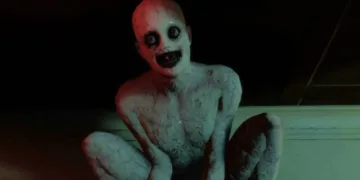
The Mimic’s creature design stands out as a central piece of the film’s visual language. Its pale-skinned look feels memorable, and the staging often places it in quiet, unsettling positions: a doorway, a corner, a point in the frame that sits slightly off-center and refuses to announce itself.
That restraint makes the entity effective even when the camera holds on it. Sound supports the tension through a heavy use of silence punctuated by sudden noise, though the eerie score sometimes competes with the natural dread that a quiet hallway can generate on its own. The film is strongest when it trusts stillness and lets the mortuary’s emptiness do part of the work.
Figures in the Shadows
Willa Holland plays Rebecca with striking subtlety, shaping the character through small physical tics that suggest early recovery while keeping a professional exterior intact. Rebecca begins the night as competent and focused, and the performance tracks the gradual cracking of that focus as the shift wears on.
Holland keeps the emotion tight, letting brittle calm carry scenes that could have tipped into louder genre theatrics. The arc from apprentice with a job to do to a woman fighting for her life lands because the transition feels measured, with each new shock taking a visible toll.
Paul Sparks makes Raymond Delver an excellent foil, delivering lines with a dry, apathetic cadence that keeps his intentions hard to read. He plays Raymond as an ambiguous mentor who knows far more than he shares, and the decision to withhold explanations becomes a narrative engine for tension.
The rules of the mortuary arrive late and in fragments, and that delay places the audience inside Rebecca’s uncertainty. Sparks sells untrustworthiness without leaning into overt villain signaling, which keeps the relationship unsettled even in moments that resemble guidance.
The dynamic between Rebecca and Raymond rests on professional necessity, and the film maintains distance by skipping over much of their shared history. The result is an intentionally cold relationship, one shaped by procedure and hierarchy rather than warmth.
Rebecca follows Raymond’s dangerous instructions because the situation corners her and offers few alternatives, and the story treats that compliance as part of the trap. Their exchanges fit the mortuary’s clinical atmosphere, even as the film leaves lingering questions about why Rebecca accepts so much from a man who keeps her locked inside a building full of demons.
Mechanics of the Night Shift
The film works hard to translate the procedural structure of its source material into cinematic form. Sigils and letting strips become investigative tools for identifying the demonic presence, and Raymond’s computer interface and desktop imagery connect directly to the game’s systems.
These elements give the horror rules, and Rebecca’s task becomes legible as problem-solving under extreme pressure. Embalming remains the recurring ritual that anchors the night, a steady sequence of steps that the supernatural keeps interrupting and contaminating.
The script also strains under the weight of its own mythology. It tries to compress a large amount of background information into a tight runtime, introducing multiple demonic houses and several types of hauntings in quick succession. The “Night Shift Database” delivers context with the density of reference material, and the film sometimes pauses its momentum to fit that material in. The lore can pull attention away from the immediate terror of a woman alone in a mortuary with an entity closing in.
That tension between atmosphere and information shows up in the scare rhythms as well. The first act takes its time, building dread through small disturbances that feel plausible inside the shift’s routine. In the final act, pacing accelerates into a rapid run of jump scares, with entities arriving one after another and sometimes colliding in their impact.
A moment involving an old lady banging on a window loses force when another monster appears at the same time, and the film’s earlier patience becomes harder to find as the night barrels forward. The third act plays like a checklist of horror beats, and the story’s escalation feels less organic than the careful pressure built at the start.
The Mortuary Assistant made its theatrical debut on February 13, 2026, bringing the viral 2022 horror game to the big screen with a focus on practical effects and psychological dread. For those who prefer to watch from home, the film is set to begin streaming exclusively on Shudder starting March 27, 2026. The story follows a young mortician whose routine night shift at River Fields Mortuary descends into a terrifying battle against demonic possession and the ghosts of her own past.
Where to Watch The Mortuary Assistant









Full Credits
Title: The Mortuary Assistant
Distributor: Seismic Releasing, Epic Pictures Group, Shudder
Release date: February 13, 2026
Running time: 91 minutes
Director: Jeremiah Kipp
Writers: Tracee Beebe, Brian Clarke
Producers and Executive Producers: Patrick Ewald, Cole Payne, Jake Heineke, Brian Clarke, Katie Page, Yulissa Morales, Randy Sinquefield, Patrick Fischer, Oliver Garboe, Lindsey Kibler
Cast: Willa Holland, Paul Sparks, Mark Steger, John Adams, Shelly Gibson, Keena Ferguson Frasier
Director of Photography (Cinematographer): Kevin Duggin
Editors: Don Money
Composer: Jeffery Alan Jones
The Review
The Mortuary Assistant
The Mortuary Assistant succeeds as a visual tribute to its source material but struggles to find its own voice as a standalone film. Willa Holland provides a grounded center for the chaos. The practical effects remain impressive throughout. The narrative suffers from a heavy focus on lore that slows the pace and blunts the impact of the scares. It captures the look of the morgue perfectly while missing the organic tension of the gameplay. It remains a fair effort for fans of the genre.
PROS
- Willa Holland delivers a grounded and nuanced performance.
- The practical body horror is visceral and high quality.
- The production design recreates the atmosphere of the morgue with precision.
CONS
- Excessive lore and backstory details clutter the narrative.
- The third act feels rushed and loses its sense of dread.
- Jump scares become predictable through repetition.