
























The air in Seoul’s most exclusive districts carries expensive perfume and the low, steady hum of money moving quietly from one hand to another. A lavish launch party for the brand Boudoir draws the top 0.1 percent to celebrate a label sold as the peak of taste. Sarah Kim stands at the front of this machine, polished enough to look like she belongs there by birthright.
As regional director, she glides through the room with practiced ease. Her philosophy matches the setting: she talks about truth like a blinding light, and lies like a sunset that smooths reality’s rough edges into something people can admire.
That controlled image fractures with the discovery of a woman’s body beneath a sewer grating in an affluent neighborhood. The victim has no identification. A rare designer handbag sits beside the remains, giving the police a single thread to pull.
Detective Park Mu-gyeong follows that thread by tracing the accessory’s serial number back to its origin. It leads him to Jung Yeo-jin, a cosmetics CEO, who is shaken into recognition. She identifies the body as Sarah Kim, and the case begins stripping the shine off a life built to look seamless from a distance.
The Craft of a Manufactured Persona
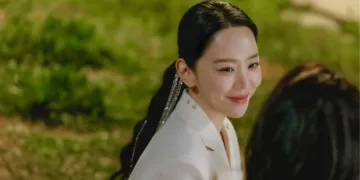
Shin Hye-sun plays Sarah with a precision that feels both seductive and unsettling. Sarah reads as someone who studied the wealthy like course material, then copied the performance with academic discipline: cadence, posture, taste, and the small social reflexes that signal belonging. The result is a woman who can pass as “real” to people who pride themselves on spotting fakes.
That fluency becomes the engine of a massive con. Boudoir exists as a story Sarah invents and sells as pedigree, complete with suitcases of cash and a fabricated lineage. People like Jung Yeo-jin hand over billions because the myth is built to flatter their aspirations. The scam sits alongside a darker core that involves identity theft and violence, and the series keeps tightening that thread until the couture façade starts to look like camouflage.
The death at the sewer grating becomes the sharpest pivot in that camouflage. The body belongs to Mi-jeong, the woman who tried to expose the fraud and take Sarah’s position. Sarah survives the struggle and kills Mi-jeong in the fight that follows. She then takes calculated steps to keep the corpse anonymous. She destroys the victim’s face to obstruct the investigation, and she uses a distinctive foot tattoo to steer identification away from what happened.
When Sarah finally confesses, she does it with a twist that turns confession into strategy. She admits to the killing while insisting she is Mi-jeong. The claim plays like madness, yet it functions as a deliberate shield. By accepting the identity of a common criminal, she protects the Boudoir name and keeps her invented legend intact, even as her freedom collapses.
This is where the series’ interest in representation lands with bite. Sarah’s success depends on how easily a wealthy image gets accepted as proof of legitimacy, and how quickly people grant humanity, respect, and benefit of the doubt to someone dressed in the right signals. The performance becomes her passport, and the show asks viewers to watch how many gates open on sight alone.
Wearable Badges and the Performance of Class
Designer handbags operate as status documents in this story. They sit in plain view, yet they do the private work of power: they announce rank, they quiet suspicion, they warn people away from uncomfortable questions. Sarah understands how expensive leather and a recognized logo function like armor. Prestige becomes a soft barrier that keeps scrutiny at a polite distance.

Jung Yeo-jin embodies the emotional cost of that system. She carries the hunger of a middle-class striver who believes proximity to the elite will validate her life and her business. That hunger makes her vulnerable to Sarah’s myth. Logical gaps in Sarah’s story fade because belonging is treated as a prize, and questioning the prize can feel like self-sabotage. The series frames that dynamic as a social contract many people live under: display the right markers, and you gain access to spaces that promise safety and esteem.
The show pushes the idea further by tying identity to possession until the self starts to blur. Sarah admits she has lost track of where the illusion ends and her lived reality begins. She speaks like someone trapped inside a role that once felt empowering, then turned parasitic. In a culture where “looking poor” reads as an offense that invites punishment, the pressure to curate appearances becomes relentless. The series treats that pressure as social discipline, enforced through gossip, exclusion, and the constant threat of being seen as disposable.
This is also where the show’s commentary on shifting norms cuts closest to social justice questions without turning into a speech. People receive different treatment based on perceived class signals, and those signals are treated as moral evidence. The series keeps returning to how quickly institutions and individuals accept an expensive story, and how easily they dismiss anyone without the right packaging. The luxury economy here looks like a machine built on insecurity, with aspiration sold as selfhood and shame used as the fuel.
Noir Shadows and the Final Illusion
The visual design reinforces the divide between high-fashion polish and the grim mechanics that support Sarah’s rise. Bright, sterile offices and immaculate showrooms give way to the dark cold geometry of drainage systems. The noir texture fits the material: a world of spotlighted surfaces paired with hidden rot. The camera language keeps reminding you that glamour can be a lighting choice, and darkness can be infrastructure.
Detective Park Mu-gyeong supplies the friction this world needs. He moves with logic and patience, dismantling Sarah’s fantasy through methodical police work. His progress reads as a quiet rebuke to everyone who accepted Boudoir on faith. His eventual promotion lands as a reward for seeing clearly in a society that confuses polish with truth.
The structure leans on frequent flashbacks to explain how the con worked and who kept it running. Seong-sin’s role becomes part of that anatomy. As Sarah’s accomplice, he steals tissue samples from a hospital so the police cannot get a DNA match that would expose her identity.
The series uses these back-and-forth reveals like a streaming-era habit: suspense built through reconstruction, character reframed through withheld context, and plot delivered in layers that invite binge momentum. The form mirrors the theme. The audience keeps learning how the illusion was assembled while watching how many people wanted the illusion to be real.
The final image brings the series’ thesis into a single, chilling choice. Sarah sits in prison, sentenced to ten years under the name of Mi-jeong. In her cell, she visualizes herself dressed in Sarah Kim’s expensive clothing. She gives up her legal existence to preserve the character she invented, and she keeps performing even when the stage is concrete and steel. The lie becomes her remaining form of agency, and the show leaves her there, holding onto the one version of herself that society rewarded.
The Art of Sarah premiered globally on Netflix on February 13, 2026. This South Korean mystery thriller captures the dark intersection of high-end fashion and criminal deception. You can currently stream all eight episodes of the first season on the Netflix platform. The show has gained significant attention for its complex narrative and stylish production since its arrival yesterday.
Where to Watch The Art Of Sarah


Full Credits
Title: The Art of Sarah
Distributor: Netflix
Release date: February 13, 2026
Rating: TV-MA
Running time: 39–51 minutes
Director: Kim Jin-min
Writers: Chu Song-yeon
Producers and Executive Producers: Park Joon-seo, Lee Kyung-sik, Song Kyung-soo, Song Dam-yi, Kim Ji-hoon, Chu Song-yeon
Cast: Shin Hye-sun, Lee Joon-hyuk, Kim Jae-won, Jung Da-bin, Shin Hyun-seung, Jung Jin-young, Bae Jong-ok, Kim Yong-ji, Park Bo-kyung, Im Gi-hong, Lee Mi-do, Kong Jeong-hwan
Director of Photography (Cinematographer): Joo Song-rim
Editors: Nam Na-yeong
Composer: Hwang Sang-jun
The Review
The Art Of Sarah
The Art of Sarah offers a sharp dissection of cultural vanity anchored by a mesmerizing performance from Shin Hye-sun. While the middle chapters suffer from a cluttered narrative that prioritizes twists over emotional depth, the series excels in its visual critique of Seoul’s rigid class structures. It remains a striking example of the global noir trend on streaming platforms, effectively using fashion as a weapon of deception. Despite an underutilized supporting cast, the show provides a haunting look at the cost of social performance.
PROS
- A masterclass in depicting a woman performing various identities with subtle shifts in posture and gaze.
- The use of luxury goods as a direct commentary on social insecurity and the desire for inclusion.
- High-fashion luxury settings juxtaposed with gritty, dark investigative environments.
CONS
- An excessive number of twists that occasionally obscure character development.
- Detective Park Mu-gyeong serves as a plot device rather than a fully realized individual.
- The core message regarding the emptiness of wealth is revisited frequently without gaining new depth.