




















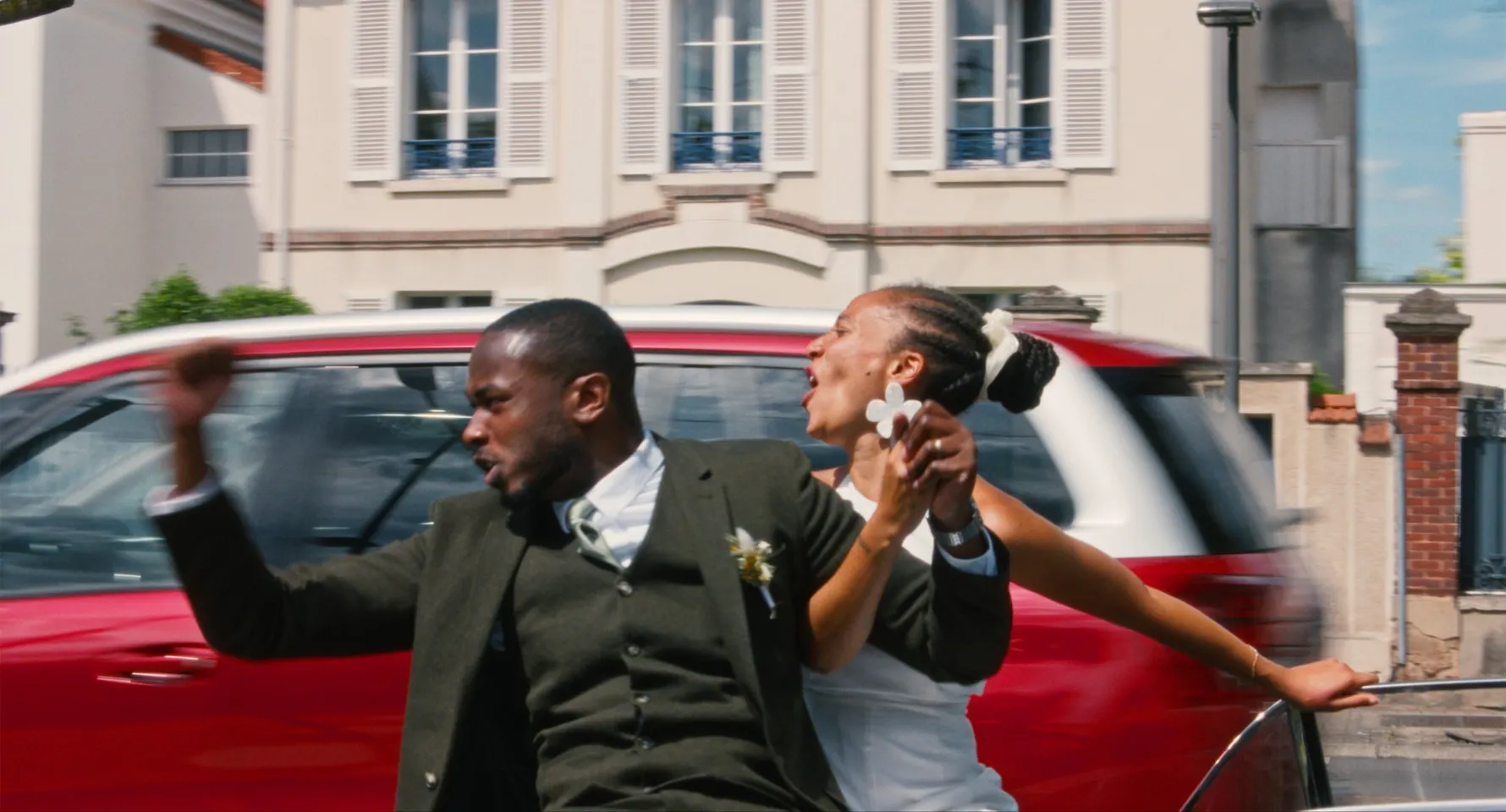

Alain Gomis has spent years mapping the spaces people inhabit between nations, languages, and versions of themselves. Earlier films often traced the rough seam between France and Senegal; this new feature stretches the canvas into a three-hour contemplation of the Bissau-Guinean experience. The story runs on two major family gatherings: a memorial ritual held in a remote African village and a wedding staged at a French country estate.
The title gestures toward a perpetual, circular motion that runs through everything, a current meant to bind the world together. That idea sets the film’s tempo. Scenes drift with an atmospheric patience that treats linear storytelling as optional, leaning into a more fluid state of feeling and observation.
Scripted drama and documentary immediacy share the same frame, feeding off each other until the film starts to feel like a breathing thing. Gomis turns away from the familiar template of migrant suffering and opts for something messier and more human: the low, persistent hum of a people living across two worlds at once. It is an enormous undertaking, and it asks a simple favor from the audience. Listen for pulse, then let plot take the back seat.
The Architecture of the Real-Fake Family
Gomis begins with a formal gambit that puts the machinery on display. The film opens on the real casting sessions for the leads. Katy Correa and D’Johé Kouadio sit in a blank white rehearsal room and talk through hopes and fears for characters they have not fully inhabited yet. This framing peels away cinema’s polish and offers an immediate intimacy with the performers before they step into fictional environments. The effect is bracing, almost awkward in the way honesty can be awkward.
Call it “rehearsal-realism”: a method where the line between an actor’s lived self and the script’s demands grows porous, and the film benefits from that leakage. The narrative energy follows a collective body rather than a single protagonist’s arc. People gather, speak, sing, argue, and drift; the group becomes the unit of meaning.
Six editors shape this material into a restless, flickering rhythm. The camera jumps from Guinea-Bissau’s sun-baked, dusty tracks to France’s manicured lawns with a suddenness that echoes the mental whiplash of diaspora life. Between these spaces, elders speak in interview fragments, recalling the heavy weight of Portuguese colonialism. Their testimony gives the celebrations a historical undertow, tying present-day festivities to inherited struggle.
Rituals of the Grave and the Gala
The film rests on two distinct ways of assembling. In Guinea-Bissau, the community gathers for elaborate rites honoring the father of the central character, Gloria. The rituals land with tactile force: wooden idols are anointed, and an “investigation ceremony” unfolds where the dead are questioned about their earthly deeds. It plays as spiritual accounting, ancient in texture and heavy in implication, as if the living are balancing a ledger that stretches far past any single lifetime.
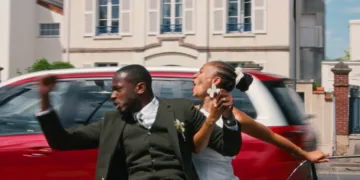
In the French countryside, the wedding offers a picture of westernized elegance. Chanel gowns move through linen-draped tables and carefully arranged comfort, the kind of middle-class polish that signals control and composure. Yet the faces do not change. The same people occupy both worlds, carrying the same emotional residue across vastly different rooms.
Music becomes connective tissue. Abdullah Ibrahim’s elegiac jazz piano lays a mournful, sophisticated veil over the African landscapes. At the wedding, a mass singalong to the Fugees’ version of “Killing Me Softly” turns into pointed self-awareness about cultural layering. The chain is visible: a song by Haitian-Americans, built from a folk-rock original, sung by French grandchildren of African immigrants. Identity circulates here as practice, passed hand to hand across oceans, revised each time it returns.
Watchful Gazes in a Fragmented Home
Katy Correa plays Gloria, known in some sequences as Béa, with remarkable restraint. She stands as a quiet, watchful anchor inside a storm of celebration. Detachment clings to her, suggesting someone trained by experience to remain slightly outside every room she enters, even when she is surrounded by family. As a grieving daughter and a wary mother, she carries herself with straight-backed dignity that reads as soft and steely in the same breath.
Her daughter Nour shifts the film’s emotional temperature. As a second-generation immigrant, she approaches the ancestral village with curiosity and awe; nostalgia sits heavier with her mother, tinting each glance and pause. The film feeds on these small frictions: the unannounced arrival of a prodigal brother, the brittle tenderness of a conversation between Gloria and her ex-husband, Slimane. Each moment chips away at the fantasy of “home” as a stable point on a map.
Home becomes a scattered archive: memories and broken hearts dispersed across borders, recalled in flashes, rearranged through ritual, music, and reunion. Belonging lives in motion here, in the continual act of carrying oneself between places that each feel partial, and still insisting that the pieces add up to a life.
Dao premiered on February 14, 2026, as part of the official competition at the 76th Berlin International Film Festival. Directed by the acclaimed Alain Gomis, the film is a sprawling, three-hour “docu-drama” that explores the intricate threads of African identity and heritage through two parallel family celebrations: a wedding in the French countryside and a traditional commemorative ceremony in Guinea-Bissau. The film is currently making its way through the international festival circuit and is scheduled for a wider theatrical release in France starting April 29, 2026. Viewers looking to catch this immersive experience should check local film festival listings or wait for its rollout by Jour2Fête and Canal+ later this year.
Where to Watch Dao
Full Credits
Title: Dao
Distributor: Jour2Fête, The Party Film Sales
Release date: February 14, 2026
Running time: 185 minutes
Director: Alain Gomis
Writers: Alain Gomis
Producers and Executive Producers: Sylvie Pialat, Benoît Quainon, Toufik Ayadi, Christophe Barral, Yoro Mbaye
Cast: Katy Correa, D’Johé Kouadio, Samir Guesmi, Mike Etienne, Nicolas Gomis, Fara Baco Gomis, Poundo Gomis, Béa Mendy, Thomas Ngijol
Director of Photography (Cinematographer): Céline Bozon, Amath Niane, Mabeye Deme
Editors: Alain Gomis, Fabrice Rouaud, Assetou Koné, Dimitri Ouedraogo, Elizabeth Ndiaye, Moustapha Mbalo Dieng
Composer: Gaspard Gomis, Space Dukes, Keïta Janota, Cie
The Review
Dao
Dao is a monumental exercise in patience that rewards the viewer with a profound sense of human continuity. It functions as a visual poem rather than a traditional story. The three hour length feels like a physical commitment to the lives of these characters. Some might find the lack of a central plot frustrating. The emotional payoff is substantial for those who can sit with the silence. It is a rare work that manages to make the mundane feel sacred.
PROS
- Intimate rehearsal style performances that bridge fiction and reality.
- Superb jazz infused soundtrack featuring Abdullah Ibrahim.
- Deep cultural layers and historical grounding.
CONS
- Imposing three hour runtime.
- Meandering non linear structure.
- Occasional repetitive pacing in the village scenes.