


























September 11, 1973, sits as an open wound in Chilean memory. On that date Santiago witnessed a democratically elected government erased under the authority of a military junta. Juan Pablo Sallato frames this rupture around Captain Jorge Silva (Nicolás Zárate), a man defined by altitude.
Silva arrives on screen as a celebrated parachutist and the head of the Aviation Academy, a figure of strict discipline and ritual. Years earlier he saved President Salvador Allende from an assassination attempt, a fact that becomes quietly ironic when Silva later functions as a gear in the apparatus dismantling Allende’s legacy.
The academy that trained cadets is repurposed in a rapid and terrifying fashion. Training grounds turn into detention rooms. Sallato concentrates on a single day of intensifying constraint, the exact instant when military procedure acquires the character of finality. The sky that once signified liberty becomes a silent witness to a brutal political shift.
The Armor of Silence
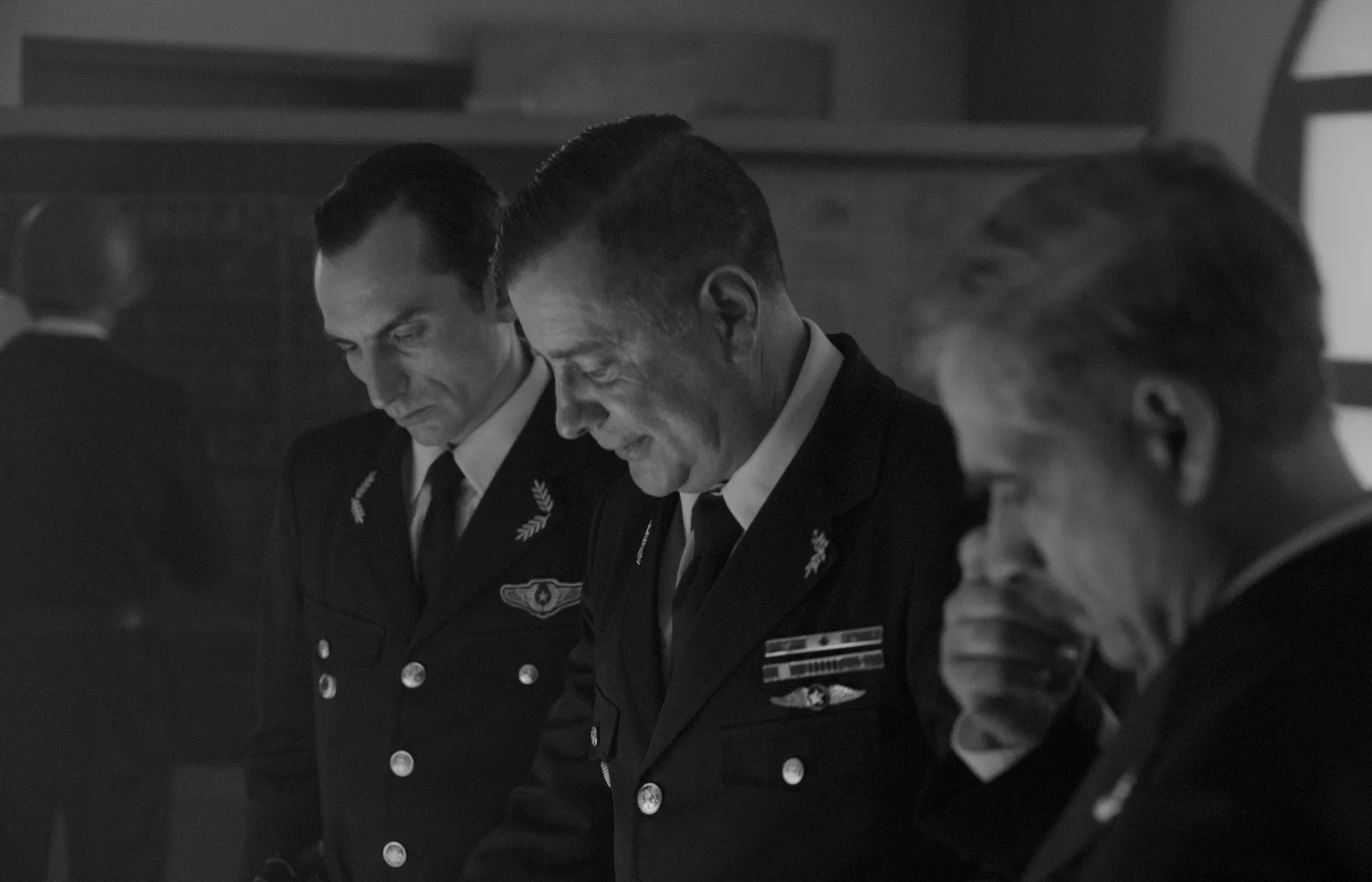
Nicolás Zárate composes a performance of dense stillness. He treats the uniform as a constructed defense, a sartorial shell that orders his gestures and buffers him from external collapse. Silva operates by protocols and uses rank to deflect moral burden. This dependence on the chain of command exposes obedience as a form of moral withdrawal.
He expects that adherence to rules will confer neutrality. Colonel Jahn arrives carrying a private grudge and a taste for settling scores under the cover of the coup. Jahn compels Silva to observe the methods of the new regime. Their friction reads as small-scale cruelty with far-reaching consequence. Outside the base the city burns. Silva learns of university raids and student deaths from his wife, Rosa.
Her telephone calls supply the only tether to civilian catastrophe beyond the gates: teachers arrested, students murdered. Silva listens as if frozen. He denies his own capacity to intervene and adopts silence as protection. The portrait that emerges is of a man striving to survive by shrinking into the shadows of his former life.
Shadows of the Brutalist State
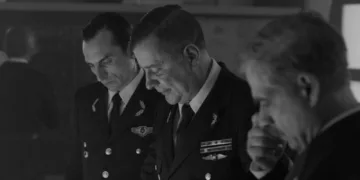
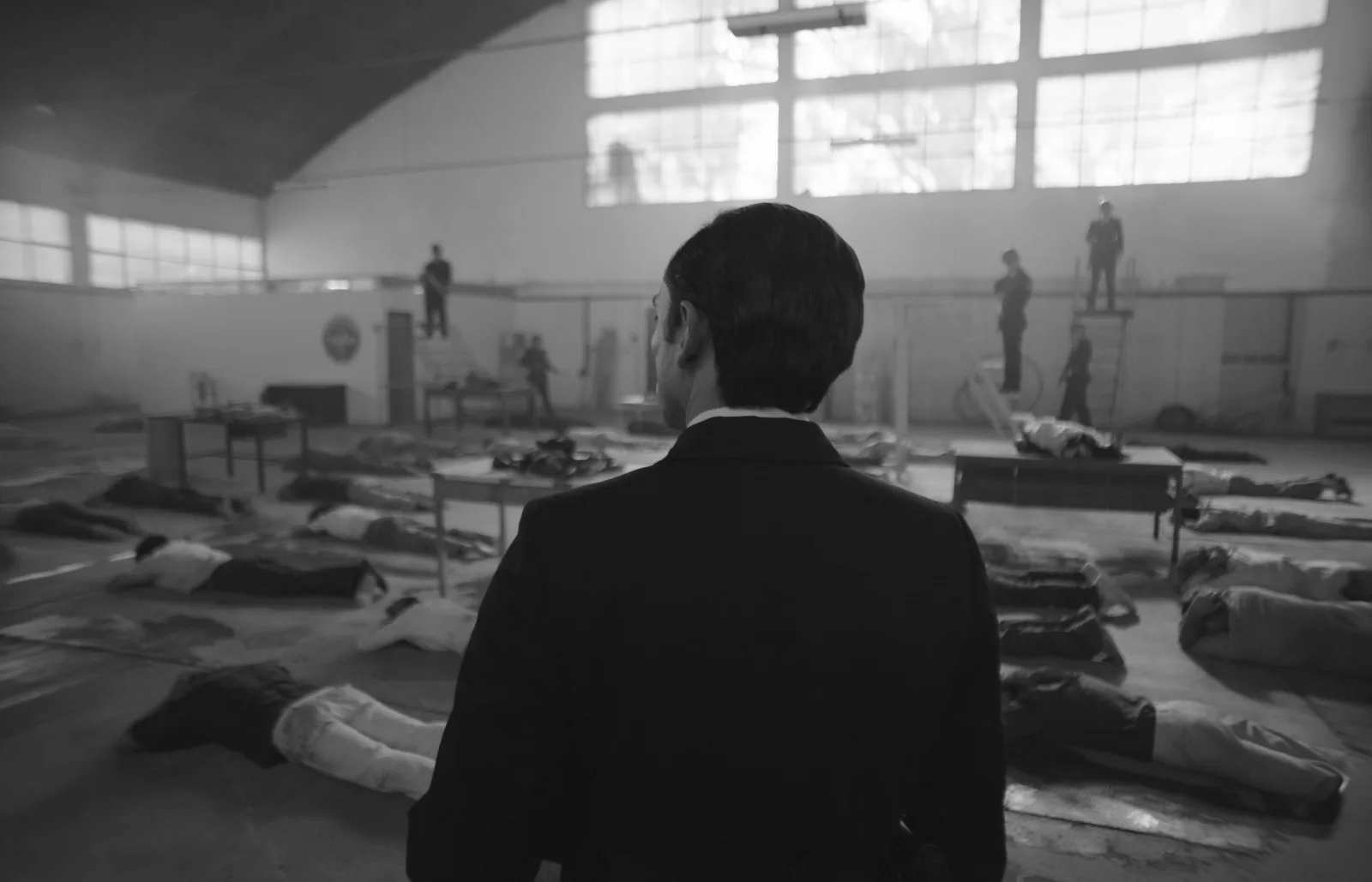
Diego Pequeño renders this environment in stark, clinical black and white. The lack of color accentuates the brutalist geometry of the base; gray concrete becomes a kind of physical confinement. The camera traces empty corridors and the looming hangar with an architectural apprehension I name Stasis-Gothic.
Sallato resists spectacle and privileges sound to register violence. Footsteps echo heavily, doors groan closed, distant engines supply a constant industrial hum that cultivates entrapment. Silva’s history as a parachutist furnishes a metaphor of the Fall. His descent from the sky loses heroic sheen and reads as a landing into complicity.
The film’s 80-minute runtime functions with precision. It compresses events so they feel immediate and forces the audience to remain within Silva’s narrowing circle of choices. The film demonstrates how spatial design can imply psychological breakdown.
The Ledger of Atrocity
Sallato stages the coup as a bureaucratic operation I call Paper-Terror. Atrocity is administered with the mundane exactitude of clerical work: stamps, files and forms that catalog the end of civil life. Violence becomes procedural. Silva loses control of his hangar, which becomes an interrogation site while he watches from the perimeter.
The junta’s leaders are not mythic monsters. They are petty men driven by small rivalries and deep anxieties. Jahn and Soler act from spite and insecurity; their authority depends on manufactured fear. Silva reaches the limit of silence and recognizes that uniform cannot safeguard the soul. He confronts a choice between oath and humanity and accepts exile and the collapse of status as consequence.
Sallato demonstrates how ordinary routines and the conviction of doing one’s duty propel historical change. The film studies individual behavior when rules become lethal. Silva’s path suggests that compliance erodes and that even a modest refusal can interfere with the machinery of dictatorship.
The Red Hangar is a stark, black-and-white political thriller that premiered internationally at the Berlin International Film Festival on February 13, 2026. Set during the 1973 Chilean military coup, the film follows an Air Force captain who is forced to transform his aviation academy into a detention center, leading to a profound moral crisis. The movie is a co-production between Chile, Argentina, and Italy, and it is currently available through specialized festival screenings and regional platforms like TVN and MUBI.
Where to Watch The Red Hangar
Full Credits
Title: The Red Hangar (Hangar Rojo)
Distributor: MPM Premium, Berta Film, TVN
Release date: February 13, 2026
Rating: TV-MA
Running time: 81 minutes
Director: Juan Pablo Sallato
Writers: Luis Emilio Guzmán, Fernando Villagrán
Producers and Executive Producers: Juan Ignacio Sabatini, Juan Pablo Sallato, Mercedes Cordova, Valeria Forster, Gonzalo Rodriguez Bubis, Lucia Van Gelderen, Valentina Quarantini, Marco Luca Cattaneo, Stefano Mutolo, Raika Khosravi, Carolina Pezzini
Cast: Nicolás Zárate, Boris Quercia, Marcial Tagle, Catalina Stuardo, Aron Hernández, Francisco Carrasco, Juan Cano
Director of Photography (Cinematographer): Diego Pequeño
Editors: Valeria Hernández, Sebastián Brahm
Composer: Alberto Michelli, Matteo Marrella
The Review
The Red Hangar
The Red Hangar offers a chilling look at the mundane machinery of a coup. It rejects the spectacle of war for the cold reality of paperwork and protocol. Jorge Silva’s silence is a heavy weight that grounds the film in moral ambiguity. While the runtime feels brief for such a massive historical shift, the visual austerity creates a lasting dread. It is a sharp study of how obedience functions as a weapon.
PROS
- Clinical black and white cinematography.
- Restrained lead performance by Nicolás Zárate.
- Tense, atmospheric sound design.
- Focused examination of bureaucratic systems.
CONS
- Abrupt ending.
- Limited emotional warmth.
- Simplified historical context.