











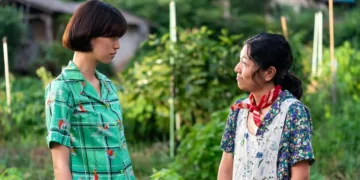
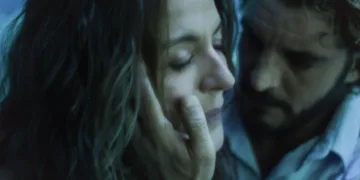
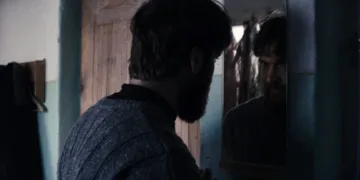
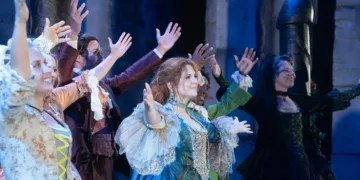











Death arrives in this film as a force that alters the living, a prism that fragments carefully held selves into sharp, jagged lines. In Leyla Bouzid’s In A Whisper the Tunisian coastal city of Sousse is the frame for that fracture. Lilia returns from France to attend her uncle Daly’s funeral and carries the sense of displacement that migration leaves behind. She is a professional engineer who has assembled a measured life across the Mediterranean, and she steps back into a household where personal autonomy dissolves into the clan’s collective rituals.
Alice, her partner in France, travels with her yet remains removed, kept in a hotel room to keep the possibility of scandal from entering the family home. The opening fact of Daly’s death gives the film a raw, almost forensic charge. Daly was discovered naked in the street. The exposure of his body becomes a persistent presence, a physical detail that the family’s rites cannot silence. Inside the childhood house the matriarchs convene.
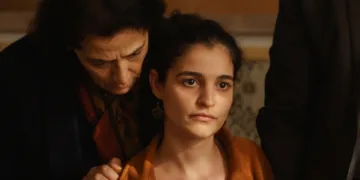
Wahida and Néfissa preside over the funeral rites with the exactitude of habit and tradition. They move between rooms with the weight of long-practiced custom. Lilia feels unmoored in that space. The family’s accepted explanation of a natural death sits thinly over a colder truth she senses beneath. The narrative begins where mourning and the demand to know intersect, where ritual meets suspicion.
Archaeologies of Silence
Lilia begins a quiet excavation of Daly’s life. She moves like an archaeologist brushing away dust to reveal the shards of a hidden existence. She seeks out old friends and reads letters that had been kept from view. A portrait comes into focus of a man who loved men in a time and place that required hiding. Daly maintained parallel lives, finding small moments of joy in darkness, and he died alone and exposed. Lilia confronts that loneliness and recognizes her own likeness in it, the risk that a life pared down to pleasing others can curtail the self.
The house becomes a theatre of omission. The women who live there hold a silence so dense it feels built into the rooms. They know the fact of Daly’s desires. They always knew. They will not speak it aloud. Hiam Abbass’s Wahida embodies a protective instinct that favors reputation over reality; she preserves the family name with a look that can calcify affection into something brittle.
That deliberate refusal produces a crushing tension. Alice, isolated in the hotel, grows restless and bitter at being reduced to a shameful secret. The home accumulates history and exclusion together; everyone seems to carry knowledge that no one grants a voice. Silence functions as a weight that presses on the living.

The Architecture of Time
Bouzid places the film inside a house that itself seems to count down. The building used for filming belonged to the director’s grandmother and was scheduled for demolition. That fact gives each frame an urgency of loss. Walls and rooms feel as if they are holding their breath before something ends. The film treats time as a fluid substance that gathers in the corners of those doomed interiors. Bouzid composes images that collapse then and now into the same field of vision. Flashbacks appear within the present frame: adult Lilia stands in a hallway while a child version of herself runs past, or she sits in a car and sees a younger self in the rearview mirror.
Memory in the film arrives as a ghost of the present rather than a distant country. Remnants of the past settle into plaster and light. Cinematographer Sébastien Goepfert relies on natural light and restrained camera setups that make stillness feel like a presence. That stillness creates an intimacy that leans toward claustrophobia; the house’s gaze is inescapable.
In moments of private reverie the film layers images of Lilia and Alice over one another so their bodies blur and merge. Those superimpositions suggest a spiritual union that resists the enforced distance between them. The score by Yom threads clarinet lines through electronic textures to produce a soundscape that reads as both ancestral and synthetic, a melancholy companion to a search that moves backward in order to change what lies ahead.
The Law and the Liberation
The state’s logic presses into the private world with precise harshness. Article 230 of the Tunisian Penal Code appears as a legal constraint that criminalizes the form of Lilia’s love. Her very existence registers as a transgression under the law. Judgment arrives along two vectors: legal sanction and cultural condemnation. A scene with a traffic cop reveals popular resentment toward the diaspora; Lilia’s French life marks her as a returnee who critiques from the outside. The older generation treats female sexuality as a phase to be corrected by marriage and motherhood.
Lilia faces the possibility of erasure. The inquiry around Daly’s death shifts from a search for external facts into an interrogation of her own terror. She recognizes that the silence which shielded the family also suffocated her uncle. The film moves from a procedural of the dead toward an awakening among the living. Lilia refuses the safety of a contained lie.
She elects to bring together the fractured parts of herself and to expose private truth to public view. The ending resists tidy closure. It declines a full severing from family and it declines a promise of easy acceptance. It offers instead the difficult work of honesty, messy and necessary. The final scene reconfigures the funeral rites; the mourning of a life wasted yields a defiant celebration of a life that refuses burial.
In A Whisper premiered in competition at the 76th Berlin International Film Festival on February 13, 2026. Directed by Leyla Bouzid, the film is a French-Tunisian co-production that follows Lilia as she returns to Sousse for her uncle’s funeral, only to navigate a labyrinth of family secrets and societal constraints regarding her own queer identity. Following its successful festival run, the movie is scheduled for theatrical release in France and Tunisia in late April 2026. Currently, the film is primarily available through international film festivals and select arthouse screenings as it begins its global distribution cycle.
Where to Watch In A Whisper
Full Credits
Title: In A Whisper (À voix basse)
Distributor: Hakka Distribution (Tunisia), Neue Visionen Filmverleih (Germany), Lazona (Spain), Cineworx (Switzerland), Playtime (International Sales)
Release date: February 13, 2026 (Berlin International Film Festival Premiere), April 22, 2026 (France), April 29, 2026 (Tunisia)
Rating: NR (Not Rated / Arthouse)
Running time: 113 minutes
Director: Leyla Bouzid
Writers: Leyla Bouzid
Producers and Executive Producers: Bruno Nahon, Caroline Nataf
Cast: Eya Bouteraa, Hiam Abbass, Marion Barbeau, Feriel Chamari, Salma Baccar, Karim Rmadi, Lassaad Jamoussi
Director of Photography (Cinematographer): Sébastien Goepfert
Editors: Lilian Corbeille
Composer: Yom
The Review
In A Whisper
Leyla Bouzid constructs a haunting meditation on the cost of silence within the Tunisian family structure. The film transcends a simple mystery to become an archaeological dig into repressed identity and the physical spaces of memory. While the pacing occasionally languishes in its own atmosphere, the emotional resonance of Lilia’s quiet rebellion offers a profound catharsis. It is a work of delicate power that refuses to simplify the friction between tradition and truth.
PROS
- Sébastien Goepfert’s static shots and natural lighting create a suffocating yet beautiful domestic atmosphere.
- The visual blending of past and present within single frames effectively physicalizes memory without standard flashback transitions.
- Hiam Abbass delivers a formidable portrayal of maternal authority and protective denial.
- The film handles the intersection of grief, legality, and queer identity with nuance rather than melodrama.
CONS
- The deliberate slowness of the investigation may feel lethargic to viewers expecting a traditional mystery thriller.
- Certain subplots regarding the police investigation and minor characters dissolve without full resolution.