

























Beirut appears here as a spectral frequency, a ghostly hum under the surface of a violent episode. Beirut functions less as a map and more as an atmosphere that shapes choices and wounds. Suzanne, a 63-year-old Palestinian widow, moves through this atmosphere with the compacted resignation of someone who has long learned the contours of her life. Her days are a ledger of muted rituals until a street assault ruptures the ledger.
She intervenes to save Osmane, a young Sudanese migrant whose body arrives at her threshold already scored by the city’s indifference. The rescue is immediate and bloody. It breaks the brittle shell of her solitude. She pulls him into the shelter of her apartment, a place that changes quickly from an isolated cell to a provisional sanctuary. Outside influences recede.
Their bond begins in the pragmatic language of care and quiet, then deepens into a recognition of shared exile. The city beyond the window asserts itself as hostile abstraction, an illusion that threatens to dissolve the fragile reality they assemble inside. They become two spectral presences seeking weight in one another’s company, attempting to be whole within a room that refuses simple definitions.
A Theater of Displacement
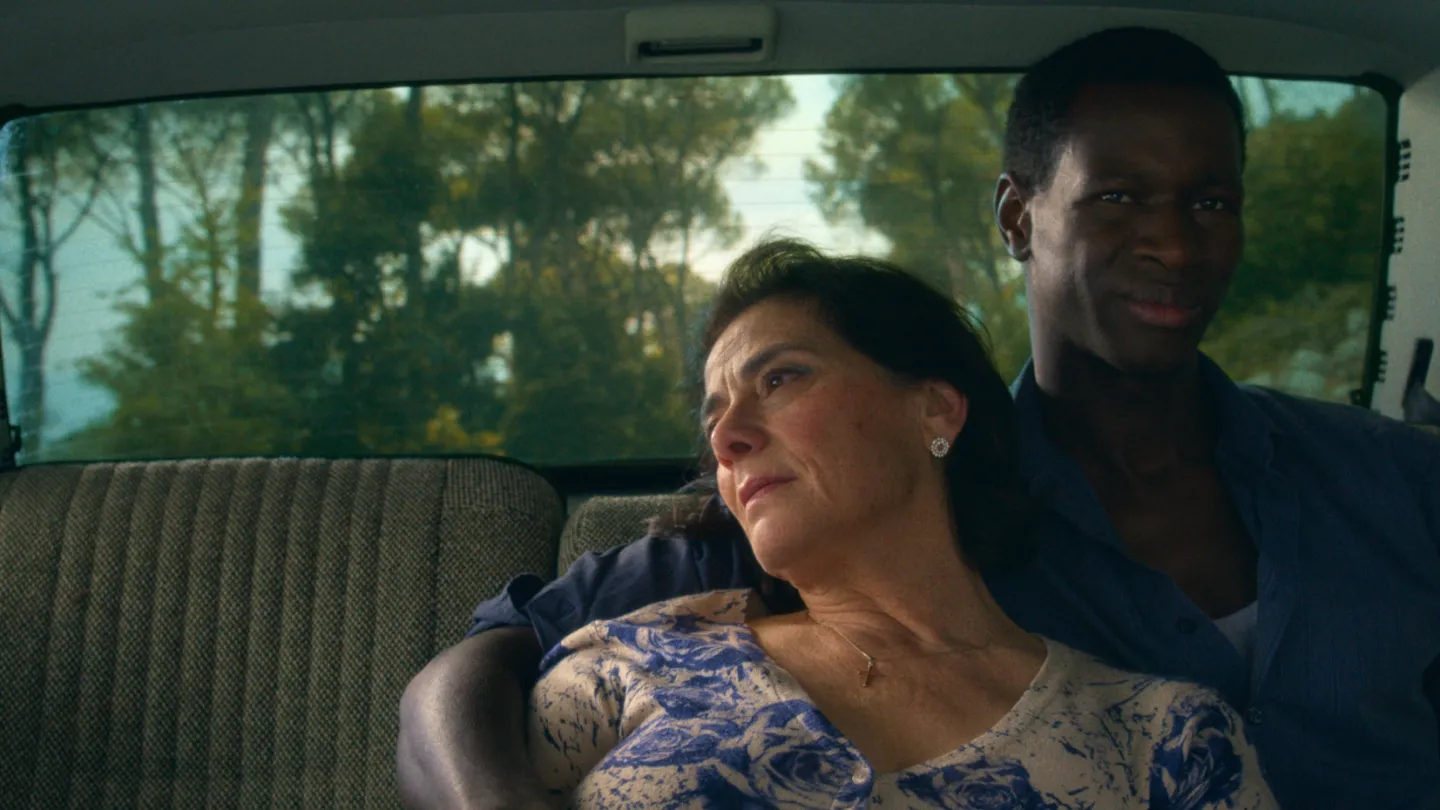
The film’s visual syntax embraces artifice as necessity. Unable to film on location because of the brutal reality of Israeli bombings, the director relocated production to a French studio and shot the piece entirely against rear-projection backdrops. That constraint becomes an aesthetic decision with moral force.
The Beirut we see is a flicker on a wall, a memory playing behind the performers instead of terrain under their feet. The images lend the action the cadence of a passion play or a tragic fable, removing cinematic pretension and revealing the raw affective machinery of the scenes.
Lighting and tangible props feel uneasy next to the flat, recorded street footage. This mismatch mirrors the characters’ inner dislocation. Suzanne and Osmane occupy a world they cannot fully enter. The backdrop stays unreachable. Its distance amplifies their isolation with a theatrical force that often rings truer than location photography.
Also Read





They act on a stage of constructed realities, playing out a fragile intimacy while the pictured city continues its indifferent course. The formal choice argues that for those cast out, the city is more a picture than a home.
The Architecture of Desire and Decay
Hiam Abbass grounds this staged emptiness with a performance of stern grace. Her portrayal of Suzanne is a claim to corporeal presence and private desire in late life. Her gaze holds. Her gestures acquire a renewed economy. She resists the social prescription that older women, and widows in particular, fade into background.
Nearby, Amine Benrachid supplies a restrained heartbreak as Osmane. He watches and conserves himself with a quiet that carries weight. The generational gap of roughly forty years and the visible difference of race operate here as a challenge to conventional social order.
Their spirits do not travel the same course. Suzanne toughens and flowers under mounting pressure, demonstrating an inward fortitude that feels deliberate and earned. Osmane begins to break. The crushing lightness of his invisibility combined with the stark visibility of his race in a prejudiced context erodes his center.
The film observes a painful psychic shift. The man who arrives with a bruised face and intact interior slowly unravels beneath the ongoing psychic siege of his surroundings. His failure is not moral weakness. It is structural collapse. He becomes a building whose supports are removed one by one. Suzanne tries to shore him up, but the entropy of exclusion proves relentless.
The Poison of Polite Society
Tragedy here issues from the ordinary cruelty of intimates rather than from caricatured villains. The film exposes a toxicity that wears the mask of civility in family and neighborhood life. Suzanne’s daughter, Sana, functions as a chorus of condemnation, wrapping prejudice in the language of reputation. Her son expresses cruelty with bluntness, using shame to police his mother. They stand for a generation that has inherited earlier hatreds and sharpened them into instruments of control.
This social poison permeates conversations at the fabric shop where Suzanne works and echoes along the building’s corridors. A rigid hierarchy of disdain operates here. Lebanese Arabs regard the Palestinian woman from above, and she faces pressure to reciprocate scorn toward the African man. Scorn cascades.
The pair find ephemeral shelter in a neighborhood bar, a low-lit refuge for trans women and other social outsiders, yet such havens remain fragile. Community pressure acts like a slow-acting toxin. It does not kill suddenly; it squeezes until choices grow desperate and tragic. The film lays bare the existential toll exacted by a society that demands conformity at the cost of the self.
Only Rebels Win premiered on February 12, 2026, as the opening film of the Panorama section at the 76th Berlin International Film Festival. This French-Lebanese-Qatari co-production tells the story of a 63-year-old Palestinian widow living in Beirut who falls in love with a young Sudanese migrant after saving him from an attack. Because of the geopolitical situation in Lebanon during production, the film was uniquely shot in a French studio using rear-projection footage of Beirut. It is scheduled for a theatrical release in France on May 6, 2026, and is currently making its way through the international festival circuit.
Where to Watch Only Rebels Win
Full Credits
Title: Only Rebels Win
Distributor: JHR Films, Fandango Sales
Release date: February 12, 2026
Rating: Not Rated
Running time: 98 minutes
Director: Danielle Arbid
Writers: Danielle Arbid
Producers and Executive Producers: Omar El Kadi, Nadia Turincev, Georges Schoucair, Ziad Srouji, Amanda Turnbull, Antoine Khalife
Cast: Hiam Abbass, Amine Benrachid, Shaden Fakih, Charbel Kamel, Alexandre Paulikevitch, Rubis Ramadan, Ziad Jallad, George Sawaya
Director of Photography (Cinematographer): Céline Bozon
Editors: Clément Pinteaux
Composer: Bachar Mar-Khalifé
The Review
Only Rebels Win
A haunting exploration of intimacy amidst exclusion. The deliberate artifice of the rear-projection technique elevates a simple melodrama into a profound fable of displacement. Hiam Abbass commands the screen with a performance of quiet devastation. While the relentless cruelty of the supporting cast can feel suffocating, the film succeeds as a stark portrait of how society polices desire. It is a necessary, if painful, watch.
PROS
- Hiam Abbass delivers a commanding and deeply felt performance.
- The use of rear projection creates a compelling, dreamlike aesthetic.
- The narrative confronts social prejudice with unflinching honesty.
- The chemistry between the leads effectively sells their shared isolation.
CONS
- The secondary characters display a cruelty that can feel relentless.
- Osmane’s psychological decline is a heavy, dispiriting trajectory.
- The deliberate theatricality may alienate viewers seeking traditional realism.