





























Released on February 5, 2026, Lovish presents a careful riff on retro design from developer LABS Works and creator Matt Kap. Published by DANGEN Entertainment, it draws its visual vocabulary from the Famicom era, building a pixelated world that reads as familiar and cheerfully irreverent. The story follows Sir Solomon, a knight expected to rescue Princess Tsuna from the Devil Lord.
That premise quickly tilts into an absurd character study. Solomon’s insecurity takes the wheel, and he convinces himself the other heroes will charm the princess first. He responds by throwing his companions into the castle moat and pushing forward alone. The game uses that anti-party decision to frame a modern strain of cynical comedy inside an 8-bit skin. It commits to a light, self-mocking tone, keeping Solomon’s fragile ego in constant view while the kingdom-saving stakes sit in the background.
Single-Screen Gauntlets and the Fragility of Love
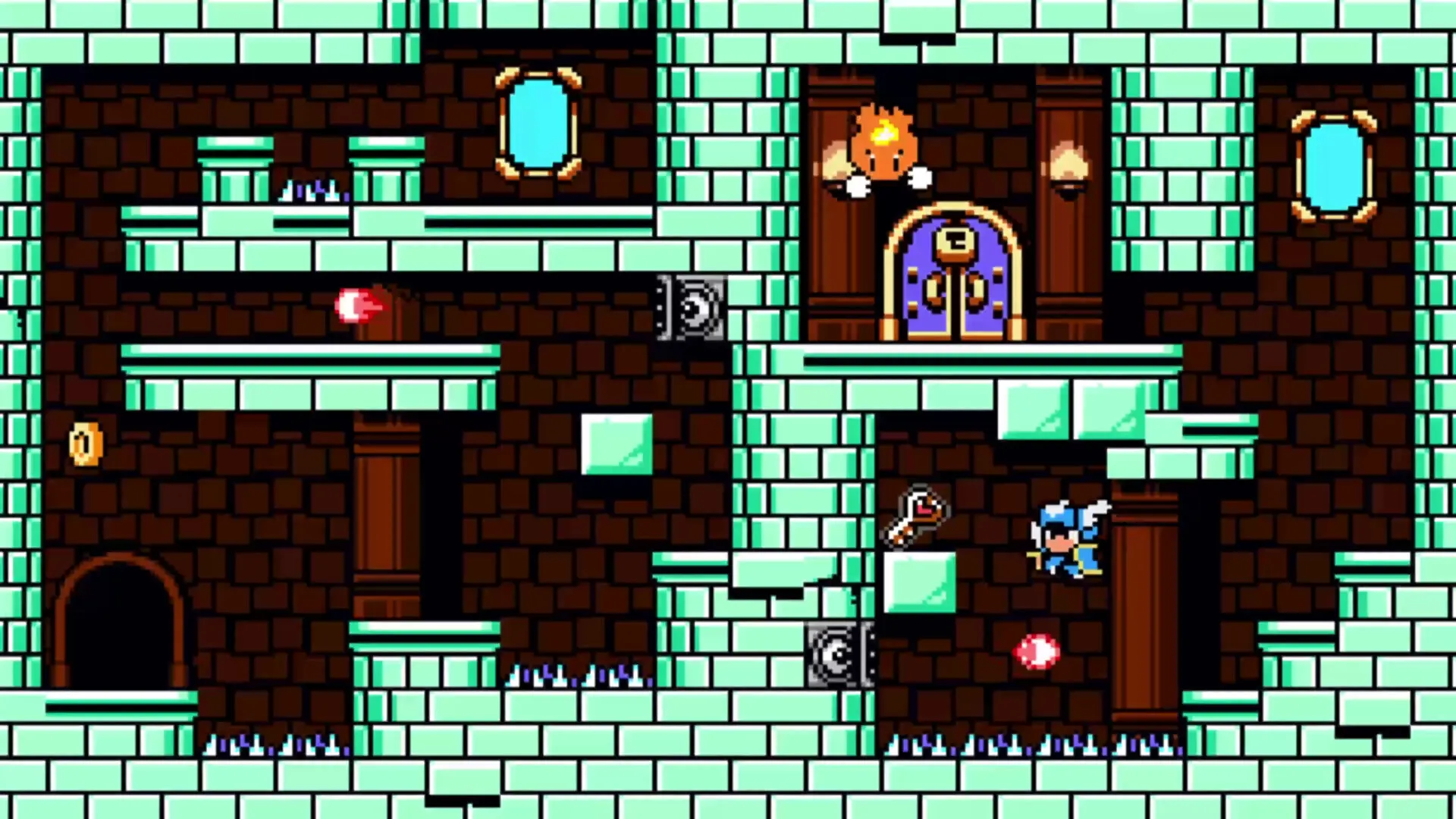
The mechanical core of Lovish lives in 50 single-room stages spread across seven themed worlds. Each room plays like a compact test of timing and movement, often cleared in under a minute. That quick structure supports a difficulty curve that hits hard, because Solomon follows a strict 1HP rule and any contact with a hazard ends the attempt immediately. The game gives players 100 hearts as a total life count, yet the space for mistakes stays narrow from room to room.
The hazards create variety through crumbling blocks, spikes, and water currents, and the magic mirrors add a spatial twist that recalls modern portal-style puzzle logic. They ask the player to reconsider 2D routes and momentum, even inside tight, single-screen layouts. Combat stays simple at the baseline, built around sword swings, while bosses arrive every ten rooms and demand a more thematic rhythm.
Solomon uses a specialized video helmet to pacify enemies through affection, tying the narrative’s fixation on “love” directly to the button presses. By world five, enemies move with far more agility, and the game pushes players into high-precision execution. That pressure lands as a mechanical mirror for Solomon’s own anxious mindset, with each claustrophobic room turning his insecurity into a physical problem of spacing, timing, and nerve.
Economic Growth and the Pursuit of Perfection
Progress runs on pennies and prestige. Coins collected in stages feed a shop that unlocks abilities that reshape Solomon’s mobility, including a dash and directional attacks that open up new options for later rooms. The lightning bolt upgrade stands out as a practical tool, giving ranged coverage and higher damage that matters in boss fights. Items also carry a knowing wink toward contemporary life. A smartphone functions as meta-commentary by turning defeated enemies into “contacts” listed inside a digital interface.
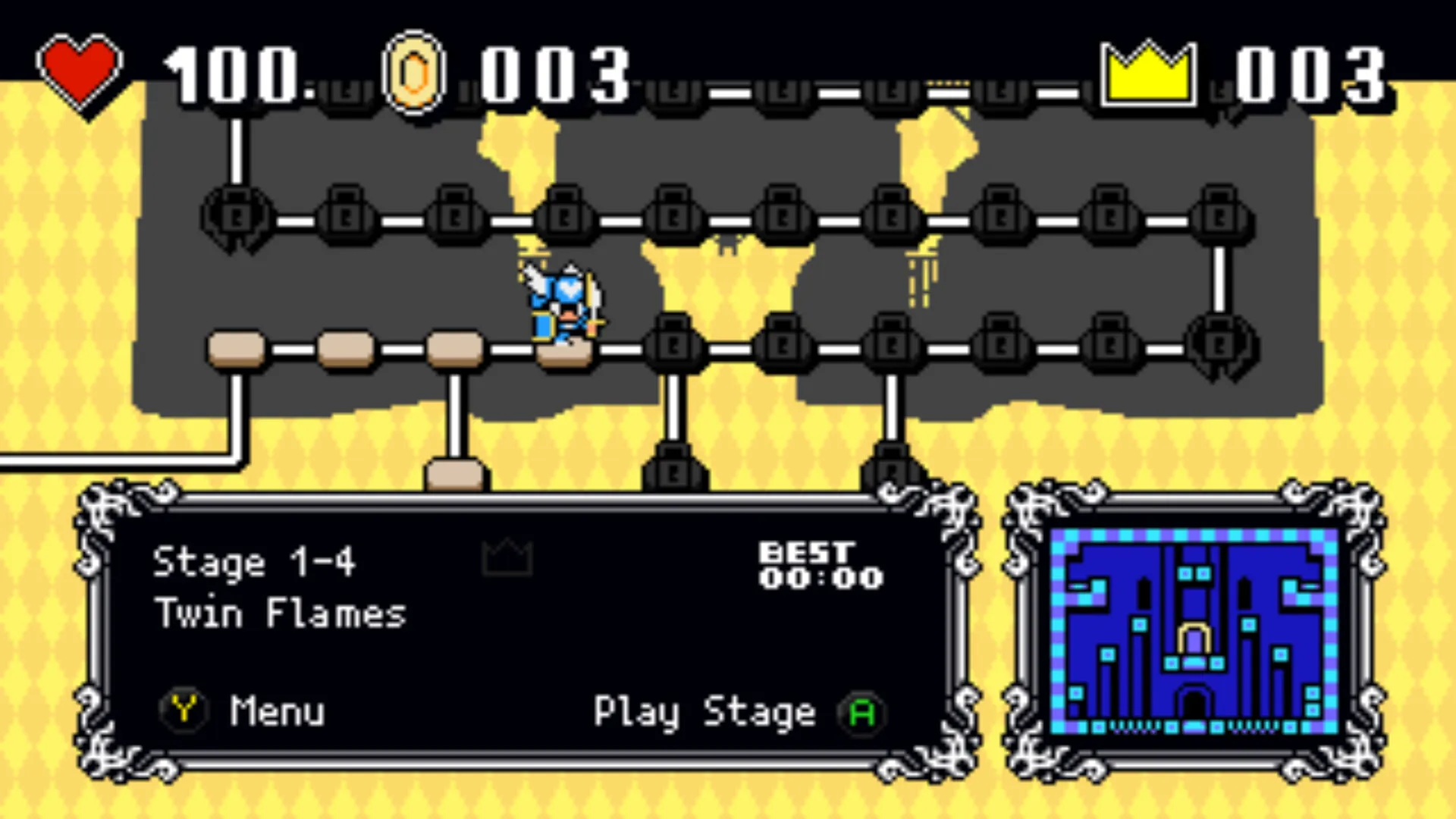
Replay value comes from the Crown System, which sets three challenges per room. The Speed Crown prizes efficient clears, the Pacifist Crown asks for a non-violent method that changes the cadence of play, and the Hidden Crown rewards players who experiment with the environment. Beyond the main rooms, Solomon can find a handheld device that contains a complete top-down adventure.
The text calls it a Zelda-inspired clone, and its slower pace offers a different touchstone from the main game’s single-screen gauntlets. Taken together, the optional goals and parallel modes frame Lovish as a game that speaks to speedrunners and completionists, using familiar genre languages and remixing them inside a compact retro shell.
Collaborative Artistry and the Chaos of Chance
Lovish sharpens its identity through the involvement of manga artist Ryūsuke Mita. His character designs give the 8-bit sprites a bouncy, expressive personality, linking the game to a wider lineage of Japanese humor and animation even within strict pixel limits. Matt Kap’s chiptune soundtrack matches that energy with driving melodies that keep momentum alive through repeated deaths. Players can toggle an aliasing filter. The raw, chunky pixel presentation delivers a clearer sense of the intended texture, especially on portable screens like the Nintendo Switch.
Between major stretches, the game pulls from a pool of 150 random event scenes. These interruptions can swing from treasure finds to getting bitten by a hippo, and their effects vary from healing Solomon to draining his health in an instant. The uncertainty becomes part of the texture, keeping players alert even during repeated room attempts.
Some events trigger sudden genre pivots, dropping the player into a turn-based JRPG battle or a survival-style encounter against a zombie horde. The result is a constant sense of volatility that matches the game’s taste for surprise. Mita’s expressive character work, paired with these spontaneous beats, gives Lovish an active, restless energy that stays lively even while the player cycles through the same punishing spaces.
The Review
Lovish
Lovish is a masterful subversion of the retro platformer that succeeds by embracing its own absurdity. It balances punishing, high-precision mechanics with a chaotic narrative structure, proving that 8-bit aesthetics can still house fresh, modern ideas. While the one-hit-death rule and randomized penalties may irritate those seeking a predictable experience, the sheer density of secrets and mechanical polish makes it a standout indie achievement. It is a rare game that feels both like a relic of the past and a commentary on the present.
PROS
- Precise, rewarding 8-bit controls
- Charming art by Ryūsuke Mita
- Deep replayability via the Crown System
- Surprising variety in mini-games
CONS
- High difficulty may repel casual players
- Random events can feel unfairly punishing
- Sound effect repetition in long sessions
- Upgrades can feel expensive early on