
























![Kingdom Hearts Collection [I-III] Review](https://gazettely.com/wp-content/uploads/2026/10/Kingdom-Hearts-Collection-I-III-1-360x180.webp "Kingdom Hearts Collection [I-III] Review: KHII Holds Steady as Newer Entries Fluctuate 37")




Mother Mary tells the story of an iconic pop singer who returns to the workspace of her former collaborator. Ten years after contact between them stopped, Mary seeks out Sam Anselm and asks her to create a dress for a performance that carries the weight of her career.
The film unfolds mainly inside a cold rural barn, using that confined setting to study the ruins of a friendship. David Lowery directs the psychodrama with close attention to the friction between the two women. Mary arrives fractured and desperate for a garment that can express her true self. Sam carries the bitterness of being shut out from Mary’s ascent to worldwide fame.
The narrative moves between their charged present and stylized flashbacks from arena tours. The film studies the cost art imposes on the people who make it. Celebrity appears here as a kind of possession. The production builds a sonic world shaped by modern pop heavyweights and joins it to a visual approach that moves from grounded realism into surreal nightmare.
The Geography of Resentment
The first reunion plays like a ritual of abasement. Mary, a global icon, appears at Sam’s door with the air of a lost dog. She arrives stripped of her usual armor, trembling in the rain and asking to reenter a life she once left behind. Sam holds complete control.
As a sought-after designer, she uses that authority to wound her former friend. The imbalance lands with force. Sam sees Mary’s influence as a carcinogen. In her internal monologue, she calls the singer a tumor, a malignant force that once threatened to overtake her own creative identity. The language is brutal and it tears the glamour from their shared past.
The repurposed barn suits the film’s gothic mood. It is drafty, remote, skeletal, and full of empty space, all of which sharpens the vacancy in their bond. The setting reflects the Miss Havisham quality of Sam’s solitary creative life. She has withdrawn into an atelier suspended in time, surrounded by the remains of her ambition. The two-hander structure gives the script a severe pressure. Dialogue carries the burden of ten years, and each exchange lands with the force of a surgical strike.
Sam’s anger about the Mother Mary persona has a clear shape. She believes she armored a Joan of Arc and received none of the credit for the religious imagery that defined the star’s ascent. In Sam’s eyes, the singer is a construction assembled through other people’s labor.
Mary arrives in search of absolution. She believes Sam can design a dress that will allow a return to her true self. That desire gives the film the ache of a broken friendship. The loss cuts deep because it destroys a shared mirror. These women are no longer two kids trying to conquer the world. They are the survivors of an impact.
The Physicality of the Divine
Anne Hathaway builds her performance through a sharp shift in scale. Inside the stillness of the barn, she speaks in a whisper, as if her voice could crack the brittle air around her. She takes on the shape of a wounded dove while asking Sam for help. That fragility disappears in the arena passages.
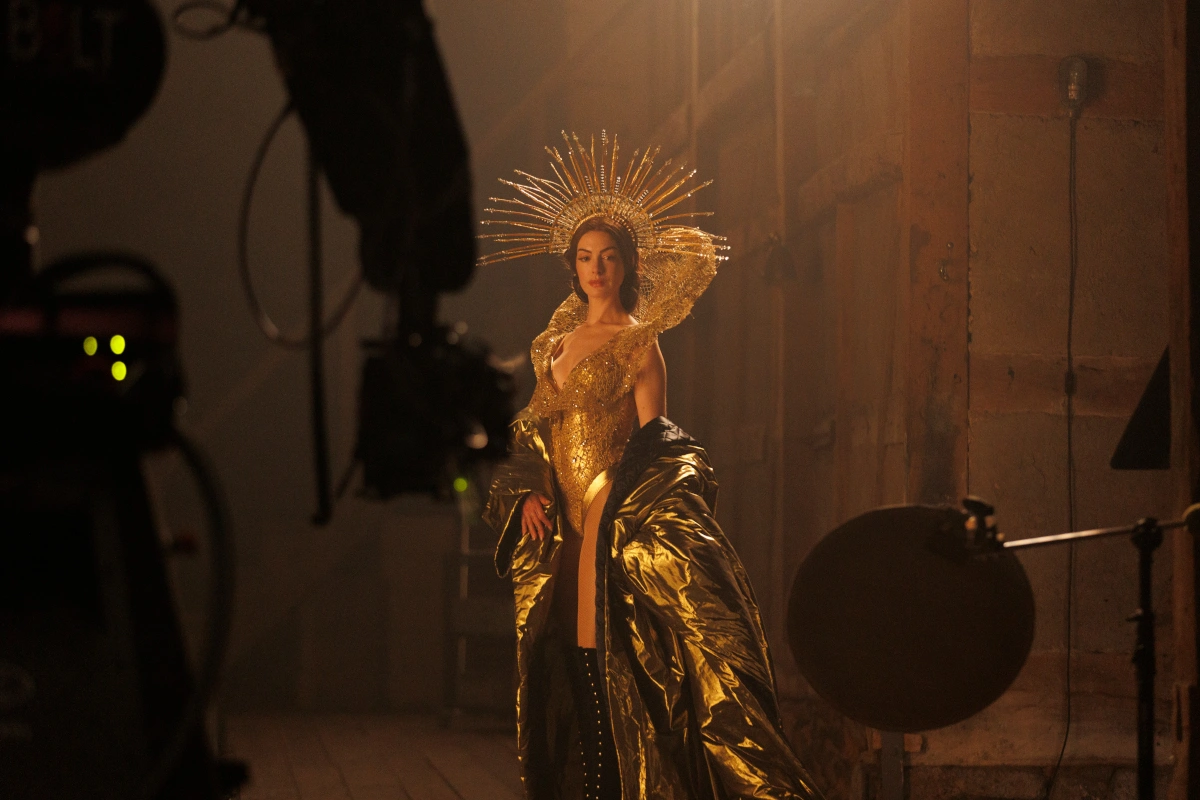
On stage, she commands the space with a presence built for worship. The fiercest moment comes in a pivotal dance sequence. Mary performs demanding choreography in silence. Slamming bones and strained breathing replace music, turning the routine into an act of possession. The scene exposes the physical labor beneath pop spectacle and tears away its artifice.
Michaela Coel serves as a regal, glacial counterweight to Hathaway’s volatility. She carries herself with the certainty of a woman who has lived through her own ruin. Her shifts from a warm smile to an embittered frown keep the scene unstable. Coel gives the script’s dense philosophical dialogue a grounded force. She makes the high-concept absurdity of the music industry feel immediate and mortal. Through her, the film’s ideas retain emotional weight.
The supporting players gather around the edges of the psychodrama with their own distinct charge. FKA Twigs appears as a peer and a participant in a quasi-erotic tango. A Ouija board shapes that scene and blurs memory with the supernatural.
Hunter Schafer plays Sam’s assistant, Hilda, and delivers a fantastical monologue near the end that alters the film’s reality. Sian Clifford appears as the harried manager, offering a needed glimpse of the professional pressures that follow Mary. These figures keep reminding the audience that the barn may be isolated, yet the industry never stops watching.
A Visual and Auditory Exorcism
Andrew Droz Palermo’s cinematography follows a deliberate progression. The opening scenes rely on static, restrained compositions that register the distance between the characters. As their defenses start to crack, the camera grows fluid and intimate. A side-scrolling dream ballet sequence emerges as a technical feat.

It presents Mary moving across different stages in a single take and gives form to the exhaustion of endless touring. The film also uses face-fading transitions that echo the visual language of classic psychodramas. The effect points to a merging of identities, where the line separating creator and muse begins to dissolve.
The costume design feels tactile and dense. Heavy fabrics and intricate detail suggest armor. Religious imagery appears everywhere, most clearly in the halo headpieces Mary wears like a crown of thorns. A central supernatural entity takes shape as a spirit made from red fabric.
It stalks the women as a physical expression of their shared trauma. That image leads the film into a stomach-turning passage of body horror. The stage surrealism feels Dalí-esque, joining high-tech gloss to distorted reality.
The music comes from a collaboration between Jack Antonoff and Charli XCX. The original pop songs move away from standard anthemic hits and take on an ethereal, aloof quality, one that feels closer to confession than product.
Titles such as My Mouth Is Lonely For You and Holy Spirit sustain the traffic between the secular and the sacred. Daniel Hart’s pulsating score runs beneath those songs like a dark current. It produces dread even in the film’s most melodic passages. The soundscape suggests that music has ceased to be a source of joy for Mary. It has become a ritual she must endure.
The Transubstantiation of Celebrity
The film takes the idea of transubstantiation and places it in a modern setting. It asks how an artist can turn something terrible into a holy vessel for an audience. Mary exists as a constructed deity. Her fans worship at the altar of her songs, finding personal meaning in a product she no longer recognizes. Sam names that dynamic with a cutting line. She tells Mary that her only gift is giving people a reason to care about her. The remark points to the parasitic quality of fame. The audience feeds on the artist’s pain and receives it as entertainment.
The characters understand the artificial nature of what surrounds them. Mary eventually says the metaphors are exhausting. That moment of meta-commentary addresses the film’s dependence on symbolism. The red ghost can read as a literal spirit or as a manifestation of Sam’s resentment.
The instability between the real and the representational is fully intentional. The story expands from a quiet chamber piece into a sprawling nightmare. It proposes that once a person becomes an icon, literal life slips out of reach.
The relationship between the two women takes on the quality of quantum entanglement. They exist as two sides of the same person and cannot move ahead without the participation of the other. The ending stays ambiguous about what belongs to literal reality and what belongs to spiritual exorcism.
It leaves behind a feeling of absence that cannot be shaken. The film plays like a séance called to summon the ghosts of a dead friendship. Resurrection carries a cost here. By the final frame, the issue of healing matters less than the simple fact that they have finally seen one another.
Mother Mary is an “epic pop melodrama” that explores the volatile relationship between a fictional music superstar and her former creative collaborator. Released by A24 on April 17, 2026, the film follows Mother Mary (Anne Hathaway) as she navigates an existential crisis while reuniting with estranged fashion designer Sam Anselm (Michaela Coel). The narrative shifts between the claustrophobic tension of a rural workspace and the high-energy spectacle of global arena tours. You can currently catch the film in limited theatrical release across the United States, with a wide expansion scheduled for April 24, 2026.
Where to Watch Mother Mary (2026) Online








Full Credits
Title: Mother Mary
Distributor: A24
Release date: April 17, 2026
Rating: R
Running time: 112 minutes
Director: David Lowery
Writers: David Lowery
Producers: David Lowery, Toby Halbrooks, Jeanie Igoe, James M. Johnston, Jonas Katzenstein, Maximilian Leo, Jonathan Saubach
Executive Producers: Michael Bloom, Philipp Klausing, Ryan Heller, Len Blavatnik, Danny Cohen, Timo Argillander
Cast: Anne Hathaway, Michaela Coel, Hunter Schafer, FKA Twigs, Sian Clifford, Kaia Gerber, Jessica Brown Findlay, Alba Baptista
Director of Photography (Cinematographer): Andrew Droz Palermo, Rina Yang
Editors: David Lowery
Composer: Daniel Hart
The Review
Mother Mary
Mother Mary is a demanding study of the cost of creation. It succeeds through the friction between its leads and the haunting precision of its style. While the heavy reliance on abstraction might alienate those seeking a linear story, the film remains a visually arresting examination of the distance between a person and their icon. It is a work that values emotional honesty over narrative clarity.
PROS
- Visceral and physical lead performances
- Strikingly intimate cinematography
- Hauntingly specific sound design
- Commanding choreography
CONS
- Muddled metaphors in the final act
- Opaque narrative structure
- Absence of grounding realism







