












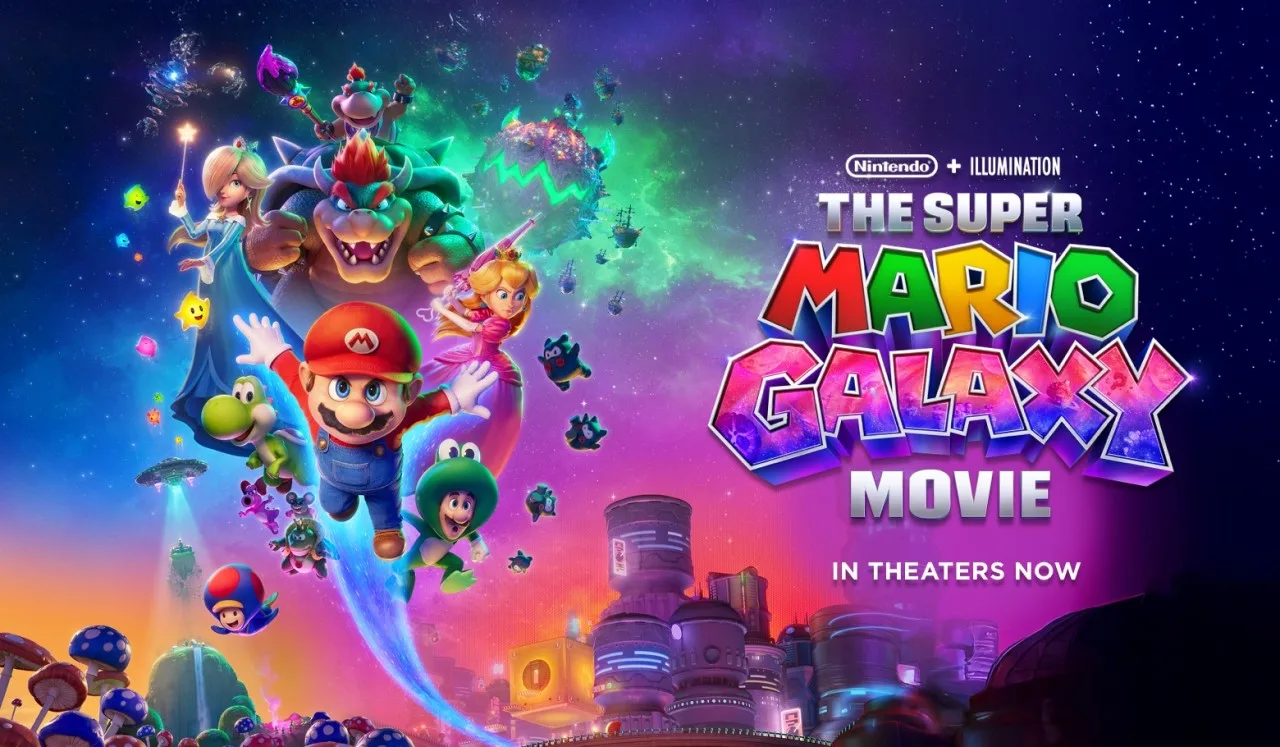

The Super Mario Galaxy Movie abandons the agrarian safety of the Mushroom Kingdom for the cold vacuum of deep space. Illumination directs this sequel with an eye for high-speed kineticism and technical polish. We open with a targeted assault on the comet observatory. Bowser Jr. materializes as a surprisingly credible threat, capturing Princess Rosalina to siphon her magic into a weapon of mass cosmic destruction (a sort of infantile Manhattan Project).
Mario and Luigi attach themselves to Princess Peach and Toad for a rescue operation. This quest requires them to hurl themselves between small, spherical planets, each boasting distinct gravitational pulls.
They are out of their depth.
The film sweeps through diverse biomes, spanning the granular isolation of the Sand Kingdom to entirely new celestial galaxies. The script gestures toward exploring Peach’s mysterious background while providing a domesticated look at a shrunken Bowser living within the castle walls. The sudden arrival of Yoshi injects an unpredictable variable into the rescue team. The production actively satisfies long-term Nintendo loyalists through exact, calculated callbacks while maintaining a hyper-paced distraction for younger viewers.
Orbital Mechanics and Oedipal Ambitions
The antagonist baton passes to Bowser Jr., an heir apparent operating with a calculated menace entirely absent in his father’s previous campaigns. He actively exploits the vulnerabilities of his adversaries. He seeks to earn the approval of an absent patriarch through the wholesale subjugation of the cosmos.
It is a classic tale of daddy issues writ large across the stars.
The inciting incident is brutally simple. He abducts Rosalina, the maternal protector of the Lumas, securing the necessary narrative fuel for our heroes’ interstellar transit. The sudden removal of this celestial matriarch creates a power vacuum, forcing plumbers into the role of peacekeepers. The script attempts to thread several subplots through this void. Princess Peach exhibits a sudden curiosity concerning her own origins. She questions her birth date and home world, supplying her with a strictly personal motivation for the expedition.
A peculiar narrative device surfaces in the dynamic between the two Koopas. They both paint. Bowser, currently confined to a cage and shrunken to the size of a household pet, uses a brush for rudimentary art therapy. Bowser Jr. utilizes his artistic endeavors to blueprint his path of destruction. This parallel method of expression (the therapeutic versus the megalomaniacal) creates a surprisingly poignant symmetry.
Bowser himself transitions from a caged prisoner to an accidental ally, generating a steady hum of comedic friction among the rescue party. It is deeply amusing to watch a former despot reduced to bickering over travel logistics.
The physical movement of the narrative relies entirely on the “launch star” system. Characters are shot violently from one miniature planet to the next, a mechanic mimicking the architectural flow of the 2007 source material. Tracing the mission from the arid, sun-bleached wastes of the Sand Kingdom straight into the shimmering Gateway Galaxy, every orbital stop introduces a fresh environmental hazard. Perhaps this planet-hopping is a commentary on modern attention spans. We bounce endlessly from one shiny object to the next, never settling long enough to understand the ground beneath our feet. I found it exhausting at first. I eventually surrendered to the sheer momentum of it all, accepting the superficiality as a design choice.
Avatars, Dinosaurs, and the Atrophy of Heroism
Donald Glover’s introduction as the green dinosaur Yoshi injects a specific, necessary chaotic energy. He delivers those signature, high-pitched vocalizations with total commitment, sounding exactly like a creature entirely unaware of tax codes or civil responsibilities. Yoshi’s immediate, almost parasitic integration into the team permanently alters their dynamic. Brie Larson voices Rosalina with a gentle detachment suited for a celestial princess. Her maternal bond with the glowing Lumas provides a desperately needed soft center against the coldness of outer space.
Then we suffer the inclusion of Fox McCloud.
Voiced by Glen Powell with exhausting bravado, this crossover from the Star Fox series feels like an unwelcome military intrusion into a civilian dispute. His aggressively macho persona serves as a jarring contrast to the blue-collar anxieties of the plumber brothers. The film relies heavily on retro, anime-style flashbacks to define his history, a stylistic choice feeling entirely imported from a different cinematic universe. It is a severe tonal shift.
Chris Pratt and Charlie Day maintain a sturdy vocal consistency as Mario and Luigi. Their frantic, overlapping banter remains intact. Their narrative function here is noticeably diminished. They are largely reactive, ping-ponging across the galaxy while others drive the action. Anya Taylor-Joy ensures Princess Peach remains a highly capable leader, consistently taking the vanguard during active combat scenarios. She has fully shed any remnants of the damsel archetype, wielding halberds and issuing tactical commands.
Jack Black continues to find absurd humor in Bowser’s shrunken state. The Koopa King’s internal conflict over his duties as a “villain parent” provides the film with its sharpest comedic beats. Benny Safdie, voicing Bowser Jr., leans into a genuinely sinister performance. He strips away the buffoonery of the Koopa bloodline, leaving behind a dark, ruthless tyrant in training. Safdie plays him like a sociopathic Roman emperor who hasn’t quite hit puberty.
Kinetic Geometry and the Commodification of Nostalgia
Illumination renders this universe with hyper-saturated, violently cheerful color palettes. The studio has significantly upgraded the textural details of their character models and special effects, rendering every mustache hair and polished scale with alarming clarity. The animation is polished to a terrifying sheen, reflecting a corporate mandate for visual perfection.
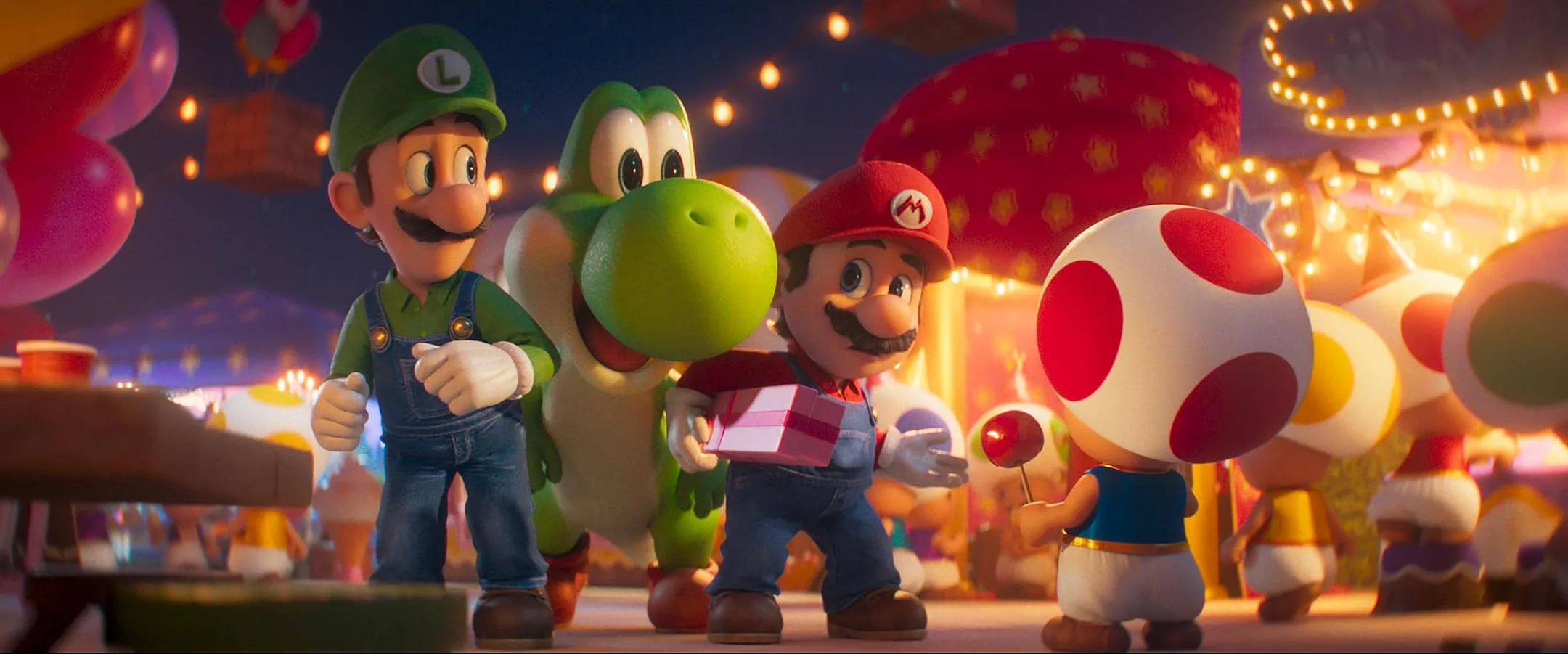
The cinematic choreography occasionally betrays a surprising sophistication. The initial skirmish with Bowser Jr. carries distinct traces of wuxia wire-work, defying gravity with balletic grace. A later action sequence featuring Peach and Toad borrows heavily from the bullet-time aesthetics of The Matrix. These are strange bedfellows for a film about Italian plumbers, yet the sheer audacity of the execution mostly succeeds.
The directors deploy a fascinating stylistic fusion midway through the second act. They force a collision between archaic 2D pixels and fully rendered 3D environments. This deliberate aesthetic crash bridges the gap between old-school constraints and modern computational excess. It is a visual manifestation of what we might call ‘pixel-nostalgism’, weaponizing our collective memories of cathode-ray tube televisions.
The camera work frequently locks into a rigid side-scrolling perspective. This framing functions as an overt homage to the original game formats, flattening the 3D space into a tight, theatrical stage. The perspective constantly snaps back and forth between sweeping, open-world vistas and these suffocating, traditional platformer angles.
We must acknowledge the environmental design. Space, usually depicted in cinema as a hostile void of terror and asphyxiation, is presented here as entirely inviting. The pervasive presence of glowing Lumas and shimmering celestial textures creates an atmosphere of warm cosmic safety. The film thrives on environmental whiplash. The viewer is dragged from the lethal, jagged geometry of Bowser’s lava traps straight into the plush, aggressively cozy interior of the comet observatory. It keeps the optic nerve perpetually guessing.
Symphonic Pavlovian Responses and Late-Stage Capitalism
Brian Tyler delivers a sweeping orchestral score aggressively mining the Nintendo archives. He threads iconic, deeply embedded melodic themes throughout the grand sonic architecture of the film. He mercifully avoids the jarring needle-drops of contemporary pop songs that so deeply compromised previous animated ventures. Tyler’s compositions successfully heighten the perceived scale of this space mission, granting a false operatic weight to what is essentially a series of athletic jumps.
The soundscape operates as a sophisticated psychological trigger for the older audience, activating dormant dopamine receptors tied to childhood gaming.
The directors crowd the margins with obscure nostalgic references. We are subjected to fleeting cameos from the notoriously weird Super Mario Bros. 2 era, including brief glimpses of Birdo, Mouser, and Wart. These inclusions feel less like organic storytelling and more like an archival flex. The most effective deep cut arrives via the R.O.B. (Robotic Operating Buddy) cameo. The archaic physical peripheral is recast as a painfully slow information desk clerk, a clever sight gag rewarding only the most seasoned veterans of the 1985 console launch.
Hints of a wider, interconnected cinematic universe are scattered everywhere. The screen is littered with recognizable items and artifacts pointing toward future franchise expansions.
We cannot ignore the aggressive commercial context of this project. The film boldly integrates actual consumer products directly into the narrative logic. Characters handle items designed to look exactly like the plastic toys currently hanging on retail pegs in the physical world. This blurs the line between storytelling and a feature-length marketing brochure. The production carefully calibrates its legacy appeal. It leans entirely on visual recognition to secure the attention of long-term gamers while bombarding a new generation with enough flashing lights to ensure total sensory compliance. It is a cynical, perfectly executed strategy.
The Super Mario Galaxy Movie premiered at the Minami-za in Kyoto on March 28, 2026, followed by a wide theatrical release in the United States on April 1, 2026. As a direct sequel to the 2023 blockbuster, this installment expands the franchise into deep space, introducing fan-favorite characters like Rosalina and Yoshi. Viewers can currently experience the film in theaters globally, including premium formats like IMAX, which showcase the improved technical detail and vivid celestial animation provided by Illumination.
Where to Watch The Super Mario Galaxy Movie (2026) Online







Full Credits
Title: The Super Mario Galaxy Movie
Distributor: Universal Pictures
Release date: April 1, 2026
Rating: PG
Running time: 98 minutes
Director: Aaron Horvath, Michael Jelenic
Writers: Matthew Fogel
Producers and Executive Producers: Christopher Meledandri, Shigeru Miyamoto
Cast: Chris Pratt, Anya Taylor-Joy, Charlie Day, Jack Black, Keegan-Michael Key, Benny Safdie, Donald Glover, Brie Larson, Glen Powell, Kevin Michael Richardson, Luis Guzmán, Issa Rae
Production Design/Visual Direction: Guillaume Aretos
Editors: Eric Osmond
Composer: Brian Tyler
The Review
The Super Mario Galaxy Movie
The Super Mario Galaxy Movie provides a visually aggressive spectacle that effectively activates childhood nostalgia while expanding the franchise's cosmic footprint. The shift to deep space offers beautiful environmental design and thrilling kinetic action. The sheer volume of cameos and hyper-focused fan service frequently crowds out organic character development. The core protagonists feel sidelined by a sprawling cast and a cynical marketing agenda. It remains a deeply entertaining sensory overload that sacrifices narrative depth for a polished commercial sheen.
PROS
- Exceptional orchestral score by Brian Tyler honoring classic Nintendo melodies.
- Visually stunning orbital environments with creative gravitational mechanics.
- Sharp comedic timing from Jack Black and Benny Safdie.
- Clever aesthetic crash of retro pixels into modern 3D spaces.
CONS
- Mario and Luigi are sidelined within their own narrative.
- Heavy reliance on nostalgic callbacks limits original storytelling.
- Jarring tonal shifts caused by the Star Fox crossover.
- Aggressive product placement blurs the line between cinema and merchandising.