
























![Kingdom Hearts Collection [I-III] Review](https://gazettely.com/wp-content/uploads/2026/10/Kingdom-Hearts-Collection-I-III-1-360x180.webp "Kingdom Hearts Collection [I-III] Review: KHII Holds Steady as Newer Entries Fluctuate 37")




The Legacy of Kain series has spent the better part of two decades in a state of suspended animation. Fans kept the flame alive through forum threads, fan sites, and the kind of stubborn devotion that only attaches itself to franchises that genuinely deserve better. Now, with a new mainline entry on the horizon and a string of remasters bringing the back catalog to modern platforms, the resurrection is finally underway.
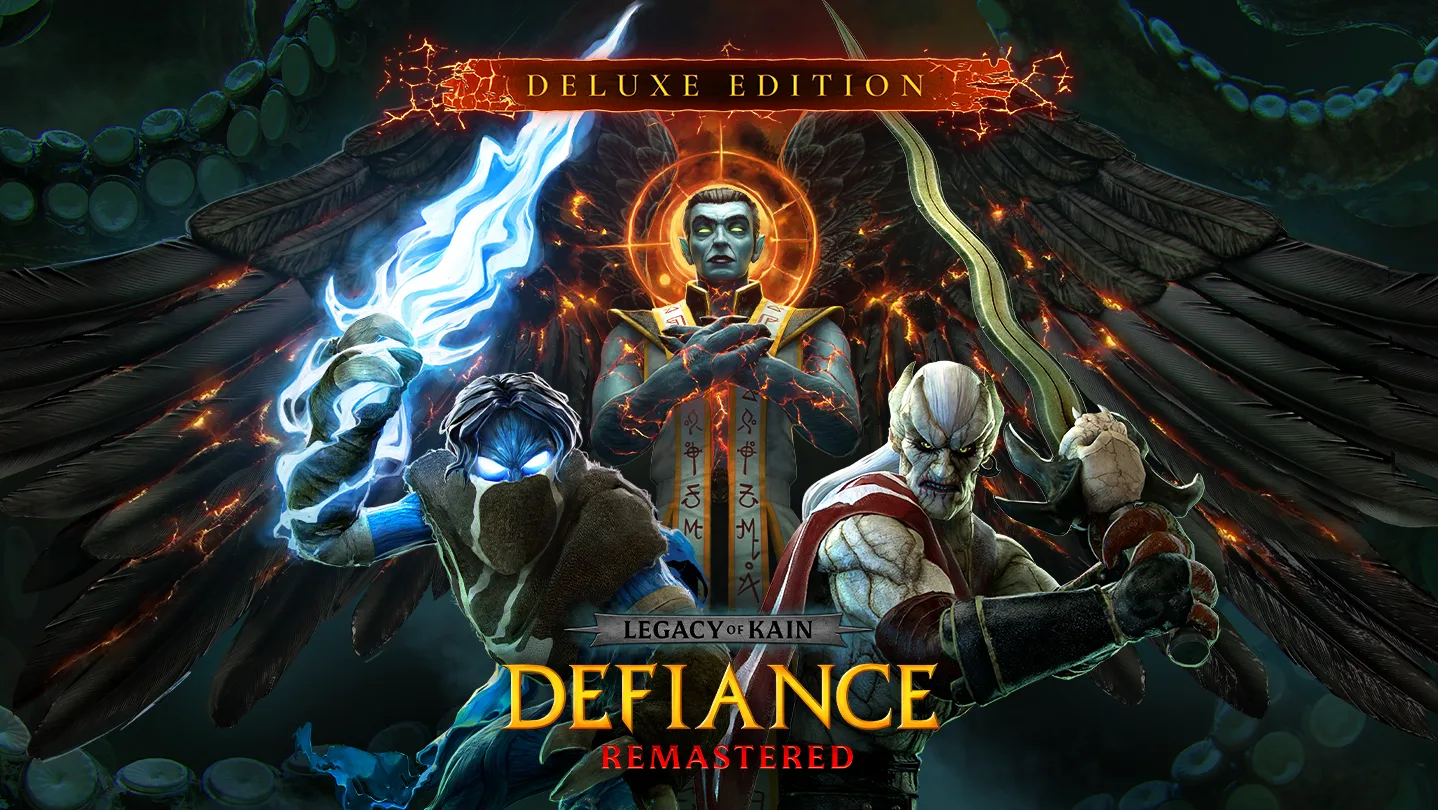
Legacy of Kain: Defiance originally released in 2003 on PS2 and Xbox. It was the fifth game in the series and, as fate would have it, its unplanned finale, closing out the intertwined stories of the vampire overlord Kain and the spectral wraith Raziel. This remaster is the third in the current revival wave, arriving after the well-received Soul Reaver 1 and 2 Remastered package. It comes in two editions: Standard and Deluxe. This review is based on the full Deluxe package. What you get is a game carrying tremendous narrative ambition on one shoulder and considerable mechanical age on the other, and the gap between those two things defines the entire experience.
A Story Written in Blood and Fate
Defiance functions as the closing chapter of two parallel sagas. The Blood Omen thread, which follows Kain’s centuries-long chess match against the forces manipulating Nosgoth’s fate, and the Soul Reaver thread, which traces Raziel’s transformation from loyal lieutenant to free-willed agent of change, converge here for the first time in a single game. The structure alternates between the two protagonists, each pursuing separate goals across different points in Nosgoth’s fractured timeline before their paths collide in the finale.
The thematic core is genuinely rich. Defiance is preoccupied with predestination, the cost of free will, and the possibility of breaking cycles that seem cosmically fixed. These are ideas the series has been building since Blood Omen, and Defiance handles them with real weight. The writing treats the player as an adult, layering exposition and revelation in a way that rewards attention rather than handholding. For newcomers, this is a problem. The story assumes familiarity with four prior games, and arriving without that context is like walking into the final act of an opera cold. The in-game lore summary and the Dark Chronicle encyclopedia help, but they are supplements, not substitutes.
For returning players, the payoff is substantial. The revelation of Raziel’s ultimate fate, the recontextualisation of events from earlier games, and Kain’s gradual emergence as something closer to a tragic hero than a villain all land with real dramatic force. The writing has an operatic density that sits at odds with most modern game scripts. Lines are long, vocabulary is deliberate, and no character speaks the way a real person would. That distance is a feature, not a flaw. This is mythological storytelling, and it earns its register.
The voice acting is the production’s greatest achievement. Simon Templeman’s Kain is one of the finest vocal performances in the medium’s history. He delivers arrogance and intelligence in equal measure, with a sardonic wit that never tips into camp. Michael Bell’s Raziel is more earnest and morally conflicted, and some players may find his more plaintive register less immediately charismatic.
The contrast between the two performances mirrors the contrast between the characters themselves, which is exactly how it should work. Preserved in the bonus content are behind-the-scenes recording sessions featuring Tony Jay and Rene Auberjonois, and watching those sequences is a reminder of how seriously this production took its craft.
Where the Gameplay Gets in Its Own Way
Defiance made a deliberate choice to pivot away from the exploration and puzzle-solving that defined the Soul Reaver games. The emphasis here is on action combat, structured around light and heavy attacks, a telekinetic push, and aerial combo chains. The system carries clear Devil May Cry influence, though it operates at a fraction of that game’s mechanical depth.

Both Kain and Raziel share the same core combat kit, which is the system’s most significant structural problem. Playing as Kain should feel like inhabiting a calculating, centuries-old predator. Playing as Raziel should carry the weight of a soul fighting against a fate already written. The combat does not communicate either of those things. They swing the same way, combo the same way, and progress along the same upgrade tree as they earn EXP from defeated enemies.
The special abilities do introduce some differentiation: Raziel gains elemental Reaver enhancements that let him freeze or ignite enemies, while Kain can turn enemies against each other or slow time. These are genuinely interesting tools. The meter that powers them, however, drains quickly, takes a long time to build, and frequently depletes before a combat encounter gives you a meaningful window to use it. Across a 12 to 15 hour playthrough, the system starts to feel like a promise that never quite pays out.
The mechanical gap between Kain and Raziel is most apparent in how they move. Raziel shifts between the material and spectral realms, which in the Soul Reaver games was the central mechanic around which everything else orbited. Here it has been reduced to a utility function: passing through certain gates, stabilising health in dangerous stretches. The spectral realm was once a parallel world full of its own logic and possibility. In Defiance, it is closer to a key. Kain, by contrast, is a heavier, slower character whose sections lean almost entirely on combat. The result is that his chapters feel more laborious, particularly in a game where the combat system already starts to show fatigue by the midpoint.
Hit feedback is a persistent issue. Enemies absorb strikes without convincing physical response, making combat feel imprecise. The irony is that Kain and Raziel themselves get knocked backwards by comparatively minor attacks, creating an asymmetry that reads less as intentional difficulty and more as unresolved design. Level design amplifies these problems. The structure is largely linear, funnelling both characters through corridors and cylindrical arena spaces that gate progress behind elemental Reaver upgrades. Puzzles are straightforward, and platforming ranges from functional to genuinely frustrating depending on how clearly the geometry communicates what can and cannot be interacted with.
The Remaster’s Wins and Losses
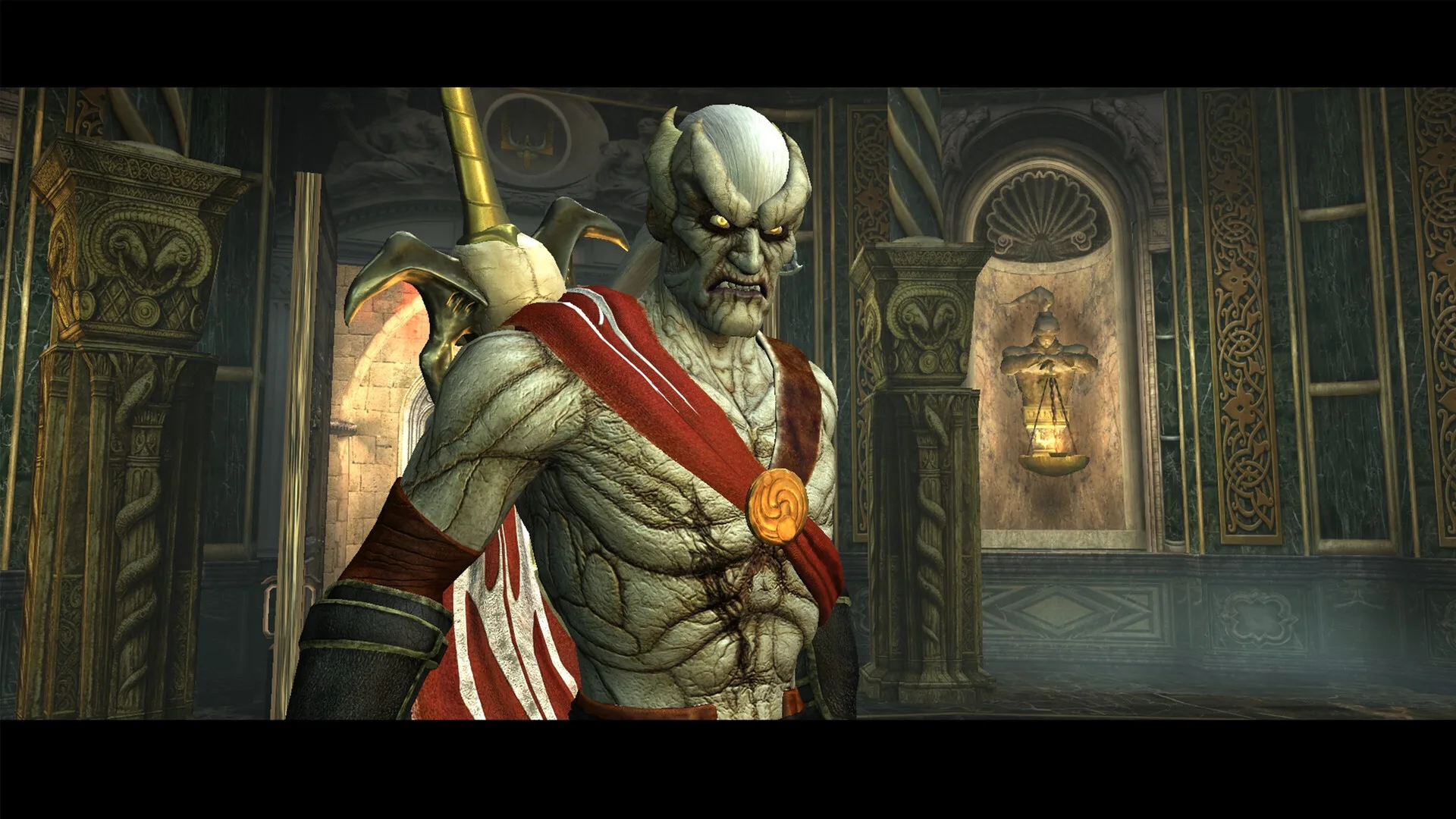
The most impactful change in this remaster is the camera. The original used a fixed cinematic system in the style of early PS2 action games, a choice that was already causing problems in 2003. The new fully controllable 3D camera transforms the game’s playability. Combat encounters that were previously obscured by walls or poor angles become readable. The original camera remains available and toggleable at any point, which is the right call: the cinematic framing does give the game a visual staging quality that the freeform camera cannot replicate. Both options have genuine merit depending on what you prioritise.
The visual upgrades are more uneven. Character models have received appreciable improvements, and some environmental textures benefit clearly from the higher resolution pass. The problem is that sharper textures applied to low-polygon geometry can have the opposite of the intended effect, drawing attention to the age of the underlying construction rather than concealing it. Skyboxes remain small and geometrically simple, and the HD treatment makes their limitations more visible. The new lighting is inconsistent: certain areas gain atmosphere from it, while others are over-lit in ways that flatten the gothic mood the original cultivated carefully. Thankfully, the visual toggle extends to lighting and camera simultaneously, so reverting to the original presentation is always an option.
Audio carries its own complications. The soundtrack is largely intact and the main theme retains its power. The voice acting is pristine. The problem is that a set of audio bugs that were documented in the original 2003 release, music cutting out during boss fights, ambient tracks replacing combat music unexpectedly, footsteps falling out of sync with animation, have made the journey across unchanged. For a remaster positioned as a celebration of the game, leaving known technical issues unaddressed is a visible omission.
The UI has been meaningfully improved. A new interactive menu system, a skills screen showing unlocked abilities, and a full map that marks locked areas for return visits all contribute to a more navigable experience. One technical hazard from the original also survives intact: a softlock in Vorador’s Mansion triggered by completing two open-ended objectives in the wrong sequence. Saving frequently is strongly advised.
The Vault of Lost Things
The bonus content is where the Deluxe Edition earns a portion of its premium, though how much depends on your investment in the series. The Lost Levels offer playable access to areas cut during development, spaces that were originally intended to house the elemental Reaver upgrade sequences before the design was simplified for the final release. They are largely empty, with no enemies or puzzles, and each takes only a few minutes to walk through. As historical artifacts they are fascinating, sketching a version of the game with more expansive, less linear architecture. As gameplay they offer very little.
The Dark Prophecy demo, exclusive to the Deluxe Edition, presents what the cancelled sixth Legacy of Kain game might have looked like. In practice, it is a brief combat encounter of roughly two minutes, built on Defiance’s existing engine, with some visible bugs. The design notes surrounding it carry more interest than the demo itself: a Kain-only focus, a continuation of Defiance’s ending, a sensibility closer to Blood Omen 2 than Soul Reaver. For a dedicated fan, it is a window into a road not taken. For a casual player, it is unlikely to justify the price difference between editions.
The archival content is the package’s strongest preservation element. Concept art unlocked through collectible Arcane Codexes provides a visual history of the game’s development. Tomb galleries extend that history back to the original Blood Omen on PS1. The comic scans included in the Deluxe Edition are brief and unlikely to draw repeated visits, but they add texture to the lore. The preserved behind-the-scenes footage of the voice recording sessions, originally included on the 2003 disc, remains a highlight.
Seeing Tony Jay and Rene Auberjonois recording their lines in a casual studio environment gives the production a human dimension that the finished game’s theatrical tone tends to obscure. The Dark Chronicle lore encyclopedia stands as the single most accessible and rewarding feature for any player, new or returning, who wants to understand the full scope of Nosgoth’s history.
Who Should Return to Nosgoth
Defiance Remastered is a package built primarily for people who already care about Legacy of Kain. The story rewards the investment of four prior games. The bonus content speaks most clearly to players with an existing attachment to the franchise. The gameplay, in its current state, is a considerable ask for anyone arriving without nostalgia to soften its edges.
For returning fans, the value proposition is clearer. The narrative still holds up as one of the most ambitious pieces of storytelling the medium produced in that era. The voice performances remain extraordinary. The archival content offers genuine insight into a franchise whose development history is as interesting as its fiction. The camera improvement alone makes the game substantially more playable than its original form.
The timing of this release adds a layer of relevance. With Ascendance arriving and the franchise actively rebuilding its audience, Defiance completes the trilogy of Soul Reaver remasters and gives players the full Kain and Raziel story before the new chapter begins.
PlayStation is currently the only platform where the complete franchise, including Blood Omen and Blood Omen 2, is accessible in one place, which makes this an opportune moment to engage with the series in full. The hope that the Blood Omen titles receive similar treatment in the near future feels reasonable given the current momentum. Defiance Remastered is an imperfect package, carried by a story and a world that still have very few peers.
Legacy of Kain: Defiance Remastered is an action-adventure hack-and-slash game that serves as the modernized definitive edition of the 2003 series finale. Released on March 3, 2026, the game concludes the epic saga of the vampire lord Kain and his spectral lieutenant Raziel as they navigate the dark, gothic world of Nosgoth to defy their preordained fates. This remaster features significantly upgraded HD visuals, a new modernized camera system, and restored “lost levels” and bonus content previously unseen by fans. The game is available on PC via Steam and the Epic Games Store, PlayStation 5, PlayStation 4, Xbox Series X|S, Xbox One, and Nintendo Switch.
Full Credits
Director (Creative/Game Director): Amy Hennig
Writers (Lead Writer/Narrative Designer): Amy Hennig
Producers/Studio Leadership (Producers, Executive Producers, and Key Studio Heads): Scot Amos, Thomas Vu, Rosaura Sandoval, Lyle Hall
Lead Voice Cast: Simon Templeman, Michael Bell, Tony Jay, Richard Doyle, Anna Gunn, René Auberjonois, Paul Lukather
Art Director/Lead Artist: Daniel Cabuco, Hiroshi Minagawa
Key Engineering/Technical Leads: Jason Bell, Gary Snethen, Thomas French
Composer/Sound Director: Kurt Harland, Jim Hedges
Developer, Publisher: Crystal Dynamics, PlayEveryWare, Crystal Dynamics
Release Date: March 3, 2026
The Review
Legacy of Kain: Defiance Remastered
Legacy of Kain: Defiance Remastered is a package defined by contrast. The story, voice acting, and world-building remain exceptional, and the archival bonus content shows genuine care for the franchise's history. The gameplay, though, has aged poorly. Combat grows repetitive, exploration is shallow compared to its predecessors, and several technical issues from 2003 survive untouched. The camera overhaul saves the experience from feeling unplayable, but it cannot fix the underlying mechanical fatigue. Dedicated fans will find enough here to justify the purchase. Everyone else should approach with measured expectations.
PROS
- Exceptional voice acting, particularly Simon Templeman as Kain
- Rich, mythologically dense storytelling that rewards series veterans
- New 3D camera dramatically improves playability
- Generous archival content, including behind-the-scenes footage and the Dark Chronicle encyclopedia
- Visual toggle between original and remastered presentation is seamlessly implemented
CONS
- Combat is repetitive and lacks meaningful feedback
- Kain and Raziel play too similarly, undermining their distinct identities
- Known audio bugs from 2003 remain unresolved
- Visual upgrades are inconsistent and occasionally counterproductive
- Spectral realm mechanic is a shadow of its Soul Reaver implementation