

























![Kingdom Hearts Collection [I-III] Review](https://gazettely.com/wp-content/uploads/2026/10/Kingdom-Hearts-Collection-I-III-1-360x180.webp "Kingdom Hearts Collection [I-III] Review: KHII Holds Steady as Newer Entries Fluctuate 37")




Super Meat Boy 3D shifts a series built on 2D precision into a three-dimensional format. Sluggerfly and Team Meat reshape the 2010 classic through the addition of a Z-axis. The setup stays simple. Meat Boy and Bandage Girl share a quiet moment before Dr. Fetus kidnaps her.
That premise sends the player into a string of brutal challenges. Progress means surviving deadly stages and reaching the end. This is a masocore platformer that asks for exact execution and constant control. Moving into 3D changes how the series works on a fundamental level.
Each level plays like a speed puzzle, with momentum and route planning tied closely together. Saws, pits, and lasers threaten the player from multiple angles. The chase through five worlds keeps the action in constant motion. Reaching the goal alive is the only measure that matters. The new perspective changes how movement is read and planned, yet the game still carries the same intense spirit.
Precision and Physics
Movement stays fast and responsive, which gives returning players something familiar to hold onto. Jumping still depends on button pressure. A quick tap produces a short hop, and a full press sends Meat Boy across wide gaps. The physics feel exact and dependable.
A new air dash gives players a way to stop momentum on command. That tool helps recover from a jump that was lined up a little wrong. It also lets you redirect in mid-air to slip past a saw blade. Wall running joins the moveset as well. Since the levels now stretch through 3D space, Meat Boy can run along surfaces that do not sit directly opposite each other.
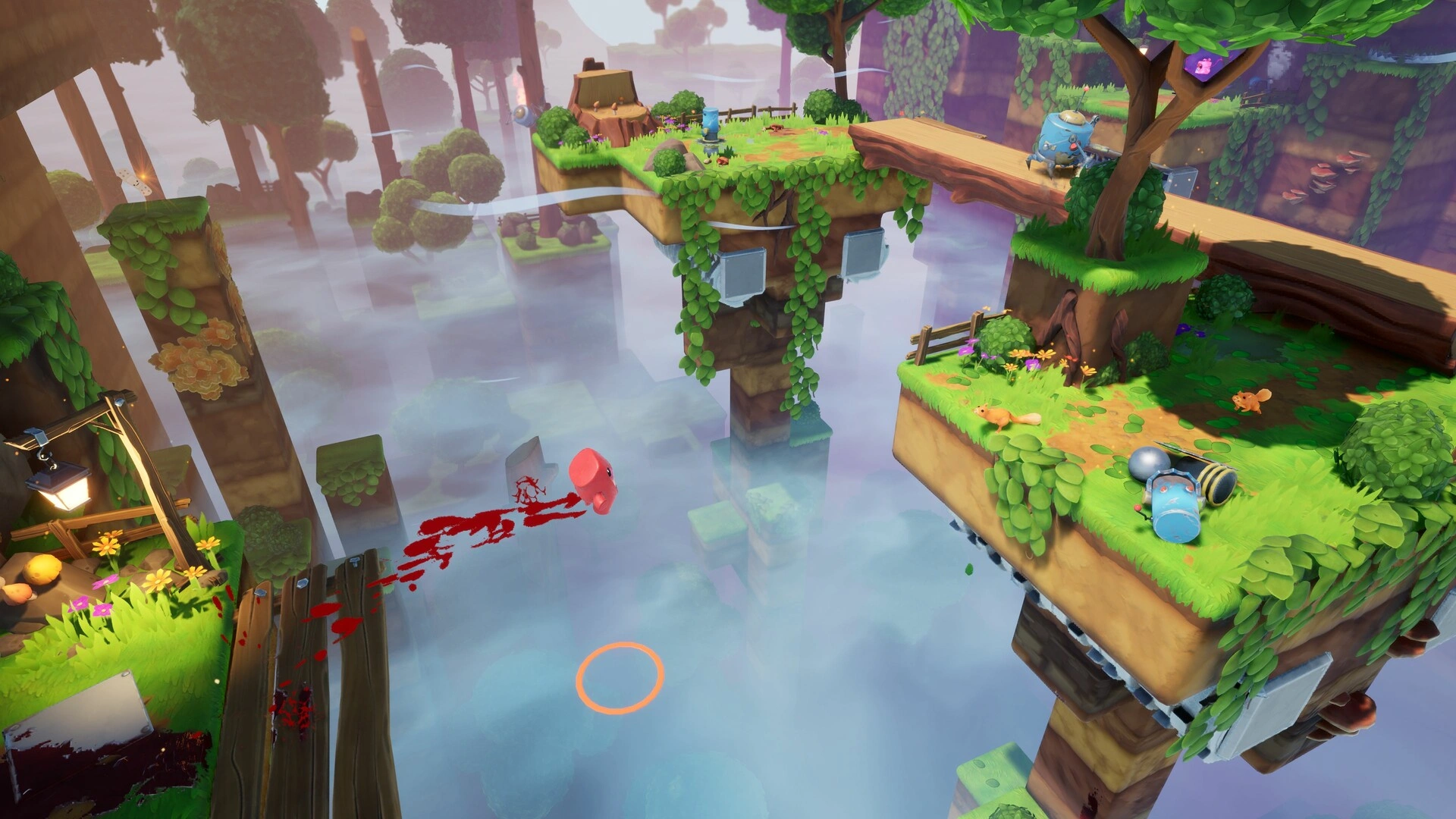
The game uses an 8-directional movement system, so the character locks to 45-degree angles. That choice keeps long sprints clean and direct, though it can create a slight stiffness. A red ring under Meat Boy marks the point where he will land.
In a 3D platformer built around exact spacing, that marker becomes essential. The game asks players to react on instinct. Progress comes from repetition, timing, and control refined through failure. The systems support that rhythm well. Survival in the harder stages depends on learning how these mechanics interact and committing them to muscle memory.
The Structure of Suffering
The game is split into five distinct worlds. Each one is filled with short levels meant to be replayed at high speed. Most runs last between 20 and 45 seconds. That structure keeps failure from dragging and makes retries feel natural. Each world ends with a boss fight built across three phases, with each phase raising the danger and adding complexity.
The A+ ranking system gives finished stages continued value. Beating a level fast enough earns that rank and opens the Dark World version. These variants reuse the base layouts and add harsher hazards with less room for safety. Hidden bandages create another layer of challenge.
They sit in difficult places, so collecting them demands precision and a willingness to explore risky paths. Gathering enough bandages unlocks guest characters such as Headcrab and Meat Ball Boy, each with distinct movement styles. That changes the feel of certain levels and gives repeat runs a fresh mechanical angle.
One of the strongest features is the replay system. After a successful run, the game shows every failed attempt at once. A crowd of Meat Boys races forward, crashes, and dies together across the stage. It turns repetition into a visible record of effort. Failure becomes part of the show and part of the reward. The structure is built around mastery. Finishing the game already asks a lot from the player. Unlocking everything asks for sustained commitment and a very high level of execution.
Aesthetics and Technical Constraints
The art style leans into gore and grime through a colorful cartoon look. Meat Boy visibly breaks down during a run, with bones showing or an eye knocked loose as he pushes through hazards. The soundtrack uses heavy rock and metal. Some tracks push the action with force, and others land in a calmer space.

The fixed camera shapes much of the experience. Players cannot rotate the view, and the game tracks Meat Boy automatically. That decision makes depth harder to read. Some deaths come from platforms appearing closer than they really are, which becomes especially irritating during precise jumps. Performance also shows inconsistency.
The target is 60 frames per second, yet the game often drops into the 30 to 40 range. During demanding sections, the action can feel choppy. Docked play runs with greater stability. Handheld mode stutters more often. For a game built around instant response and exact timing, that is a serious issue.
Fast restarts soften some of that frustration. After a death, the game throws you back into the level almost instantly. That pace keeps attention locked on the next attempt. The bloody visual details and breakneck movement give the game a clear identity. Even with the hardware issues, it still delivers a frantic, high-pressure energy that fits the series well.
The Review
Super Meat Boy 3D
Super Meat Boy 3D translates the frantic energy of the original into a new dimension with mixed results. The responsive movement and rewarding progression systems maintain the high stakes of the series. Technical hitches and camera perspective issues create friction during play. It remains a stiff challenge for fans of the genre. The transition feels successful but lacks the refinement found in the 2D entries.
PROS
- Responsive movement physics
- Rewarding post-level replay system
- Extremely fast restart times
- Deep list of unlockable characters
CONS
- Inconsistent depth perception
- Unstable frame rates
- Inflexible camera angles
- Repetitive boss encounters







