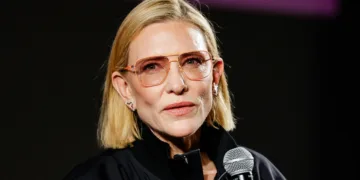












Cate Blanchett declared that the #MeToo movement “got killed very quickly” in Hollywood, speaking Sunday at a public conversation during the Cannes Film Festival — remarks that landed the same weekend that Julianne Moore accepted a gender equality award at the same festival and warned that true parity remains a distant prospect.
Blanchett, speaking with Cannes moderator Didier Allouch, questioned why the movement’s momentum had been suppressed so swiftly. “There are a lot of people with platforms who are able to speak up with relative safety and say this has happened to me, and the so-called average woman on the street is saying #MeToo. Why does that get shut down?” she asked. “What the movement revealed is a systemic layer of abuse, not only in this industry but in all industries, and if you don’t identify a problem, you can’t solve the problem.”
Blanchett’s comments carried particular weight given her history at Cannes. In 2018, serving as jury president at the height of #MeToo, she led a women’s march on the Palais steps, holding hands with Kristen Stewart, Léa Seydoux, Ava DuVernay, and Agnès Varda. The 82 women who joined her that day symbolized the number of female directors who had competed at Cannes up to that point — compared to 1,866 male directors over the same period.
Eight years on, she told the audience that film sets remain overwhelmingly male. “I’m still on film sets and I do the headcount every day, and it is still, you know… there’s 10 women and there’s 75 men every morning,” she said. “I love men, but what happens is the jokes become the same. You just have to brace yourself slightly, and I’m used to that, but it just gets boring for everybody when you walk into a homogeneous workplace. I think it has an effect on the work.”
Moore’s remarks at the Kering Women in Motion dinner offered a parallel reckoning. Accepting an award for her career and advocacy, Moore pushed back against the industry assumption that women’s stories hold less appeal: “There’s a cultural assumption, particularly in the United States, that women’s stories are less interesting or smaller, or that if we’re at the center of a narrative we need to be stronger or accomplishing something great or doing something particularly male if we want men to watch us. And I think that’s untrue.” She also recalled arriving on a set where, in the aftermath of Hillary Clinton’s 2016 election loss, she looked around the room and realized the only women present were herself and a third assistant camera operator.
Moore told Reuters the problem extends well beyond entertainment: “We’re pretty far away, honestly, in lots of the world in terms of real gender equality. It’s not something that is endemic to the film industry. It’s something that’s a global issue.”