









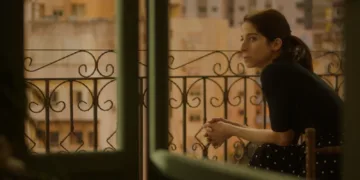














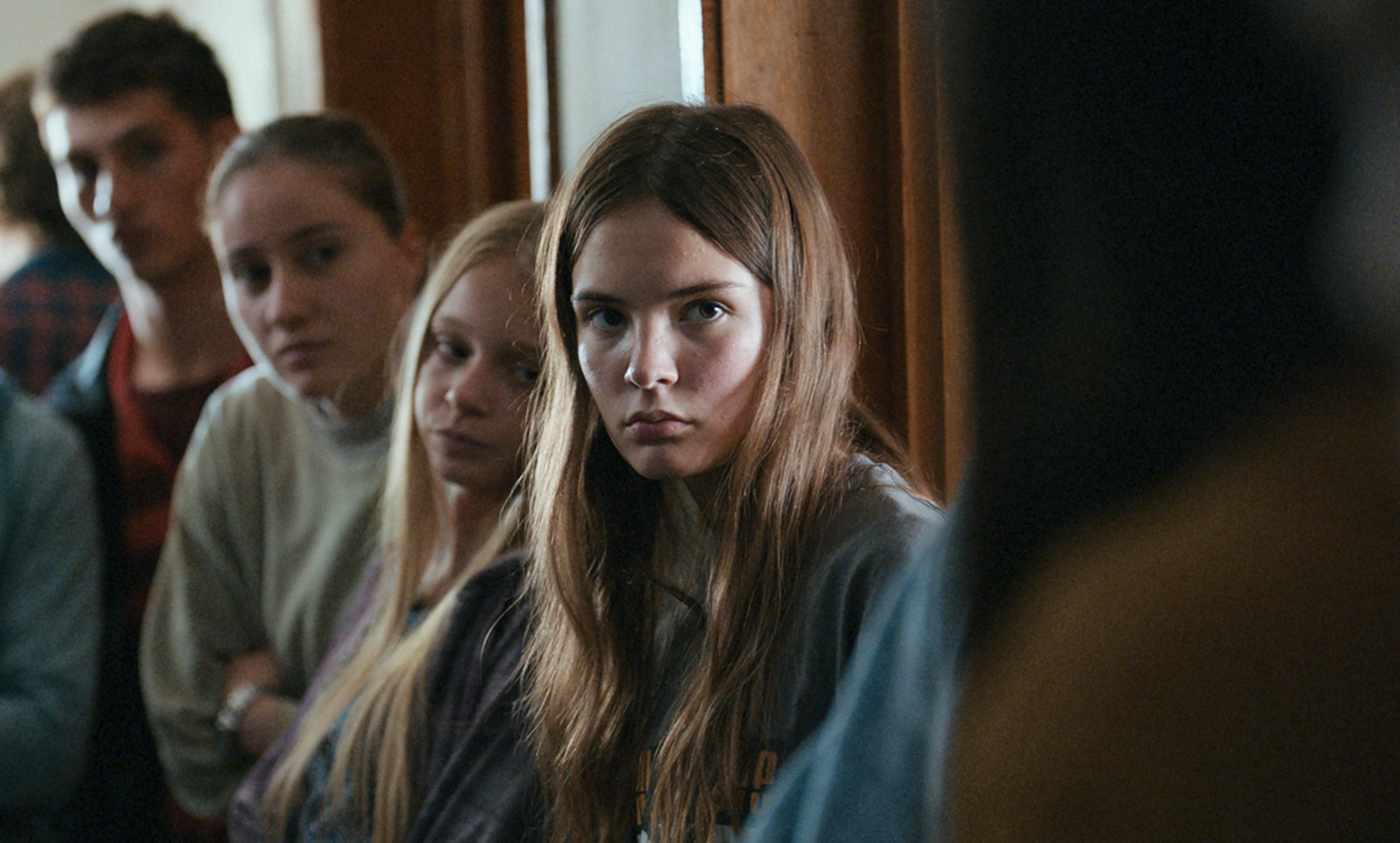

Prishtina in the late 1990s seems trapped in one long held breath. Thirteen-year-old Dua sits in a disco bathroom, working over her makeup with the solemn precision of a priestess preparing for a minor pop-cultural rite. The opening notes of a pop song offer a thin coating of Western normality (a cosmetic defense, and a fragile one). The scene’s ordinariness carries a strange political charge. A girl trying to look older becomes a civic event when the city around her has been divided, policed, and trained to flinch.
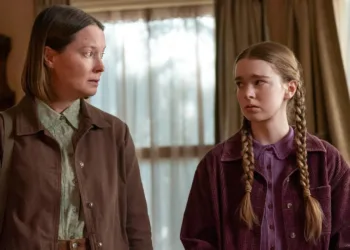
Police raids break through this fragile teenage ceremony. The Serbian military presence sits on ethnic Albanians with the pressure of architecture, a built thing pressing on lungs, streets, classrooms, family rooms. Dua moves through a city whose barriers have become atmospheric. She watches social plates shift under her feet with a calm that feels borrowed from the elderly.
School has left public buildings for packed private apartments, where unpaid teachers preserve order with almost monastic stubbornness. Gossip gives way to guerrilla education. Childhood ends through administrative displacement, which is a terribly dull phrase for a terrible historical fact. The film understands that political violence often reaches a child first through routine: where lessons happen, who whispers, which streets are safe, which adults suddenly stop answering questions. A first kiss weighs as much as a military checkpoint.
The Optical Mechanics of Paranoia
Cinematographer Lucie Baudinaud builds an anxiety-machine from handheld camerawork, giving Dua’s inner fracture a physical grammar. The lens twitches, searches, hovers. It copies the body language of someone trained to suspect the edge of every shadow. Long, unbroken takes keep the viewer trapped inside the same duration as the threat. The discomfort has to be lived through second by second.
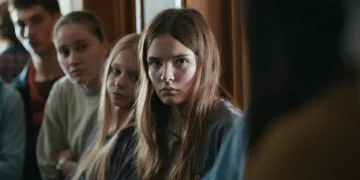
The camera clings to Dua. It peers over her shoulder or sits close enough to turn her face into terrain. This subjective approach creates what might be called peripheral terror, the horror that lives outside the frame until its effect appears on a child’s expression. We read the wound before we receive the blow. In the family apartment, the visual scheme tightens into suffocating claustrophilia. Bodies press against bodies. Siblings and parents consume the available space. Privacy has become a relic, one of those vanished luxuries people remember with unnecessary politeness.
The framing keeps Dua as the image’s moral anchor, even when she stands at the edge of the action. Visual instability gathers around her, and her limited sightline becomes the film’s governing intelligence. The political war grows sharper through this narrowed view. History arrives through a keyhole, and the keyhole belongs to a frightened child.
Acoustic Fractures and Ghostly Brutality
Sound operates here as an instrument of psychological demolition. The soundscape is jagged, full of distorted echoes and industrial hums, suggesting a world being processed by historical machinery. Radio broadcasts become a distant oracle of doom. They report geopolitical shifts that feel abstract in language and lethal in consequence.
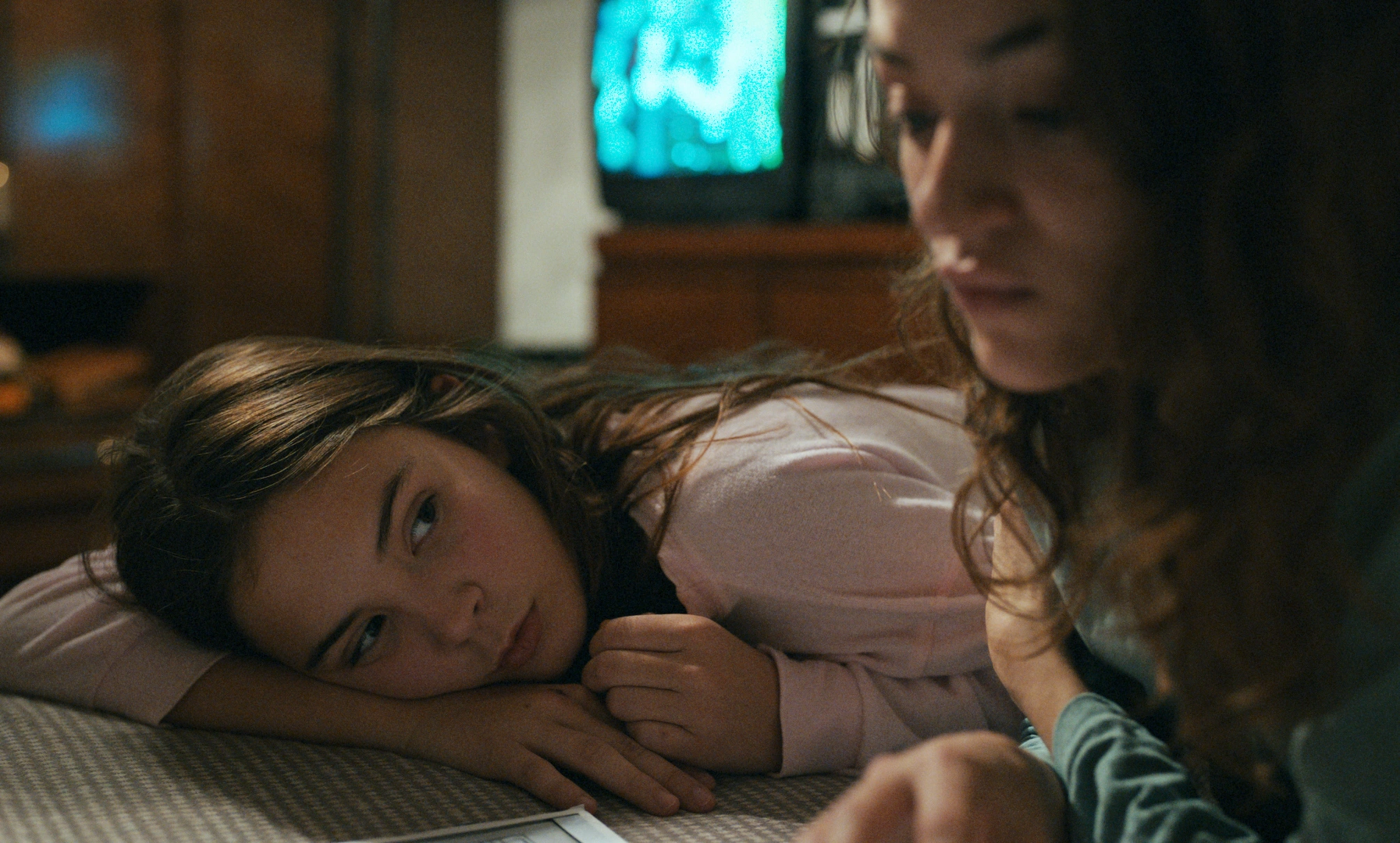
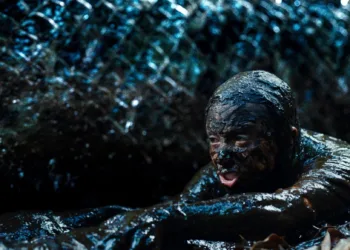
The film often asks the audience to measure violence through sound and through the terror on Dua’s face. The car trip with her father crystallizes this method. A single trickle of blood snakes down his neck after a beating. Dua faces forward. She cannot make herself look back. The silence that follows carries greater force than the strike itself. It becomes a metaphor for a generation trained to internalize trauma before it can safely name what happened.
Relief arrives already contaminated. The karaoke sequence with Skunk Anansie gives pain a brief outlet, yet the moment feels like a scream swallowed by a vacuum. The city’s background noise becomes a gauntlet of ethnic slurs and military catcalls. Walking home turns into a psychological minefield. Acoustic terror never recedes. It tells the characters, again and again, that their bodies remain subject to inspection, insult, and force.
The Martial Art of Self-Preservation
Maki’s arrival shifts the household’s emotional gravity. She is a refugee carrying knowledge of rural carnage that Dua has absorbed through radio reports and adult fragments. Her presence brings survivalist pragmatism into Dua’s urban anxiety. The judo lessons between them carry heavy symbolic charge. This martial puberty gives Dua a language for agency. Her resentment finds muscle, rhythm, leverage.
A few throws cannot halt a tank (teenage fury has never enjoyed a fair relationship with physics), yet training marks a psychological victory. Dua’s anger changes shape, moving from passive flicker to dangerous flame. Retaliation tempts her because it promises moral clarity. It also threatens the family’s already precarious safety. Inside the home, hierarchy remains firm. Dua is kept outside adult knowledge. Doors close. Voices drop. Decisions pass over her head.
Her mother works at a sewing machine while her father trades petrol in the shadows. Their labor becomes resistance through persistence. Self-preservation is the available rebellion in a state intent on erasure. Pinea Matoshi gives a performance of extraordinary quiet. She lets a hidden eagerness pulse beneath Dua’s stoicism, then allows that eagerness to curdle into dread. Dialogue becomes almost secondary. Her face carries the collapse.
The film’s most severe idea may also be its plainest: staying alive can become a radical act. That thought empowers Dua and wounds her at the same time. It grants her purpose, then charges her childhood for the privilege.
Dua premiered on May 20, 2026, during the Critics’ Week competition at the Cannes Film Festival. The film explores the lives of ethnic Albanians in Prishtina, Kosovo, during the late 1990s as the threat of war escalates. Following its festival run, the movie is expected to be available for international audiences through distributors secured by The Party Film Sales, with specific theatrical and streaming dates to be announced for late 2026.
Full Credits
Title: Dua
Distributor: The Party Film Sales
Release date: May 20, 2026
Running time: 95 minutes
Director: Blerta Basholli
Writers: Blerta Basholli
Producers and Executive Producers: Valon Bajgora, Yllka Gashi, Agon Uka
Cast: Pinea Matoshi, Vlera Bilalli, Kaona Matoshi, Andi Bajgora, Yllka Gashi, Kushtrim Hoxha, Fatmir Spahiu, Armond Morina
Director of Photography (Cinematographer): Lucie Baudinaud
Editors: Enis Saraçi, Félix Sandri
Composer: Genc Salihu
The Review
Dua
Dua is a heavy, technically proficient look at a stolen childhood. The film succeeds by anchoring its historical trauma in the micro-observations of a teenage girl. The narrative pace occasionally stumbles into repetition, yet the raw power of the central performance remains undeniable. It captures the psychological weight of a siege without resorting to spectacle. This is an essential piece of Balkan cinema.
PROS
- Pinea Matoshi provides a remarkably stoic and expressive lead performance.
- Agile handheld cinematography creates a visceral sense of watching a private tragedy.
- The sound design effectively uses off-screen noise to build a sense of constant threat.
- Authentic period details ground the adolescent experience in a specific cultural reality.
CONS
- Handheld camera techniques occasionally become repetitive or exhausting for the viewer.
- The lack of traditional narrative structure may frustrate viewers seeking a clearer plot arc.
- Occasional reliance on tropes, such as the karaoke scene, feels somewhat conventional.