






















A jar of crushed wings and sugar rests on a table in Newark, where light seems exhausted before it reaches the pavement. Kantemir Balagov begins his English-language debut with a body, a blunt memento mori that stains the atmosphere of Butterfly Jam. His immigrant saga leaves the frozen geographies of his earlier cinema and finds a colder loneliness inside the industrial spread of New Jersey.
Azik, a cook whose existence feels improvised from one failure to the next, prepares traditional delens and a literal jam made from insects. His sixteen-year-old son, Temir, wrestles in high school and watches his father with reverence slowly curdling into disgust. The drama studies displacement through the daily pulse of a family diner, where fried dough, steam, and buried grief share the same air.
Balagov tracks the collision between a father’s reckless schemes and a son’s hunger for a life that might remain standing. America here grants room, yet belonging recedes like a horizon painted on a wall. Identity becomes a wound that the characters keep touching, hoping perhaps to feel proof of life. The story keeps its feet in the dirt of the tri-state area.
The Anatomy of a Masculine Void
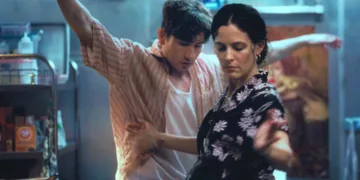
The Circassian community in Newark appears as a congregation of ghosts gathered around kitchen steam. Balagov bends the expected shape of the immigrant drama by casting this masculine struggle in pink, a color that reads like a quiet revolt against exile’s gray weather. Wrestling becomes a rite of flesh, the arena where Temir is asked to incarnate the dominance Azik cannot sustain.
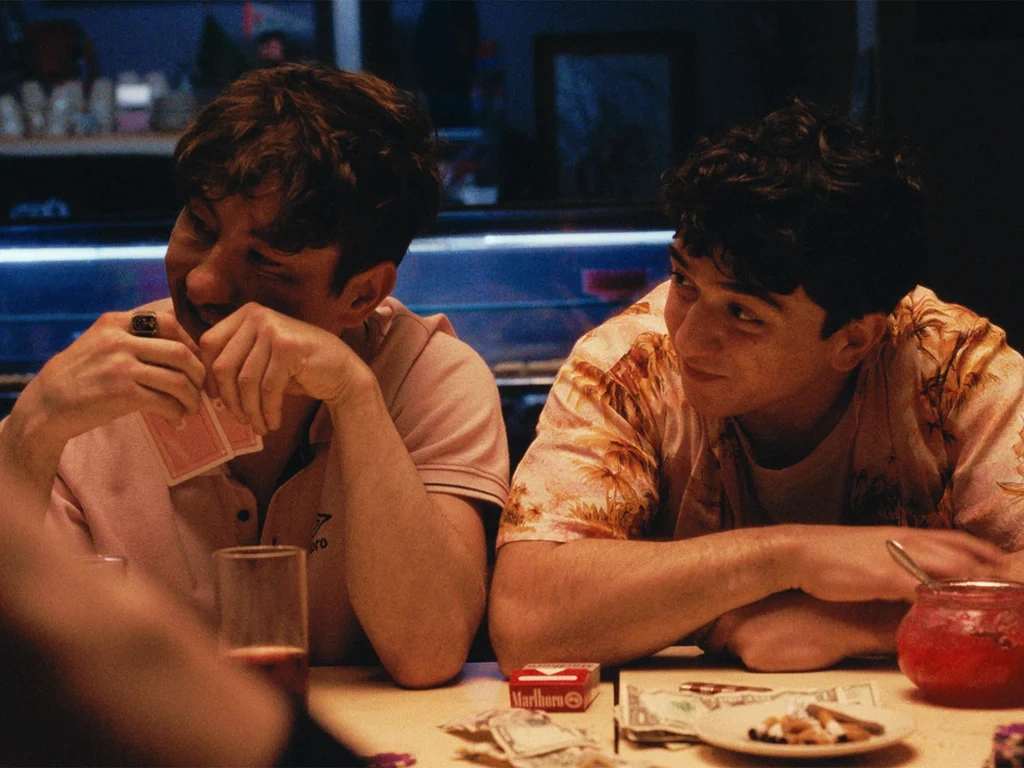
Azik loads his son with unbearable symbolic freight, treating athletic success as borrowed absolution for his own failures. Cultural objects such as delens carry the pressure of memory. These potato and cheese pancakes become a tactile bridge to a homeland reduced to abstraction. The characters occupy severe marginalization, and the film turns away from familiar American-dream machinery to examine the rot of internal exile. The butterfly jam offers a merciless metaphor for immigrant survival.
Delicacy is crushed into nourishment. Beauty enters the mouth already broken. This is cuisine as metaphysics, survival prepared through the ruin of grace. Across the film, the wrestling mat’s performed power clashes with the emotional fragility of the men who circle it. Their strength feels theatrical, a costume draped over an existential hollow. Balagov studies the poison of patriarchal inheritance, the way a father can force a child to bear the debris of a past that refuses burial in the old country.
The kitchen becomes a small arena of fate, every gesture repeating an older wound under the pressure of hunger, pride, and memory. Pain becomes performance, and performance becomes the family’s most reliable language inside the noise of a new world.
The Physicality of a Fading Lineage
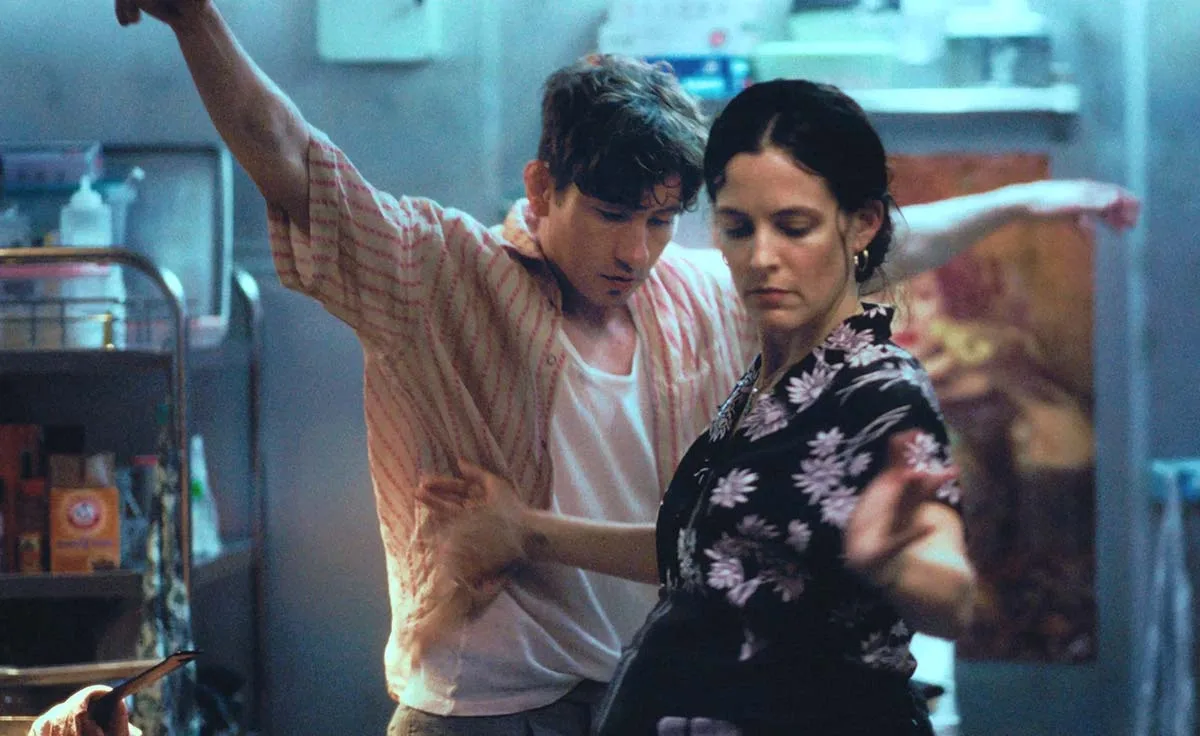
Barry Keoghan fills the frame with frantic emptiness. His Azik seems to have traded a soul for a vocabulary of nervous gestures, his body belonging to someone who never grew into his own skin. He moves with rolling, unstable grace and speaks with the air of a child trapped inside a man’s biography. The result unsettles the paternal order, raising the question of who is raising whom in that cramped apartment.
Keoghan gives the character a dark comic tremor, the faint absurdity of a man forever improvising dignity from scraps. Talha Akdogan gives Temir a necessary gravity. His performance builds through quiet watching, through resentment gathering sediment by sediment. He understands the discomfort of a boy made to become the foundation beneath a father who drifts.
Harry Melling’s Marat arrives as a feral accelerant for the film’s drop into darkness. He carries the atmosphere of a leak in a nuclear reactor, fouling the air with desperate, unearned confidence. Riley Keough gives Zalya a stillness that feels almost religious in its fatigue. She becomes the group’s weary conscience, her silences measuring the cost of keeping a sanctuary intact while the men tear at its walls.
Temir’s brief connection with Alika, played by Jaliyah Richards, gives the film a flicker of possible air. Their bond gestures toward a life outside the suffocating demands of the Circassian kitchen. It grants a short release from inherited ghosts and from the masculine performances that rule the family diner. Each actor gives the material a grounded density, keeping the story from dissolving into pure symbol.
A Candied Descent into the Absurd
The film’s visual world resembles a dream of candied decay. Jomo Fray uses shallow focus to trap the characters inside their own history, cutting them off from the wider expanse of New Jersey. Pink and burnt orange dominate, colors of sweetness already beginning to sour. This visual design transforms the grit of Newark into something closer to a modern fairy tale staged inside diner booths and cramped rooms.
The score by Sacha and Evgueni Galperine vibrates with synthetic dread, like the trapped pulse of an insect against glass. Balagov steers sharp tonal shifts, passing from shaggy observation to sudden virtuosic violence. The absurd becomes tragedy wearing a crooked mask. A sequence built from a symphony of car alarms registers as a primal scream against the silence of an overlooked life.
The kidnapped pelican further warps the film’s reality, standing as a bizarre witness to familial disintegration. Pink clothing and lighting soften the edges of aggression, exposing the vulnerability beneath the bravado of the cook’s kitchen. Violence erupts with the irrational clarity of a nightmare, and the film lets its surreal details gather moral pressure.
The film’s formal poetry shifts the drama of displacement toward a surreal inquiry into animal competition and the terror of appearing weak. Its final movement hangs in haunted uncertainty, asking what survival costs in a place as fragile as a butterfly wing. The film refuses easy answers. It stays with the discomfort of its strange beauty, unsure perhaps of salvation, certain of the wound.
Butterfly Jam had its world premiere today, May 13, 2026, as the opening film of the Directors’ Fortnight at the Cannes Film Festival. The production is a French venture led by Why Not Productions and AR Content. While it has debuted to international audiences in France, wide theatrical or streaming availability for other regions is expected following its festival run. Distribution in France is managed by Le Pacte, with international sales handled by Goodfellas.
Where to Watch Butterfly Jam (2026) Online
Full Credits
Title: Butterfly Jam
Distributor: Le Pacte
Release date: May 13, 2026
Running time: 102 minutes
Director: Kantemir Balagov
Writers: Kantemir Balagov, Marina Stepnova
Producers and Executive Producers: Pascal Caucheteux, Alexander Rodnyansky, Pauline Lamy, Gaetan Rousseau, Gregoire Sorlat
Cast: Talha Akdogan, Barry Keoghan, Riley Keough, Harry Melling, Monica Bellucci, Jaliyah Richards, Zaramok Bachok, Tommy McInnis
Director of Photography (Cinematographer): Jomo Fray
Editors: Kantemir Balagov, Juliette Welfling, Mathilde Chazaud
Composer: Evgueni Galperine, Sacha Galperine
The Review
Butterfly Jam
Butterfly Jam is a haunting, fragmented vision of a life unanchored. It captures the jagged edge of exile with a visual beauty that feels like a fever dream. While the narrative occasionally stumbles into melodrama, the raw physicality of the performances creates a lasting impression of existential weight. Balagov offers no easy resolution for his characters. Instead, he leaves us with the image of a child carrying the crushing remains of a father's pride. It is a flawed, poetic entry into the cinema of the displaced.
PROS
- Lyrical cinematography
- Talha Akdogan’s naturalistic debut
- unsettling soundscape
CONS
- Abrupt tonal shifts
- underdeveloped supporting characters
- uneven pacing