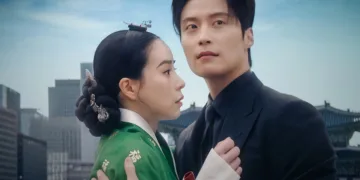




























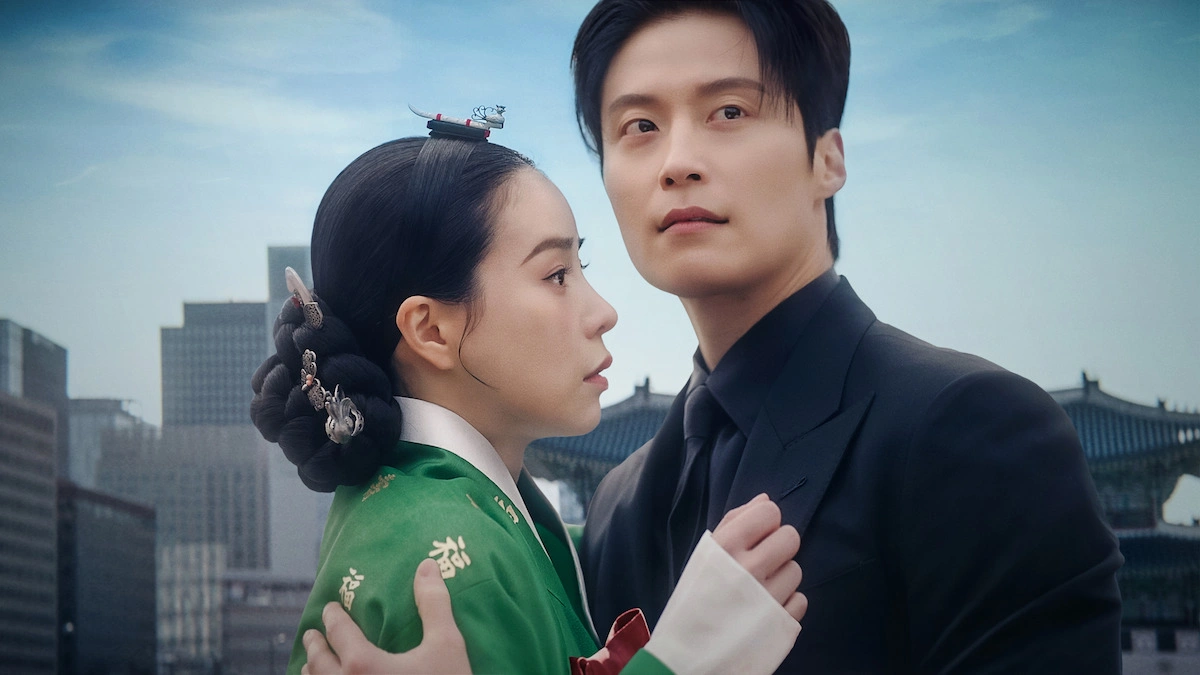

The universe keeps a vicious little ledger, and its favorite column is symmetry. In the Joseon era, a red-tailed star tears through the sky and announces a fracture in the political order. Lady Kang Dan-sim climbs from humble mud into the gold cage of a royal consort.
Her rise activates the usual machinery of power. The court invents a murder charge to remove her from the record. She swallows a lethal draught while a shaman opens her blood in ritual. This is the “Martyrdom of the Consort” (a recurring historical archetype where women are made to pay the invoice for male ambition). Time breaks.
The year is 2026. Dan-sim wakes inside the body of Shin Seo-ri, an actress hired to perform a distorted version of Dan-sim’s own life on a television set. Seoul stands around her as a concrete forest of LED screens and steel. Cha Se-gye enters as a third-generation heir caught in a digital scandal tied to deepfake technology.
Their paths meet when she falls before his car. She speaks with the strict cadence of a dead century and reads a skyscraper as a glass titan. The temporal rupture becomes a crash between ancient honor and modern artifice. It is inelegant. Good. History rarely has clean editing.
Performative Sovereignty and the Flower-Slap Dialectic
Lim Ji-yeon plays Dan-sim through a precise “Aristocratic-Abrasiveness” (the refusal to yield space after every material guarantee has vanished). She makes Seo-ri’s body feel like a vessel inhabited by displaced royalty. The internal split is severe. Dan-sim is a survivalist. Seo-ri was hollowed by the entertainment industry. Comedy rises from their friction, from a woman carrying courtly formality into a century that answers with streets, steel, and chaebol tantrums.
Dan-sim keeps her royal dialect while arguing with a chaebol in the street. The leaf-slap and floral counterstrike become a miniature theory of violence, ridiculous enough to laugh at, formal enough to deserve footnotes. The expected elegance of historical romance mutates into street-corner farce. A flower becomes a weapon. Civilization, as ever, proves fragile.
Cha Se-gye functions as a cold corporate monolith. He hides emotional damage beneath an abrasive professional shell. Secretary Son gives his life a needed human temperature, the warm-blooded presence in a world measured through profit margins. A darker current arrives through Mun-do, the cousin who carries the face of the King who ordered Dan-sim’s death. This produces “Karmic-Dread” (the terror of meeting one’s executioner in a fresh lifetime, with better lighting).
The supporting cast broadens the emotional field. Grandmother Ok-sun offers home in a form that survives temporal displacement. Gwang-nam, the neighbor, works as a social tuning device. He helps Dan-sim translate palace instincts into neighborhood language. The lead chemistry burns through mutual irritation. Its force comes from power, leverage, fear, and need. Attraction is present, yet it arrives through strategy, which is much funnier and far less hygienic.
Se-gye belongs to spreadsheets and hidden scars. His arrogance reads as armor. The show frames him through injury, keeping cartoon villainy out of the frame. He is shaped by a family that treats him as a liability. His grandfather Dal-su watches with concern and calculation folded together, the sort of gaze that can pass for affection in dynastic households. Dinner scenes become battlefields of verbal barbs, and wealth appears painfully isolating.
Dan-sim enters his world as a disruption. She has little reverence for his status. She sees him as a shield. The utilitarian romance has a pleasingly sour taste. It trims away the usual genre syrup. These are two damaged people using each other to manage separate crises, which may be the most honest courtship contract available here. Heo Nam-jun gives Se-gye careful shading, balancing the “tsundere” trope with real bewilderment.
The Vituperative Historiography and Bio-Corporate Aesthetics
The museum visit puts historiography on trial. Dan-sim finds herself labeled a villainess. Her paintings have been assigned to a rival. This is “Identity-Erasure” (the historical stripping of a woman’s agency and talent). Her grief lands in the body before it becomes language. The show treats trauma as a physical archive. A simple bowl of tonic triggers a PTSD episode because the liquid recalls the poison that ended her first life. The past lives inside the nervous system. It is hauntology with a pulse. It is a phantom limb still feeling cold.

The visual plan makes the eras argue. The Joseon palace is saturated with organic textures and natural light. Biojei’s offices are clinical spaces of glass and shadow. The “Dynaestie” brand launch turns culture into commercial inventory, history packaged as a marketing asset for a global audience. The solar eclipse acts as a mechanical bridge for the supernatural, the gear that lets impossibility move.
The museum cinematography is evocative. It captures the loneliness of a woman staring at her own stolen life behind glass. The rain-slicked Seoul streets offer another beauty, colder and less forgiving. They give the story a setting for alienation, for the struggle to find a place after the world has changed its grammar.
The two lives of Shin Seo-ri are handled with care. The original Seo-ri cared for everyone except herself. Dan-sim takes over and chooses self-preservation. The shift appears through small details. She receives flavorless food with ceremonial politeness while guarding her pride. She handles perverts and noisy neighbors with royal authority. This is “Ego-Reclamation” (the process of asserting dominance over a life that had been discarded).
The technical staff earns praise for the costumes. Joseon attire is rich and symbolic. Modern clothing is drab and functional, speaking to the character’s decline before possession. The sound design tightens the pressure. Modern technology hums around Dan-sim with oppressive insistence, making the present feel like an empire of appliances. Progress, the show suggests with a dry cough, can still sound like a threat.
Karmic Recurrence and the Bodyguard’s Instinct
Dan-sim handles her new life through “Algorithmic-Adaptation” (the use of modern media to decode current social norms). She learns Korean history through YouTube. She gains fame as a live shopping host. Her success comes from a Joseon-era work ethic redirected into commerce, which feels absurd until one remembers that every age finds a fresh costume for labor.
That career path is interrupted by the ghosts of her execution. A corporate subplot involving labor protests brings modern pressure into the plot. An assassination attempt occurs during a casting call. A dummy drops from a height onto a car. The event moves the series from comedy toward thriller, a tonal swerve that somehow tracks. Life, again, has poor genre discipline.
Dan-sim develops a supernatural sense for danger and becomes a shield for Se-gye. Her role expands from displaced royal into protector. The mystery of the “masked man” from her previous life introduces fresh uncertainty. He saved her from a wooden box centuries earlier, and his presence suggests that rescue, like betrayal, may recur under new faces.
The final confrontation with Mun-do at the end of the second episode is chilling. Dan-sim stares into the face of the man who killed her. The encounter demands a choice: concealment or combat. She seeks Se-gye’s protection, a strategic move made by someone who understands courts better than he ever will. The modern world resembles another palace full of traitors. The costumes have changed. The appetite for power remains depressingly familiar.
The series treats fate as a recurring pattern. People become actors in a script composed by history. The pacing is deliberate, giving character beats room to breathe. The passage from the absurdity of the “leaf fight” to the gravity of the museum scene feels smooth because the show understands life’s erratic rhythm. Grief and slapstick can share a hallway. Anyone who has lived through bureaucracy already knows this.
The deepfake scandal comments on the unreliability of truth in the digital age. It mirrors the lies told about Dan-sim in the past. History is written by victors. In 2026, it is written by people with better hackers. Dan-sim must face these new vipers while carrying the trauma of a woman who has already lost everything. The second episode ends with a high bar for the story ahead. It promises conflict across time, a battle for the soul of a woman who refused to stay dead. This is “Sovereign-Persistence” (the refusal of the spirit to be silenced by the grave).
My Royal Nemesis premiered on May 8, 2026, on the South Korean network SBS TV, where it holds the Friday-Saturday 21:50 KST time slot. For international audiences, the series is available for streaming globally on Netflix, with new episodes dropping weekly. The drama follows a notorious Joseon-era villainess who wakes up in modern-day Seoul in the body of a struggling actress, leading to a high-stakes, comedic clash with a cold-hearted corporate heir.
Where to Watch My Royal Nemesis Online


Full Credits
Title: My Royal Nemesis
Distributor: SBS TV, Netflix
Release date: May 8, 2026
Rating: TV-14
Running time: 70 minutes
Director: Han Tae-seop
Writers: Kang Hyun-joo
Producers and Executive Producers: Kim Min-tae, Studio Dragon, Studio S, Gill Pictures
Cast: Lim Ji-yeon, Heo Nam-jun, Jang Seung-jo, Lee Se-hee, Kim Min-seok, Kim Hae-sook, Baek Ji-won, Yoon Byung-hee
- Composer: Park Sung-il
The Review
My Royal Nemesis
My Royal Nemesis manages a difficult equilibrium between the slapstick of temporal displacement and the genuine horror of historical erasure. It rejects the sentimentality of the genre by focusing on strategic survival. The lead performance anchors the narrative in a reality that feels earned. While some subplots feel cluttered, the central friction remains combustible without appearing manufactured. It is a sharp examination of how identity is stolen and reclaimed across centuries.
PROS
- Commanding lead performance by Lim Ji-yeon.
- Subversion of typical "damsel in distress" tropes.
- Nuanced exploration of psychological trauma and memory.
- Sharp, dry humor derived from linguistic friction.
CONS
- Occasional pacing lulls during secondary subplots.
- Cluttered narrative themes in the opening hour.
- Inconsistent characterization of the male lead’s icy persona.