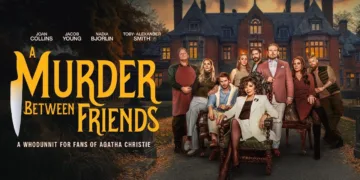
























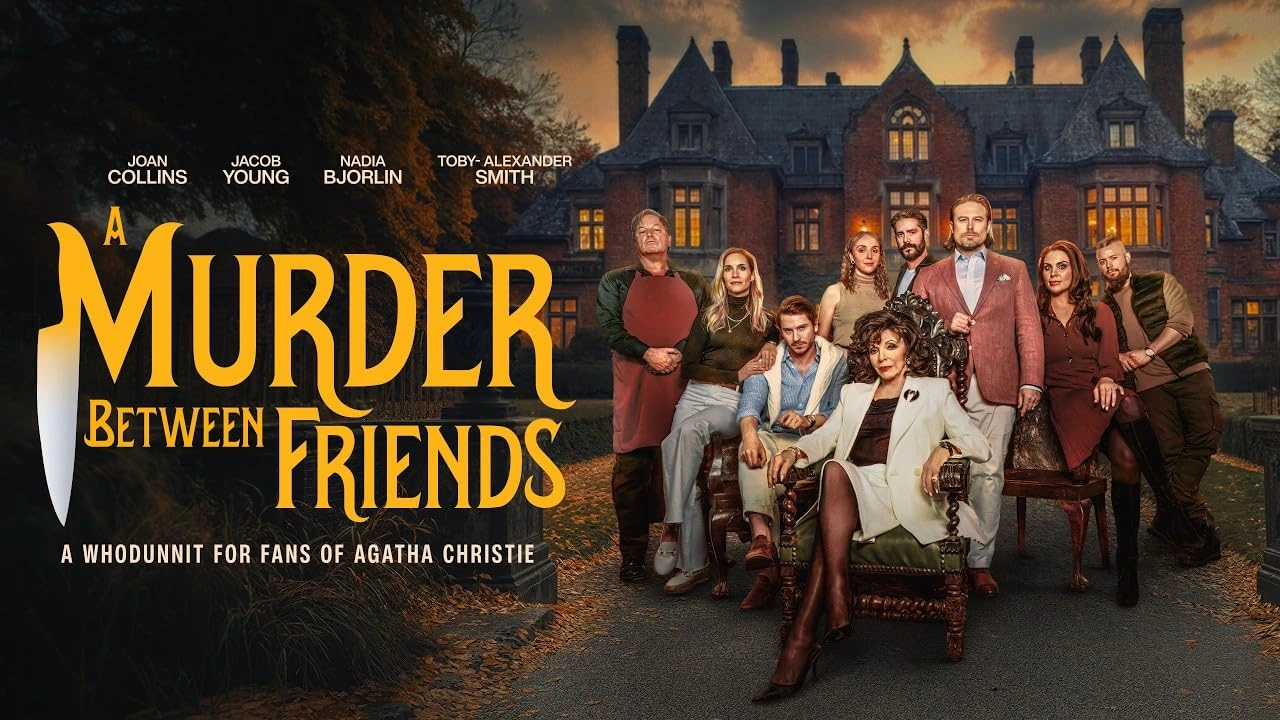

A Murder Between Friends (2026) positions itself as a lighthearted, campy murder-mystery, a deliberately low-stakes satire of traditional whodunits. At its center is Joan Collins, portraying Francesca Carlyle, a TV sleuth and mansion owner whose flair for drama eclipses the plot itself.
Collins, at 92, exudes a combination of old-Hollywood magnetism and playful self-awareness, reminding audiences why her presence alone can elevate even the most preposterous narrative. Her Francesca is part detective, part diva, and entirely irresistible, orchestrating a weekend getaway that quickly devolves into murder, betrayal, and whispered secrets.
The premise is simple: three couples with intertwined histories convene at a European castle for a leisurely retreat, only for one guest to turn up dead in a hot tub. From this point, the film spirals into a mixture of absurdity and melodrama, featuring blackmail, inheritance disputes, romantic entanglements, and farcical sexual escapades.
The tone is unapologetically soap opera-esque, with heightened performances, over-the-top costumes, and flamboyant characterizations that emphasize spectacle over suspense. Viewers seeking cerebral detective work will be thwarted. Those attuned to queer-friendly camp, diva-centered performance, and playful subversion of the Agatha Christie formula will find delight in the chaos. The movie invites audiences to revel in Collins’ charisma, turning her very presence into the central event of the story.
Weekend of Intrigue: Plot and Narrative Structure
The narrative unfolds over a confined weekend, introducing three couples—Josh & Kat, Devin & Sonia, and Sydney & Louisa—whose interpersonal histories underpin tension, envy, and comedic friction. Their arrival at Francesca’s mansion signals civility, but undercurrents of desire and rivalry emerge swiftly. The inciting incident—a hot tub murder—immediately isolates the group, creating a classical “closed circle” mystery structure, though traditional suspense is largely eschewed.
Francesca assumes investigative authority, sifting through evidence while navigating social entanglements. Hidden cameras and laptops reveal private indiscretions, exposing layers of desire, jealousy, and greed. Plot twists arrive rapidly: Sydney’s affair with Devin is discovered; Louisa’s inheritance becomes a point of contention; Kat is killed in a car accident; and other melodramatic complications—an ill-fated chef, a fatal accident, and misfired blackmail schemes—crowd the storyline. Motives are revealed en masse, often late in the narrative, replacing clue-based deduction with shock-value theatrics.
The film’s structure borrows from classic Christie conventions: a contained setting, a limited suspect pool, and a detective figure orchestrating revelations. Yet it subverts these tropes with soap opera flourishes, exaggerated sexual tension, and absurd comedic timing.
Narrative propulsion relies on character interactions and farcical complications rather than careful sleuthing, making suspense incidental to the spectacle. Each scene oscillates between melodrama and comedy, underscoring the movie’s self-aware, playful ethos.
Characters, Chemistry, and Performances
Francesca Carlyle dominates the screen, her performance a blend of wit, glamour, and diva excess. Costume choices—rhinestones, Dynasty-inspired gowns, and meticulously coiffed hair—visualize her authority and theatricality. Physical limitations necessitate seated or assisted scenes, yet these moments amplify her screen presence rather than diminish it, reminding audiences that charisma can outweigh traditional acting virtuosity.
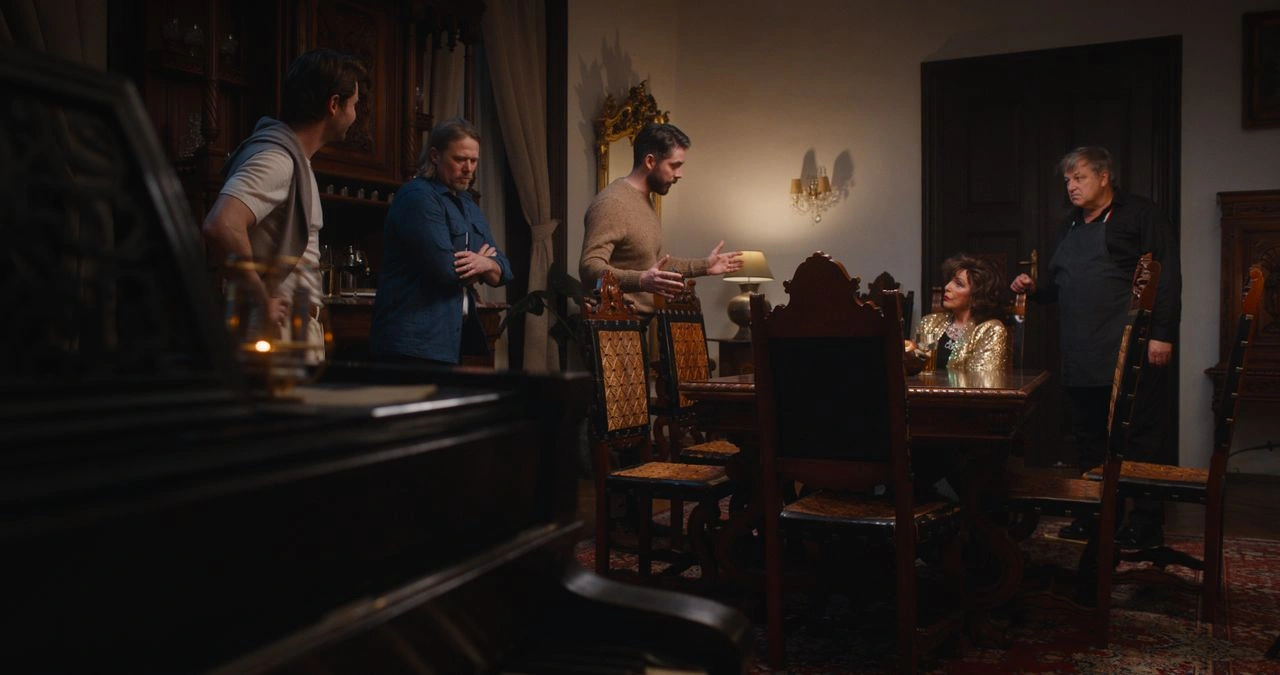
Josh & Kat embody comic polarity: Josh’s bullish energy contrasts Kat’s vampy affectations, creating both tension and humor. Devin & Sonia contribute subtler friction, with Devin’s fascination with Sydney generating understated intrigue, while Sonia provides a grounding presence. Sydney & Louisa’s narrative arc drives both romance and tragedy; Louisa’s demise catalyzes plot developments and exposes hidden dynamics among the group.
Supporting performances vary, drawn from soap opera backgrounds, oscillating between melodrama and intentional awkwardness. Actors exaggerate gestures and expressions, turning minor betrayals or flirtations into comedic punctuation. Romantic tension, jealousy, and secrets are leveraged as narrative motors, with alliances and misunderstandings compounding absurdity.
The film’s queer-friendly subtext—male-male attraction, playful innuendo, fluid sexuality—is integrated seamlessly into these dynamics, enhancing both camp appeal and Pride-month resonance. Characters function less as investigative tools and more as vehicles for spectacle, narrative chaos, and social commentary on desire, greed, and performative relationships.
Visual Style, Direction, and Tonal Composition
Filmed at Úsobí Castle in the Czech Republic, the movie capitalizes on the grandeur and isolation of its European setting. Wide shots establish spatial relationships while interiors emphasize intimacy, though camera work remains serviceable rather than painterly, occasionally bordering on generic. Co-directors Trent Garrett and Jacob Young prioritize Collins’ performance above meticulous suspense, using playful blocking and exaggerated staging to foreground spectacle over mystery.
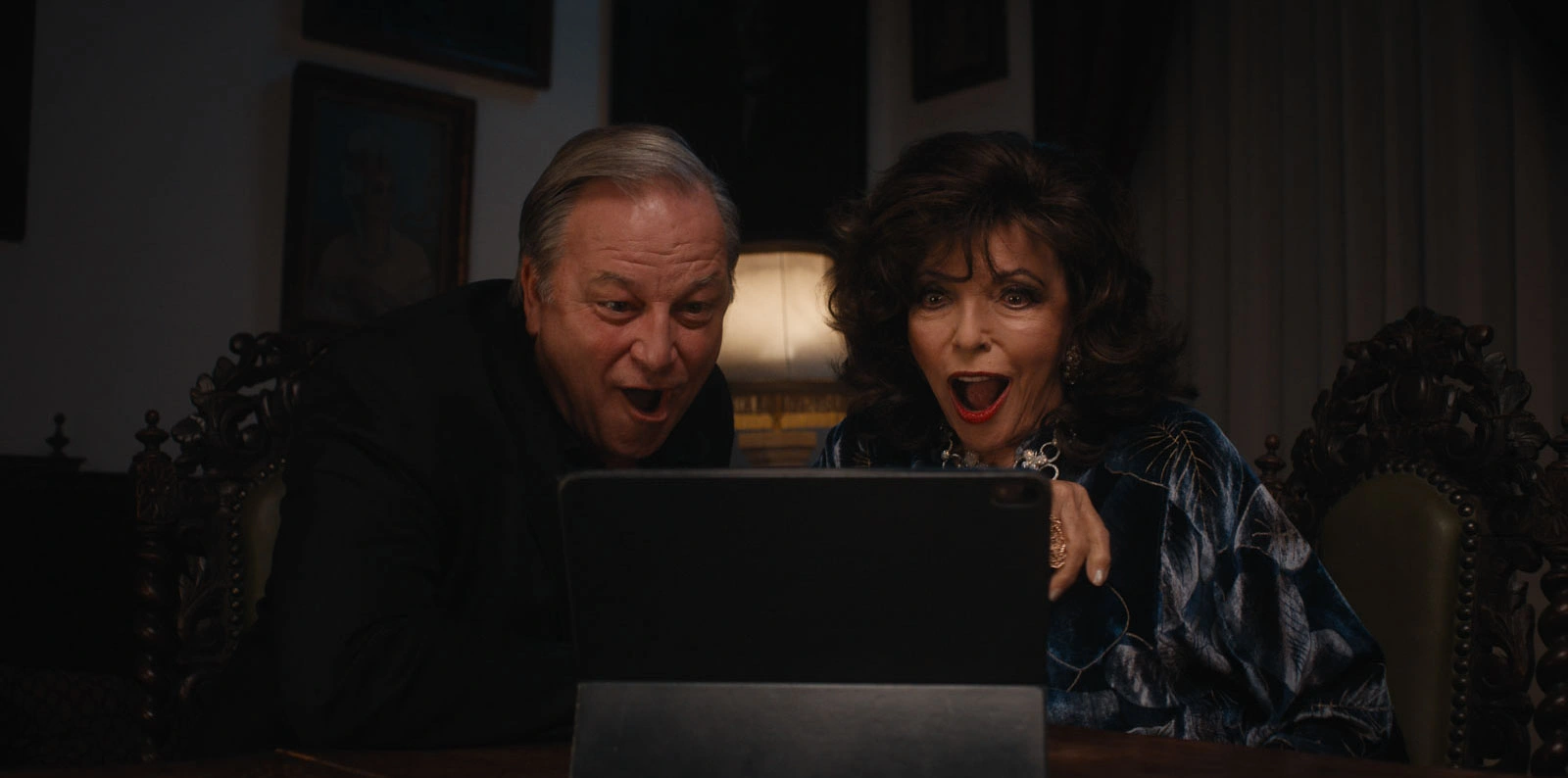
Costumes and makeup operate as narrative shorthand. Collins’ extravagant outfits signal authority, wit, and dramatic weight, while supporting characters’ attire reflects status, temperament, or narrative function. Editing emphasizes brisk pacing, with title cards introducing suspects early, allowing audiences to navigate interpersonal networks before chaos ensues. Abrupt transitions between farce and melodrama reinforce tonal unpredictability.
The soundscape complements visual exuberance. Musical cues oscillate between whimsical, playful, and melodramatic, accentuating comedic beats. Diegetic sounds—splashes, footsteps, ambient mansion noises—enhance immersion in absurdity. Collectively, cinematography, costume, editing, and score reinforce camp, glamour, and soap opera sensibilities, creating a cinematic space where spectacle and humor outweigh deductive rigor.
The film’s tone encourages indulgence in the ridiculous, privileging diva-centered spectacle, interpersonal intrigue, and flamboyant comedy over the suspense or tension expected from a conventional whodunit. Audiences are invited to watch, laugh, and marvel, accepting exaggeration as the primary engine of entertainment.
A Murder Between Friends is an American independent mystery thriller that launched on video-on-demand networks across the United States and Canada on January 13, 2026, ahead of its digital release in the United Kingdom through Plaion Pictures on June 15, 2026. Directed by daytime television veterans Jacob Young and Trent Garrett, the Agatha Christie-style whodunit tracks a group of six lifelong friends during a luxurious holiday getaway at a sprawling European country estate. Audiences can watch the campy, fast-paced murder mystery on major digital streaming platforms including Amazon Prime Video and Fandango at Home.
Where to Watch A Murder Between Friends (2026) Online







Full Credits
Title: A Murder Between Friends
Distributor: Vision Films, Plaion Pictures, Eagle Entertainment
Release date: January 13, 2026
Rating: 15
Running time: 87 minutes
Director: Trent Garrett, Jacob Young
Writers: Mark Rozzano
Producers and Executive Producers: Mark Rozzano, Joan Collins, Percy Gibson, Jacob Young, Trent Garrett, Toby-Alexander Smith
Cast: Joan Collins, Nadia Bjorlin, Jacob Young, Trent Garrett, Toby-Alexander Smith, Simon Cotton, India Thain, Hana Vagnerová, Jim Borstelmann, Espen Hatleskog
Director of Photography (Cinematographer): Lukas Kalmar
Editors: David Davis, Trevor Barroero
Composer: David Davis, Trevor Barroero
The Review
A Murder Between Friends
A Murder Between Friends thrives on Joan Collins’ magnetic presence, campy excess, and playful absurdity rather than traditional mystery mechanics. The plot is chaotic, dialogue occasionally cringe-inducing, and performances uneven, yet these flaws amplify the film’s charm for viewers who delight in diva-centered spectacle, farce, and melodrama. It is a weekend of low-stakes intrigue, flamboyant fashion, and absurd plot twists—a film to enjoy for humor, style, and audacious fun rather than suspense.
PROS
- Joan Collins’ scene-stealing, charismatic performance
- Campy, comedic, and absurdly entertaining tone
- Flamboyant costumes and glamorous visual style
- Queer-friendly and Pride-month appeal
- Playful, soap opera-inspired narrative chaos
CONS
- Weak traditional mystery structure; clues largely absent
- Uneven performances beyond Collins
- Simplistic, sometimes cringe-inducing dialogue
- Abrupt tonal shifts and inconsistent pacing
- Predictable plot elements masked by spectacle