









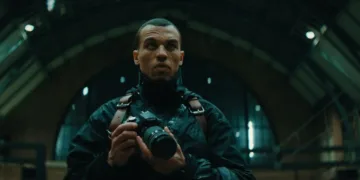










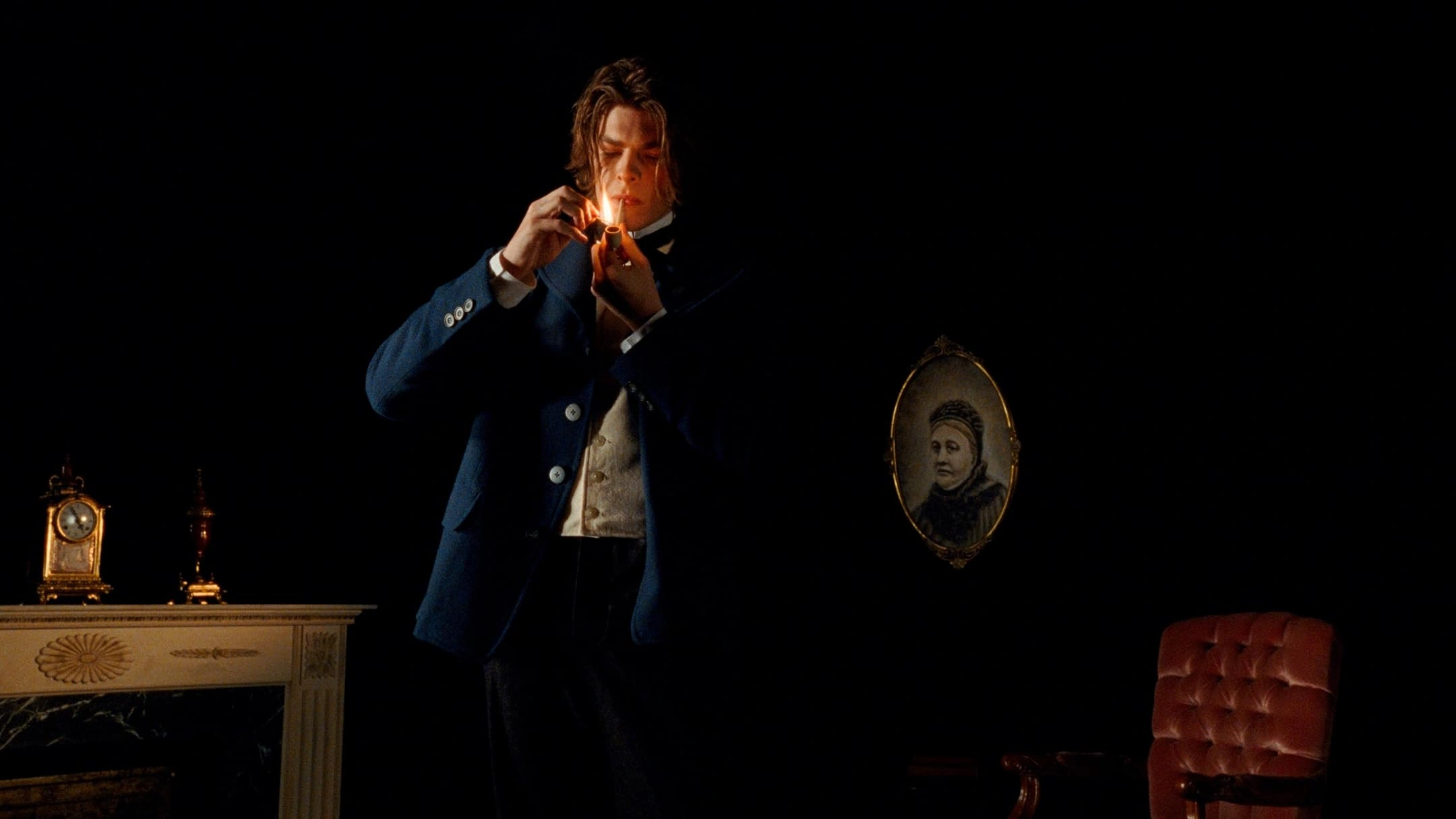

Patrick Wang’s A. Rimbaud takes the biopic and strips it down until only the volatile core remains. There are no sweeping recreations of 19th-century Paris, no bustling cafés packed with poets, no decorative period pageantry to reassure the viewer. Instead, Wang places Arthur Rimbaud inside a black-box theatrical space and lets Blake Draper carry the film across 175 minutes, from the poet’s reckless youth to his later life as a colonial merchant and envoy.
The central device sounds almost perversely risky: Rimbaud is the only visible speaking figure, while everyone around him is represented through musical instruments. Lovers, relatives, rivals, officials, and strangers enter through sound rather than flesh.
For a film about a poet obsessed with language, sensation, and escape, that choice feels fittingly strange. It turns conversation into performance, society into noise, and biography into a kind of interactive chamber piece where the viewer has to complete half the scene mentally. The result is ambitious, isolating, inventive, and sometimes tiring. It asks for patience, then keeps asking.
Blake Draper and the Burden of Being Alone
Blake Draper’s performance is the film’s main interface. In game terms, he is the entire playable system: movement, reaction, dialogue, mood, aging, failure, memory. Every emotional mechanic runs through him. That sounds like a gimmick until the scale of the task becomes clear. Draper has to respond to characters we cannot see, accept objects from empty space, register musical tones as human pressure, and make Rimbaud’s inner life legible without turning the role into a theatrical monologue.
His young Rimbaud is sharp, restless, and hungry for impact. He carries himself like someone already bored by the room he has entered. That early energy can become repetitive, especially during the first half, where scenes circle the same youthful turbulence with slightly familiar rhythms. Draper’s cadence sometimes flattens the poetry rather than releasing it.
Yet the performance gains force as Rimbaud ages. The flamboyance tightens. The face hardens. The voice becomes less eager to wound and far less certain of its own beauty. This is where the film’s loneliness starts to sting. Rimbaud is surrounded by presences, yet those presences arrive as fragments: a tuba’s comic authority, strings that suggest tenderness or accusation, musical phrases that feel close without becoming fully reachable.
That design turns Rimbaud into a man trapped inside his own perception. He wants movement, language, sensation, distance. He also leaves damage behind. Draper’s strongest work comes from making that contradiction feel lived rather than explained.
Cinema as a Handmade Machine
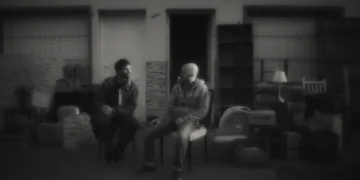
Wang’s formal approach gives A. Rimbaud a handmade intensity rarely seen in modern screen biography. The film uses minimal sets, theatrical lighting, controlled camera movement, and offscreen sound to build a world that refuses realism. Its artifice is the point. Like a stage play translated through cinema, it depends on the frame, the cut, the closeup, and the viewer’s imagination to make the absent world breathe.
The musical-instrument dialogue is the film’s boldest system, and like any demanding system, it has friction. At its best, it transforms social exchange into mood and rhythm. A tuba can make authority feel absurd. Strings can suggest intimacy, grief, or manipulation. A melodic answer can feel warmer than a spoken one. The idea can also become exhausting, since the viewer must keep decoding half-silent exchanges across a long runtime.
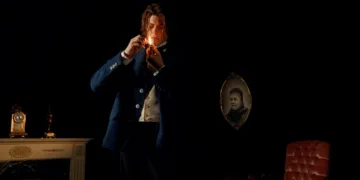
Frank Barrera’s cinematography gives the restriction a sensual charge. Faces emerge from darkness. Shadows behave like memory. Props become charged with the weight of entire rooms we never see. Warm 35mm textures soften the severity of the space, while theatrical lighting marks shifts in age, place, and psychological weather.
The poetry sequences carry the greatest risk. “The Drunken Boat,” “Vowels,” and A Season in Hell ask cinema to translate verse without flattening it into illustration. Some moments lean into abstraction with real grace, using sound, movement, and color to suggest the synesthetic force of Rimbaud’s imagination. Other passages feel less nimble, as if the film’s admiration for the words slows its dramatic pulse.
The first half can feel recursive. That is part of the experience, though not always an easy part. Wang wants the viewer to feel the loop of youth, arrogance, hunger, escape, and return. The cost is momentum.
The Poet After Poetry
The film becomes richer once it moves past the familiar legend of Rimbaud as the young literary firebrand. His later years abroad give A. Rimbaud a sharper moral charge. The boy who wanted to remake sensation becomes a man working inside systems of trade, empire, translation, and control. The shift is fascinating because Wang does not treat the abandonment of poetry as a clean death. The poet remains inside the merchant, changed, compromised, and harder to romanticize.
This later section asks what happens when artistic hunger turns practical, when freedom becomes commerce, when language becomes a tool for survival and power. Rimbaud’s life in Africa and Asia is staged as a zone of tension rather than redemption. His curiosity remains alive, yet it exists beside colonial structures that make his ambition morally uneasy. The film looks at that discomfort without smoothing it over.
There is an emotional impact in watching the younger and older Rimbaud seem to haunt each other. The film’s strongest idea may be that identity is never replaced cleanly. Earlier selves remain active, accusing or pleading from inside the body. By the time illness and bodily decline enter the picture, A. Rimbaud has moved from experimental biopic into something stranger: a meditation on how a person becomes unreadable to himself.
It will test many viewers. Its length, repetition, and formal severity create real barriers. Yet Wang’s film has the rare energy of a work made from limitation rather than reduced by it. With one actor, instruments, light, darkness, and a fierce trust in cinematic imagination, A. Rimbaud turns biography into an act of perception.
A. Rimbaud is an inventive biographical film directed by Patrick Wang that explores the life of the revolutionary French poet Arthur Rimbaud, tracing his path from his teenage school days in Charleville to his final years spent in Africa. The production presents an unconventional approach to the cinematic biography, employing a single actor on screen to portray the poet while all other characters communicate solely through unseen musical instruments. The film premiered at selected film venues in May 2026, including theatrical runs at the Roxy Cinema in New York, and is currently available through specialized independent film distribution channels and platforms like MUBI.
Full Credits
Title: A. Rimbaud
Distributor: E.D. Distribution
Release date: May 17, 2026
Running time: 180 minutes
Director: Patrick Wang
Writers: Patrick Wang
Producers and Executive Producers: Patrick Wang, Daryl Freimark, Fritzi Adelman, Evan Johnson, Victoria Sidebotham, Frank Barrera, Amy Williams, Michael Bevins, Galen Johnson, Kyle Bornais
Cast: Blake Draper
Director of Photography (Cinematographer): Frank Barrera
Editors: Galen Johnson, Patrick Wang
Composer: Patrick Wang
The Review
A. Rimbaud
A. Rimbaud is a demanding, formally fearless biopic that turns limitation into cinematic language. Patrick Wang’s single-actor design can feel repetitive, yet Blake Draper’s performance, the musical-instrument dialogue, and the stark visual design give the film a strange emotional charge. Its later-life material is especially strong, complicating the myth of Rimbaud with commerce, empire, illness, and regret.
PROS
- Inventive single-actor structure
- Strong performance from Blake Draper
- Striking sound design and lighting
- Rich later-life thematic material
- Bold use of poetry on screen
CONS
- Length may test patience
- First half can feel repetitive
- Musical dialogue device may alienate some viewers
- Some poetry sequences slow the dramatic pulse